What Is Conventional Sizing in Textile Yarn Processing?
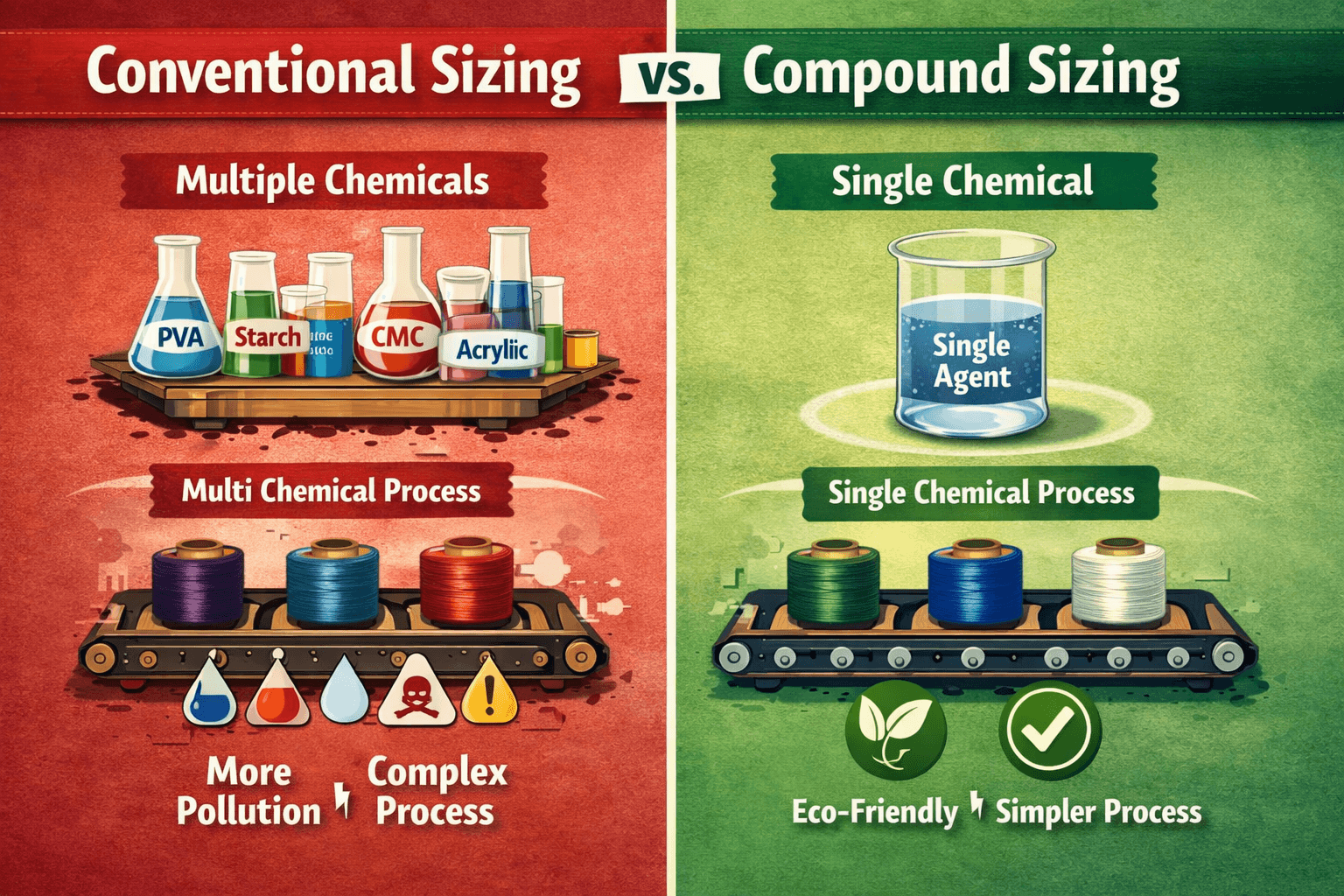
Conventional sizing relies on a compound recipe of several individual ingredients cooked together.
Common Ingredients in Conventional Sizing
Starch
Polyvinyl alcohol (PVA)
Carboxymethyl cellulose (CMC)
Acrylic binders
Waxes
Lubricants
Antistatic agents
Softners
Typical Applications
Medium to coarse cotton yarns
Denim warps
Technical textiles requiring high abrasion resistance
High-speed looms where strong protective films are needed
This method gives excellent control, but requires:
More energy
Longer preparation time
Higher wastewater load (especially when using PVA)
Conventional sizing works exceptionally well for demanding warp yarns such as denim, where Alpenol's high-performance sizing additives improve cohesion and hairiness control, even in harsh weaving environments.
What Is Compound Sizing in Textiles & How Is It Performed?
Compound sizing (also referred to as one-shot textile sizing solutions, single-shot sizing agents in fabric production, or one-time sizing agents in textiles) is a simplified, ready-mixed approach.
How Compound sizing Is Performed
Add the compound formulation directly to hot or cold water.
Heat to activation temperature (lower than conventional).
Mix until uniform.
Apply sizing in a single pass without separate chemical additions.
Dry, stretch, and wind the warp normally.
It reduces:
Preparation time
Preparation complexity
Manpower
Chemical variability
Alpenol’s eco-friendly Compound sizing technology supports mills looking for lower environmental load and faster loom setup.
Process Steps: Conventional Sizing vs Compound Sizing
Conventional Sizing - Step-by-Step
Individual chemicals weighed and prepared
Starch cooked separately
PVA dissolved at high temperature
Lubricants and waxes added sequentially
Filtration and homogenization
Application through the size box
Drying, stretching, and beam winding
Compound sizing - Step-by-Step
Add all-in-one formulation
Heat and dissolve once
Homogenize
Apply directly
Dry and wind
Conventional sizing → multi-stage
Compound sizing → single-stage
Compound Sizing vs Conventional Sizing: Advantages & Disadvantages
Advantages of Compound Sizing
Lower energy consumption
Lesser inventory cost
Reduced cooking time
High consistency
Lower viscosity fluctuations
Disadvantages of Compound Sizing
Lesser customizable recipes in mill
Less control over pick-up and viscosity
Slightly higher costs
Advantages of Conventional Sizing
Highly customizable recipes
Excellent abrasion resistance
More control over pick-up and viscosity
Disadvantages of Conventional Sizing
Higher energy use
More wastewater
Operational complexity
Chemical variability if not standardized
Human Error
Performance affected by Relative Humidity in loom shed
Alpenol supports both systems by offering high-performance sustainable sizing polymers that reduce COD and improve desizability while maintaining film strength.
Performance Comparison: PVA-Based Conventional Sizing vs Starch-Based Compound Sizing
Property | PVA-Based (Conventional) | Starch-Based (Compound) |
Film Strength | Very high | Moderate to high |
Abrasion Resistance | High | Medium |
Desizability | Low-Moderate | Excellent |
Cost | Higher | Lower |
Environmental Load | High (PVA) | Lower (starch) |
Ideal For | High-speed weaving, denim | High-speed looms, apparel |
Compound sizing products containing modified starch + specialty binders offer improved eco-efficiency.
Alpenol’s hybrid starch-polymer variants combine lower effluent load with enhanced warp strength, making them suitable for broader yarn ranges.
Common Sizing Agents & Additives Used in Conventional and Compound Systems
Primary Film Formers
Starch
PVA
Modified starches
Acrylic polymers
Additives
CMC (viscosity modifier)
Waxes (lubricity)
Softeners
Antistatic agents
Wetting agents
These chemicals form the backbone of all sizing chemicals used in textile manufacturing.
Process Parameter Differences: Pickup, Temperature & Solids
Parameter | Conventional Sizing | Compound sizing |
Pickup % | Higher | Moderate |
Drying Temperature | Medium-High | Lower-Medium |
Bath Solids % | Higher (due to multiple agents) | Lower-Moderate |
Energy Demand | High | Low |
Preparation Time | Long | Short |
The lower solids and streamlined mixing of compound sizing systems reduce preparation time - valuable for mills producing frequent style changes.
Why Would a Mill Switch Between Methods?
Switch to Compound sizing When:
Prioritizing energy savings
Reducing chemical load
Reducing inventory costs
Minimizing manpower
Want more consistency
Switch to Conventional Sizing When:
Better control on pick-up and viscosity
Requiring maximum abrasion resistance
Want to use customisable recipes
Alpenol offers variants tailored for both methods, giving mills freedom to shift without compromising quality.
Environmental Impact: Wastewater Characteristics
Conventional Sizing
Higher COD
Difficult-to-treat PVA polymers
Increased sludge
Compound sizing
Better biodegradability
Easier desizing
Lower chemical load
Mills adopting Alpenol’s biodegradable and water-based compound sizing systems often experience significantly lower effluent treatment cost.
Components of an Ideal Conventional Sizing Recipe
Film-forming polymer (Starch/PVA)
Viscosity modifier (CMC)
Lubricant/wax
Binder
Penetration agents
Antistatic components
Optional antimicrobial agents
Softner
The balance between film strength and flexibility is key.
Emerging Trends in Textile Sizing Technology
Hybrid polymer-starch blends
Energy-efficient cookers
Water-based eco-friendly Compound sizing chemicals
Zero-PVA universal sizing formulations
IoT-enabled viscosity monitoring
Sustainable sizing designed for recycled yarns
Alpenol is also contributing to this movement through bio-based polymer systems and cleaner desizing performance aligned with ZDHC goals.
FAQ
1. What is Conventional Sizing?
A multi-ingredient sizing method using starch, PVA, CMC, waxes, and lubricants for warp protection.
2. What is Compound Sizing?
A ready-mixed, single-application sizing chemical system that simplifies preparation.
3. Which is better: Compound or Conventional?
Compound Sizing is energy-efficient and simple; conventional offers customisation for various types of recipes.
4. What chemicals are used in sizing?
Starch, PVA, CMC, acrylic binders, waxes, lubricants, wetting agents, softeners and anti-static agents.
5. How does Alpenol fit into the market?
By offering compound eco-friendly sizing chemicals that improve warp performance and reduce chemical load, saving the environment for all woven fabrics.
References
Zydex Group - The Basics of Textile Sizing (incl. Single-Shot Sizing Definition),
https://zydexgroup.com/the-basics-of-textile-sizing-explained/
Amchem India - What Is the Sizing Process in Textile (One Shot Sizing Chemicals),
https://amchemindia.in/what-is-sizing-process-in-textile-a-comprehensive-guide/
ATIRA - Single Shot Sizing Analysis & Application Data (Case Study vs PVA),
https://atira.in/single-shot-sizing-analysis-application-data-case-study/
Lathia Rubber - New Compound Development for Textile Sizing Industry (Single-Shot vs Conventional),
https://www.lathia.in/new-compound-development-for-textile-sizing-industry/
RAN Chemicals - One Shot Sizing for Spun Yarn (Fine & Coarse Counts),
https://ranchemicals.in/product/textile/sizing/spun-yarn-sizing/one-shot-sizing/
Drop Chemicals - One-Shot Compound Hometextile (Low Add-On, GOTS & ZDHC),
https://www.dropchemicals.com/sizing-solutions/hot-sizing/one-shot-compound/hometextile/
PolyesterMFG - Compound Sizing Chemical (Definition of One/Single-Shot Agent),
https://www.polyestermfg.com/portfolio-items/compound-sizing-chemical/
Angel Starch - Oneshot Product Sizing (One-Shot Sizing Product for Compact Warp Yarns),
https://angelstarch.com/oneshot-product-sizing/
SMS Corporation - Modified Starch for Warp Sizing (Reducing PVA, COD & Cost),
https://www.siammodifiedstarch.com/product/non-food/detail/Warp-Sizing
PMC - Energy-Saving Environmentally Friendly Starch via Graft Copolymerization (High Adhesion & Easy Desizing),
https://pmc.ncbi.nlm.nih.gov/articles/PMC10820382/
PMC - Environmental Friendly Warp Yarn Coating from Feather Wastes (Green Sizing & Desizing COD/BOD),
https://pmc.ncbi.nlm.nih.gov/articles/PMC11825430/
GOTS - Global Organic Textile Standard (COD Limits & Chemical Criteria),
https://global-standard.org/images/GOTS_Version_7.0_Second_Revision_Draft.pdf
ZDHC - Wastewater Guidelines (COD/BOD Benchmarks for Textile Effluent),
https://downloads.roadmaptozero.com/output/ZDHC-Wastewater-Guidelines
Liked it? Share it with your people.


Disclaimer
The information provided in this blog is intended solely for educational and informational purposes within the textile industry. While the content references technical concepts, sizing and desizing practices, and general chemical information, it does not constitute professional, commercial, or operational advice for any specific textile process or production environment.
Process conditions, chemical selections, and operational parameters may vary significantly across mills, machinery types, fabric constructions, and environmental constraints. Readers should always consult qualified technical professionals, internal laboratory data, and product-specific Technical Data Sheets before making any decisions related to textile processing.
Any references to Alpenol, Sizaltex, or other products are included only for contextual, educational, and illustrative purposes and should not be interpreted as endorsements, recommendations, or guarantees of performance. The authors assume no responsibility for decisions made based on the information contained herein.