
What This Guide Covers
This complete guide explains:
What desizing is in textile manufacturing
Why desizing is a critical step in textile pre-treatment
Step-by-step desizing processes used in fabric processing
Different desizing methods used in industry
Chemicals and reagents used in industrial desizing
Comparison of oxidative vs enzymatic desizing
Impact of desizing on fabric absorbency and dye uptake
Environmental considerations in desizing
Machinery used in continuous desizing operations
Common desizing problems and troubleshooting
Optimal parameters for enzyme-based desizing
Differences between desizing cotton and polyester-cotton blends
What Is the Desizing Process in Textile Manufacturing?
In weaving preparation, warp yarns are coated with sizing materials to improve strength and abrasion resistance. After weaving, these sizing agents remain on the fabric surface and must be removed before dyeing.
Definition of Desizing
Desizing is the removal of size materials from woven fabrics through chemical or enzymatic treatment during textile wet processing.
Goals of the Desizing Process
Desizing aims to:
Remove warp sizing chemicals
Improve fabric absorbency
Prepare fabric for scouring, bleaching, and dyeing
Ensure uniform finishing results
Common Outcomes of Effective Desizing
Proper desizing leads to:
High water absorbency
Improved dye penetration
Uniform fabric appearance
Reduced processing defects
Without proper desizing, fabrics may show patchy dyeing and poor finishing performance.
Why Is Desizing a Crucial Step in Textile Pre-Treatment?
Desizing is the first stage of textile wet processing, usually followed by:
Scouring
Bleaching
Mercerizing
Dyeing
Finishing
If the size film remains on the fabric surface, it acts as a barrier that prevents chemicals and dyes from penetrating the fiber.
Consequences of Poor Desizing
Uneven dye uptake
Fabric streaks or patches
Reduced absorbency
Processing inefficiencies
Therefore, desizing is essential for achieving consistent fabric quality in textile production.
Step-by-Step Desizing Process in Fabric Processing
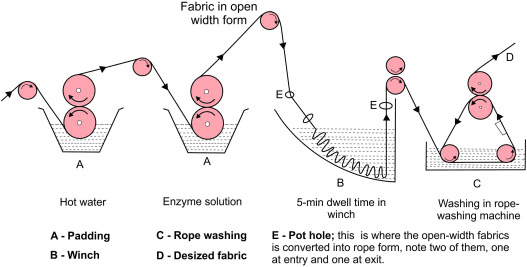
The industrial desizing process typically involves several stages.
1. Impregnation
Fabric passes through a solution containing desizing chemicals or enzymes.
2. Reaction Stage
The fabric is held at controlled temperature and pH to allow size breakdown.
3. Washing
Broken-down size materials are washed away with hot water.
4. Neutralization (if required)
Residual chemicals are neutralized to stabilize the fabric.
5. Drying
Fabric is dried before entering further wet processing stages.
Proper process control ensures complete removal of sizing materials without fiber damage.
Different Methods for Desizing Textile Fabrics
Several desizing methods are used depending on the type of sizing agent applied.
Major Industrial Desizing Methods
Method | Principle | Typical Application |
Enzymatic desizing | Enzymes break down starch sizes | Most common for cotton |
Oxidative desizing | Oxidizing agents degrade size film | Used for synthetic sizes |
Acid desizing | Acid hydrolysis breaks down starch | Less common today |
Hot water desizing | Dissolves water-soluble sizes | Used for easily removable sizes |
Among these, enzymatic desizing using amylase enzymes is the most widely used method in modern textile processing.
Oxidative Desizing vs Enzymatic Desizing
Both oxidative and enzymatic methods are widely used, but they differ significantly in mechanism and environmental impact.
Parameter | Enzymatic Desizing | Oxidative Desizing |
Mechanism | Enzymes break starch molecules | Oxidizing agents degrade polymers |
Selectivity | Highly selective | Less selective |
Fiber damage risk | Low | Moderate |
Environmental impact | Lower | Higher |
Temperature control | Moderate | Higher temperatures required |
Because of its fiber safety and environmental advantages, enzymatic desizing has become the preferred industrial method.
Chemicals and Reagents Used in Industrial Desizing
Several chemicals are used depending on the desizing method.
Common Desizing Chemicals
Amylase enzymes
Hydrogen peroxide
Sodium persulfate
Wetting agents
Detergents
Alkalis
Sequestering agents
The selection depends on:
Type of sizing agent
Fiber composition
Processing conditions
Modern sustainable textile processing increasingly favors enzyme-based systems due to their lower environmental footprint.
Impact of Desizing on Fabric Absorbency and Dye Uptake
Effective desizing significantly improves fabric absorbency.
Key Benefits
Improved wettability
Better dye penetration
Uniform dyeing results
Higher color yield
When size residues remain on the fabric, dyes cannot penetrate the fiber structure, resulting in uneven coloration.
Thus, desizing directly affects final fabric quality and dyeing efficiency.
Environmental Considerations and Effluent Treatment in Desizing
Desizing contributes significantly to textile wastewater pollution.
Effluent from desizing contains:
Size residues
Starch derivatives
Synthetic polymers
Chemicals used in treatment
Environmental Concerns
High Chemical Oxygen Demand (COD)
Increased wastewater load
Chemical contamination
One of the biggest contributors to desizing pollution is PVA-based sizing, which is difficult to biodegrade.
Sustainable sizing technologies-such as PVA-free systems developed by Alpenol-reduce environmental burden during both sizing and desizing stages.
Machinery and Equipment for Continuous Desizing Operations
Modern textile mills use continuous processing machines for desizing.
Common Desizing Equipment
Continuous desizing ranges
Padding mangles
J-box systems
Steamers
Washing ranges
Continuous systems improve:
Production efficiency
Process consistency
Water and energy management
Common Problems and Troubleshooting in Textile Desizing
Desizing problems can lead to significant quality defects.
Typical Desizing Issues
Incomplete size removal
Uneven desizing across fabric width
Excessive enzyme activity
Fabric damage during oxidative desizing
Poor washing efficiency
Troubleshooting Measures
Correct enzyme dosage
Proper pH control
Adequate washing stages
Monitoring temperature profiles
Process optimization is essential to ensure consistent desizing performance.
Optimal Parameters for Amylase-Based Desizing
Amylase enzymes are widely used to break down starch sizing agents.
Typical Process Parameters
Parameter | Typical Range |
Temperature | 55–70°C |
pH | 5.5 – 7 |
Treatment time | 20–40 minutes |
Enzyme dosage | 0.5–2 g/L |
These conditions ensure efficient hydrolysis of starch without damaging cotton fibers.
Desizing Effectiveness: Cotton vs Polyester-Cotton Blends
Fiber composition significantly affects desizing performance.
Cotton Fabrics
Starch sizes are easily removed with enzymes
High absorbency improves desizing efficiency
Polyester-Cotton Blends
Synthetic fibers may retain size film
Additional wetting agents may be required
More intensive washing may be needed
Proper chemical selection ensures effective desizing across different fabric types.
The Role of Sustainable Sizing in Improving Desizing
Desizing efficiency is strongly influenced by the type of sizing chemicals used during weaving.
Traditional PVA-based sizing systems make desizing more difficult and increase effluent load.
Modern compound sizing systems-such as Alpenol’s PVA-free technologies-are designed to enable easier removal during desizing while maintaining weaving performance.
This integrated approach improves both:
textile processing efficiency
environmental sustainability
FAQ’s
What is desizing in textile processing?
Desizing is the process of removing sizing agents from woven fabrics before dyeing and finishing.
Why must fabrics be desized before dyeing?
Sizing chemicals prevent dyes and finishing agents from penetrating fibers, making desizing essential for proper dye uptake.
Which desizing method is most commonly used?
Enzymatic desizing using amylase enzymes is the most widely used method in modern textile processing.
Does sizing chemistry affect desizing efficiency?
Yes. Sustainable sizing systems designed for easy removal can significantly improve desizing efficiency and reduce environmental impact.
How does Alpenol’s sizing technology affect the desizing process?
Alpenol’s compound sizing systems are engineered to be PVA-free and easier to remove during desizing. Because these formulations avoid heavy synthetic polymers such as polyvinyl alcohol, the size film breaks down more efficiently during washing and enzymatic desizing, reducing water usage, chemical consumption, and processing time in textile wet processing.
Why do PVA-free sizing agents improve desizing efficiency?
Traditional PVA-based sizing agents are difficult to biodegrade and often require stronger chemicals to remove during desizing. Alpenol’s PVA-free sizing technology uses biodegradable compound polymers, which are easier to break down and wash off the fabric. This improves desizing efficiency while also reducing effluent load and environmental impact.
Can Alpenol sizing solutions help reduce environmental impact during desizing?
Yes. Because Alpenol formulations eliminate PVA and reduce synthetic polymer content, the desizing stage generates lower COD and BOD levels in wastewater. This helps mills reduce effluent treatment costs and comply with sustainability standards such as ZDHC and OEKO-TEX while maintaining high weaving performance.
References
PMC – Eco-Friendly Textile Desizing with Indigenously Produced Amylase (Enzymatic Parameters, COD Reduction),
https://pmc.ncbi.nlm.nih.gov/articles/PMC10368615/
PMC – Sustainable Starch-Based Sizing and Desizing Film Behavior (Biodegradable Films),
https://pmc.ncbi.nlm.nih.gov/articles/PMC6572457/
PMC – Novel Energy-Saving Starch via Graft Copolymerization (Easy Removal During Desizing),
https://pmc.ncbi.nlm.nih.gov/articles/PMC10820382/
ACS Omega – Sustainable Photocatalytic Desizing for Starch-Based Size (Clean Desizing Process),
https://pubs.acs.org/doi/10.1021/acsomega.3c00713
UGD Eprints PDF – Enzymatic Desizing of Cotton: A Review (Amylase Parameters, pH, Temperature),
IJCRT PDF – Introduction to Enzymatic Desizing on Textiles (Mechanism, Enzyme Types),
https://ijcrt.org/papers/IJCRT2507621.pdf
ScienceDirect – Can Enzymatic Processes Transform Textile Processing? (Desizing Efficiency Review),
https://www.sciencedirect.com/science/article/abs/pii/S1359511322003877
SAGE Journals – Enzyme Treatment at Different Stages of Textile Processing (Desizing Context),
https://journals.sagepub.com/doi/10.1089/ind.2018.0018
Textile Learner – Yarn Sizing: Important Warp Preparatory Process (Sizing to Desizing Link),
https://textilelearner.net/yarn-sizing-important-warp-preparatory-process/
Textile Trainer – Sizing Ingredients with Their Function (PVA/Starch Sizing → Desizing Impact),
https://textiletrainer.com/sizing-ingredients-with-their-function/
Sekisui SC – Polyvinyl Alcohol vs Starch as Warp Sizing Chemical (PVA Desizing Difficulty),
https://www.sekisui-sc.com/blog/polyvinyl-alcohol-vs-starch-as-warp-sizing-chemical-in-textiles/
SMS Corporation – Modified Starch for Warp Sizing (Easy Desizing & COD Reduction),
https://www.siammodifiedstarch.com/product/non-food/detail/Warp-Sizing
Fibre2Fashion – Identification of Type of Size in Woven Fabrics (Desizing Test Methods),
https://www.fibre2fashion.com/industry-article/3703/identification-of-type-of-size-in-woven-fabrics
PMC – Degradation of Polyvinyl Alcohol in US Wastewater Treatment Plants (PVA Desizing Environmental Impact),
https://pmc.ncbi.nlm.nih.gov/articles/PMC8199957/
ScienceDirect – Enhanced Degradation of PVA-Containing Desizing Wastewater (COD Treatment),
https://www.sciencedirect.com/science/article/abs/pii/S221471442500933X
OSTI.GOV – Wet Air Oxidation for PVA Desizing Wastewater (Oxidative Desizing Effluent),
https://www.osti.gov/biblio/20076070
ZDHC – Wastewater Guidelines (COD/BOD Limits Relevant to Desizing Effluent),
https://downloads.roadmaptozero.com/output/ZDHC-Wastewater-Guidelines
TextilePact – Textile Industry Wastewater Discharge Quality Standards (Desizing COD Benchmarks),
GOTS – Manual for Implementation (Chemical Input Criteria Including Desizing Agents),
OEKO-TEX® – STANDARD 100 (Chemical Safety in Textile Processing Including Pre-Treatment),
https://www.oeko-tex.com/en/our-standards/oeko-tex-standard-100/
Liked it? Share it with your people.


Disclaimer
The information provided in this blog is intended solely for educational and informational purposes within the textile industry. While the content references technical concepts, sizing and desizing practices, and general chemical information, it does not constitute professional, commercial, or operational advice for any specific textile process or production environment.
Process conditions, chemical selections, and operational parameters may vary significantly across mills, machinery types, fabric constructions, and environmental constraints. Readers should always consult qualified technical professionals, internal laboratory data, and product-specific Technical Data Sheets before making any decisions related to textile processing.
Any references to Alpenol, Sizaltex, or other products are included only for contextual, educational, and illustrative purposes and should not be interpreted as endorsements, recommendations, or guarantees of performance. The authors assume no responsibility for decisions made based on the information contained herein.