
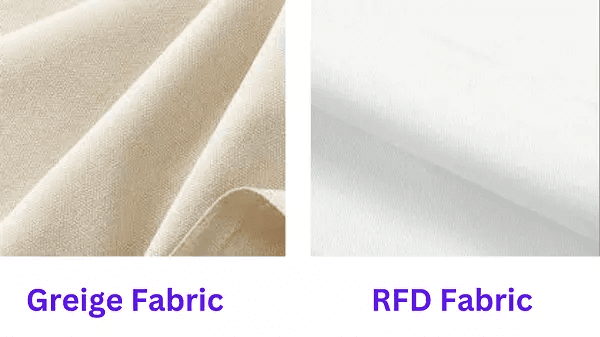
What exactly is greige fabric in textile manufacturing?
Greige (or grey) fabric is the raw woven fabric obtained immediately after the weaving process. It still contains natural and added impurities introduced during spinning, sizing, and weaving.
Key characteristics of greige fabric:
Contains size materials (starch, modified starch, PVA or PVA replacements)
Retains natural waxes, pectins, oils, and dirt
Uneven absorbency across warp and weft yarns
Slight yellowish or off-white appearance
Higher fabric stiffness and hairiness
From a weaving perspective, greige fabric reflects how well the warp sizing process was executed. Advanced sizing formulations-especially starch-based, low-synthetic systems-help ensure stronger warp yarns, fewer loom stops, and cleaner greige fabric, reducing rework during finishing.
What is Finished (RFD) fabric and why is it important?
Finished (RFD) fabric is greige fabric that has undergone desizing, scouring, and often bleaching, without adding color. The objective is to make the fabric chemically clean and physically uniform, so it can accept dyes or prints evenly.
Properties of RFD fabric:
Free from sizing chemicals and weaving auxiliaries
High and uniform absorbency
Softer hand feel
Improved whiteness index
Consistent performance in dyeing and printing
RFD fabric is especially important for high-quality cotton, viscose, modal, and blended fabrics, where shade consistency and surface clarity are non-negotiable.
How do greige and Finished (RFD) fabrics differ in properties?
Parameter | Greige Fabric | Finished (RFD) Fabric |
Processing stage | Post-weaving | Post wet-finishing |
Size content | Present | Completely removed |
Absorbency | Low & uneven | High & uniform |
Appearance | Dull, off-white | Clean, brighter white |
Hand feel | Stiff | Soft & supple |
Dye suitability | Poor | Excellent |
Fabric defects | More visible | Largely minimized |
This table highlights why fabric intended for apparel, home textiles, and printing almost always moves from greige to RFD before further processing.
What defects are common in greige fabric?
Greige fabric commonly shows issues that originate from yarn quality, sizing chemistry, and loom conditions.
Typical greige fabric defects:
Patchy absorbency due to uneven desizing
Size marks and size migration
Oil stains and loom grease
Hairiness and lint accumulation
Barre or streaks from warp tension variation
Many of these defects are not structural, but chemical or surface-related-meaning they can be resolved through proper RFD processing.
How does RFD processing resolve greige fabric defects?
RFD processing systematically eliminates the root causes of greige fabric imperfections.
Defects resolved during RFD:
Desizing removes starch/PVA residues completely
Scouring eliminates natural waxes, oils, and dirt
Bleaching improves whiteness and visual uniformity
Controlled washing equalizes warp and weft absorbency
When greige fabric is woven using low-synthetic, easily removable sizing systems, desizing becomes faster, water-efficient, and less aggressive-preserving fabric strength and improving sustainability metrics.
Why does greige fabric quality depend heavily on sizing chemistry?
Sizing plays a foundational role in determining whether greige fabric converts smoothly into RFD fabric. Poorly chosen sizing chemicals can:
Cause difficult desizing
Increase water and chemical consumption
Lead to uneven absorbency even after finishing
Modern starch-based sizing systems engineered for easy removability, high adhesion, and low residue help mills achieve:
Cleaner greige fabric
Faster RFD processing
Reduced effluent load
Better dyeing performance
This linkage between warp sizing → greige quality → RFD efficiency is often underestimated but critical for overall mill productivity.
When should mills choose greige fabric vs. RFD fabric?
Choose greige fabric when:
Selling fabric to processors
Exporting unfinished woven fabric
Performing in-house specialized finishing later
Choose RFD fabric when:
Dyeing or printing is planned
Shade accuracy is critical
Fabric is for high-end apparel or home textiles
FAQs
What does greige fabric mean in textiles?
Greige fabric refers to raw woven fabric that has not undergone desizing, scouring, or bleaching and still contains natural and added impurities.
Is RFD fabric bleached?
Yes, RFD fabric is usually lightly bleached to improve whiteness but contains no dyes or pigments.
Can greige fabric be dyed directly?
Technically yes, but results are inconsistent. RFD processing is recommended for uniform dye uptake.
Why is RFD fabric more expensive than greige?
RFD fabric includes additional wet processing steps, energy, water, and chemical costs.
How does sizing affect greige and RFD quality?
Efficient, easily removable sizing improves greige cleanliness and reduces processing severity during RFD, leading to better fabric quality.
Reference Links & Backlinks
GarmentsMerchandising: Difference Between Greige Fabric and RFD Fabric (Properties Table),
https://garmentsmerchandising.com/difference-between-greige-fabric-and-rfd-fabric/
TextileIndustry.net: Greige to RFD Processing (Desizing, Scouring, Bleaching),
https://www.textileindustry.net/difference-between-greige-fabric-and-rfd-fabric/
Green-Tailor: RFD Fabrics Explained (Greige Pretreatment Steps),
https://green-tailor.com/rfd-fabrics-understanding-what-it-means/
OnlineClothingStudy: RFD vs Greige Fabric (Cost, Processing Differences),
https://www.onlineclothingstudy.com/2013/07/difference-between-rfd-and-greige-fabric.html
GarmentExportHouse: Ready for Dyeing (RFD) Fabric (From Greige),
https://www.garmentexporthouse.com/2021/10/ready-for-dyeing-rfd-fabric.html
Google Patents: Desizing, Scouring, Bleaching Greige Cotton/Polyester (Defects Removal),
https://patents.google.com/patent/US3619111A/en
ScienceDirect: Fabric Wet Processing Environmental Assessment (Greige to RFD Effluent),
https://www.sciencedirect.com/science/article/abs/pii/S0048969722065949
FibreBio: RFD Fabrics for Dyeing/Printing (Desizing, Mercerizing),
https://fibrebio.com/en/all-you-need-to-know-about-rfd-ready-for-dyeing-fabrics/
Inflibnet: Grey Cloth Singeing, Desizing, Scouring, Bleaching (Enzymatic Methods),
_ ...
ICIRESM: Textile Wet Processing Environmental Impacts & Effluent Treatment,
...
LinkedIn TextileLibrary: RFD vs Greige Fabric Comparison (Visual Guide),
SoundaryaDigital: RFD for Digital Print (Singeing, Desizing, Scouring),
Wiley Online: Review of Textile Wet Processing & Effluent Methods (Greige Finishing),
https://onlinelibrary.wiley.com/doi/abs/10.1002/tqem.21538
DamodarMenon: Greige vs RFD Fabric (B2B Textile Insights),
https://damodarmenon.com/difference-between-greige-fabric-and-rfd-fabric/
Scribd: Preparatory Processes to Dyeing (Greige to RFD Module),
https://www.scribd.com/document/815270582/Module-1-Preparatory-Process-to-Dyeing
ZDHC Wastewater Guidelines (RFD Wet Processing Effluent),
https://downloads.roadmaptozero.com/output/ZDHC-Wastewater-Guidelines
ZDHC Wastewater V1.1 (Desizing/Scouring Standards),
https://wastewater.sustainabilityconsortium.org/downloads/zdhc-wastewater-guidelines-verson-1-1/
Textile Wastewater Standards (Greige Finishing Load),
GOTS Implementation Manual (Organic RFD Processing),
https://global-standard.org/images/Implementation_Manual_7.0_Second_Revision_Draft.pdf
OEKO-TEX Standards (Fabric Preparation Compliance),
https://www.oeko-tex.com/en/our-standards/
PMC: Potato Starch Sizing (Easy Greige Desizing),
https://pmc.ncbi.nlm.nih.gov/articles/PMC6572457/
PMC: Starch for Warp (RFD Absorbency Impact),
https://pmc.ncbi.nlm.nih.gov/articles/PMC10820382/
ACS ES&T: PVA in Greige (Removal Challenges),
https://pubs.acs.org/doi/10.1021/es504988w
Persistence: Sizing Chemicals Market (Greige Quality),
https://www.persistencemarketresearch.com/market-research/textile-sizing-chemicals-market.asp
Liked it? Share it with your people.


Disclaimer
The information provided in this blog is intended solely for educational and informational purposes within the textile industry. While the content references technical concepts, sizing and desizing practices, and general chemical information, it does not constitute professional, commercial, or operational advice for any specific textile process or production environment.
Process conditions, chemical selections, and operational parameters may vary significantly across mills, machinery types, fabric constructions, and environmental constraints. Readers should always consult qualified technical professionals, internal laboratory data, and product-specific Technical Data Sheets before making any decisions related to textile processing.
Any references to Alpenol, Sizaltex, or other products are included only for contextual, educational, and illustrative purposes and should not be interpreted as endorsements, recommendations, or guarantees of performance. The authors assume no responsibility for decisions made based on the information contained herein.