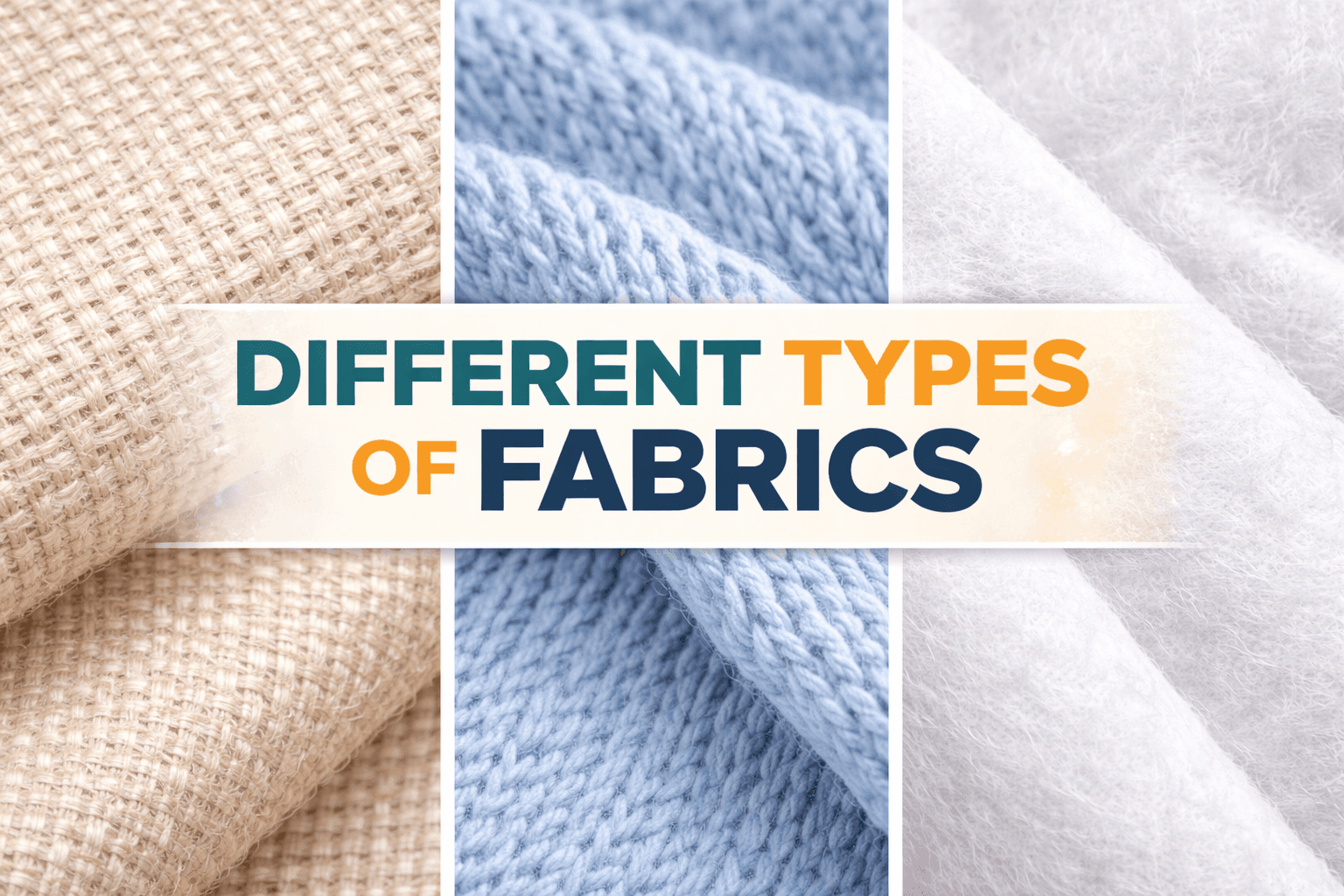
What Are the Different Types of Fabrics?
All fabrics fall into one of three major construction categories:
1. Woven Fabrics
Made by interlacing warp and weft yarns at right angles.
Common woven fabrics include:
Cotton poplin
Twill (denim, chino)
Satin
Canvas
Brocade
Organza
Taffeta
Chambray
Woven fabrics require warp sizing to ensure smooth weaving-where Alpenol’s adhesive film enhances strength, reduces hairiness, and enables high-speed loom performance.
2. Knitted Fabrics
Made by interlooping yarns to form loops.
Common knitted fabrics include:
Jersey
Rib knit
Interlock
Piqué
Fleece
Terry knit
Warp knits (tricot, raschel)
Knits do not require sizing but rely heavily on yarn uniformity and elasticity, making spun yarn types (ring-spun, compact, OE) important considerations.
3. Nonwoven Fabrics
Bonded mechanically, chemically, or thermally-no yarns or loops.
Examples:
Felt
Melt-blown polypropylene (PPE, filters)
Spunbond nonwovens (bags, diapers)
Needle-punched fabrics (geotextiles)
Used in:
Medical textiles
Filtration
Hygiene products
Agriculture
Automotive interiors
With no weaving involved, sizing is not applied-but fiber bonding chemistry becomes the critical performance factor.
Common Fabric Names and Their Characteristics
Below is a concise guide covering major fabrics across all segments:
Woven Apparel Fabrics
1. Poplin
Plain weave, smooth, crisp
Uses: shirts, uniforms, dresses
Cotton poplin benefits from warp sizing → stronger, cleaner surface for high-speed production.
2. Twill (Chino, Drill, Denim)
Diagonal ribs, durable
Uses: trousers, jackets, workwear
Denim’s heavy warp demands robust sizing for abrasion resistance.
3. Satin
Lustrous surface, smooth drape
Uses: eveningwear, luxury garments
4. Chambray
Colored warp + white weft
Uses: shirts, casual wear
5. Corduroy
Cut-pile fabric with ridges
Uses: trousers, jackets, children’s wear
Knitted Apparel Fabrics
6. Single Jersey
Lightweight, stretchy
Uses: T-shirts, underwear
7. Interlock Knit
Double-knit, smooth both sides
Uses: premium T-shirts, babywear
8. Rib Knit
Highly elastic
Uses: cuffs, collars, activewear
9. Sweater Knits / Wool Knits
Warm, insulating
Uses: sweaters, scarves, winterwear
Home Textile Fabrics
10. Sheeting (Percale, Sateen)
Soft, breathable
Uses: bed sheets, pillowcases
11. Upholstery Fabrics
Heavy-duty wovens like jacquard, canvas, twill
Uses: sofas, chairs, drapes
Require strong warp sizing → Alpenol’s consistent film improves tensile strength.
12. Terry Fabrics (Woven or Knit)
Loop piles for absorbency
Uses: towels, bathrobes
13. Curtains & Drapery Fabrics
Voile, jacquard, blackout fabrics
Uses: home decor, hotels, institutional interiors
Technical & Industrial Fabrics
14. Nonwoven Geotextiles
Needle-punched PP or PET
Uses: road reinforcement, drainage
15. Filter Fabrics
Meltblown, spunbond, woven micro-denier
Uses: HVAC, industrial dust collection
16. Fire-Retardant Fabrics
Aramid (Nomex), treated cotton
Uses: PPE, military uniforms
17. Medical Fabrics
SMS nonwovens, spunlace
Uses: gowns, masks, wipes
18. Automotive Textiles
Seatbelts (polyester), headliners (nonwovens), airbags (nylon)
How Do Woven Structures (Plain, Twill, Satin) Differ from Knits in Texture and Durability?
Plain Weave
Balanced structure
Durable, firm texture
Examples: poplin, muslin
Twill Weave
Diagonal lines
More flexible and abrasion-resistant
Examples: denim, chino
Satin Weave
Long floats, high sheen
Smooth, luxurious
Comparison with Knits:
Property | Wovens | Knits |
Stretch | Low | High |
Durability | High | Medium |
Breathability | Medium | High |
Drape | Structured | Soft |
Use Case | Shirts, trousers, upholstery | Tees, activewear, sweaters |
Woven structures benefit significantly from well-sized warp yarns-Alpenol provides this crucial reinforcement.
Compare Different Fabrics: Pros, Cons, Breathability, and Common Uses
Fabric Type | Pros | Cons | Breathability | Uses |
Cotton | Soft, absorbent | Wrinkles, shrinks | High | Apparel, towels, bedding |
Polyester | Strong, quick-dry | Low absorbency | Medium | Sportswear, home textiles |
Linen | Cool, crisp | Wrinkles easily | High | Summer wear, table linens |
Wool | Warm, elastic | Expensive | Medium | Winter wear |
Nylon | Durable, flexible | Heat-sensitive | Medium | Activewear, technical |
Viscose | Drapey, soft | Weak when wet | High | Dresses, blouses |
Spandex | Extremely stretchy | Low strength alone | N/A | Sportswear blends |
Which Fabrics Are Most Sustainable and Eco-Friendly?
Natural Sustainable Options
Organic cotton
Linen (low water usage)
Hemp (high yield, low pesticide)
Bamboo (mechanically processed)
Regenerated Cellulosics
Lyocell / Tencel (closed-loop eco-process)
Modal
Recycled Fibers
rPET recycled polyester
Recycled cotton
Bio-based Innovations
PLA fiber
Mycelium-based textiles
Orange peel and pineapple fiber (Piñatex)
Sustainability also involves processing-low-chemical, low-impact sizing agents like Alpenol contribute to cleaner woven textile production by reducing effluent load and chemical complexity.
What Technical and Performance Fabrics Should I Know About?
Moisture-Wicking Fabrics
Polyester microfibers, nylon blends
Thermal Fabrics
Wool, fleece, insulated laminates
Stretch Fabrics
Spandex, elastomultiester
Protective Fabrics
Aramids (Kevlar, Nomex)
FR-treated cotton
Breathable Waterproof Fabrics
PTFE membranes (Gore-Tex)
PU-coated fabrics
Medical-Grade Fabrics
Antimicrobial polyesters
Spunlace wipes
Industrial Fabrics
Conveyor belts (nylon-polyester)
Filtration media
Geotextiles
Many technical wovens still depend on warp stability, Alpenol’s film strength supports consistent weaving for engineered fabrics.
How Fiber Choice and Blends Translate into Fabrics and Use Cases
Cotton Blends
Cotton-polyester: balanced comfort + durability (shirts, uniforms)
Cotton-spandex: stretch jeans, fitted tops
Polyester Blends
Polyester-viscose: soft drape, office wear
Polyester-cotton: easy-care shirting fabrics
Wool Blends
Wool-nylon: improved abrasion resistance
Wool-polyester: wrinkle resistance
Technical Blends
Nomex-Kevlar: firefighter suits
Polyester-carbon: conductive fabrics
Each blend creates a fabric with engineered performance attributes. In woven manufacturing, warp yarns in these blends often require specialized sizing to maintain strength under high tension-where Alpenol’s adhesive performance supports consistent quality.
FAQs About Fabric Types and Their Characteristics
1. What are the main categories of fabrics?
Woven, knitted, and nonwoven fabrics.
2. Which fabrics are best for everyday apparel?
Cotton, jersey knits, polyester blends, viscose, denim, poplin.
3. What makes woven fabrics more durable?
The interlacing of warp and weft creates stability. Warp sizing-such as Alpenol’s-further enhances strength.
4. Which fabrics are most eco-friendly?
Linen, hemp, lyocell, and recycled fibers.
5. What fabrics are used in technical textiles?
Aramids, carbon fiber, polypropylene, polyester industrial wovens, nonwovens used for filtration and hygiene.
References
Stitch Clinic - Differences Between Knit, Woven and Nonwoven Fabrics,
https://www.stitchclinic.com/difference-between-fabrics/
MMI Textiles - Knits vs Woven vs Non-Woven Fabrics (Industrial Uses),
Yuta Textiles - Distinguish Woven, Knitted, Nonwoven (Stretch Test),
https://www.yutaitextiles.com/news/how-to-distinguish-woven-knitted-and-nonwove-85152770.html
VN Polyfiber - Nonwoven vs Woven vs Knit (Stretch/Wrinkle),
https://vnpolyfiber.com/difference-between-nonwoven-fabric-and-woven-fabric-and-knit-fabric/
Paris Textile - Cotton Linen Fabric Properties (Poplin, Twill, Drill),
https://www.parisstextile.com/cotton-linen-fabric-properties/
Boyd Biomedical - Technical Textiles Applications (Medical/Geotextiles),
Textile Industry - Classification of Fabrics and Uses (Structures),
https://www.textileindustry.net/classification-of-fabrics-and-their-uses/
Sick Bastard Streetwear - Common Clothing Materials Properties (12 Types),
https://sickbastardstreetwear.net/blogs/news/common-clothing-materials
Acme Mills - 12 Applications of Technical Textiles (Agro/Mobiltech),
Barnhardt - Fibers: Wovens vs Nonwovens vs Knits,
https://barnhardt.net/know-fibers-wovens-vs-nonwovens-knit-fabrics/
VN Polyfiber - Textile Fibers Classification (Plain/Satin/Twill),
https://vnpolyfiber.com/classification-of-textile-fibers/
Karnataka DHT PDF - Technical Textiles (Medtech/Mobiltech/Geotech),
https://karnatakadht.org/english/pdf/TECHNICAL-TEXTILES.pdf
Jason Mills - Knits vs Woven vs Non-Woven Difference (Stretch),
https://www.jasonmills.com/blog/knits-vs-woven-vs-non-woven-fabrics-difference/
MasterClass - 28 Types of Fabrics and Uses (2025 Guide),
https://www.masterclass.com/articles/28-types-of-fabrics-and-their-uses
GOTS Official - Sustainable Fabric Certifications (Organic Cotton),
OEKO-TEX - Fabric Safety Standards (Properties Testing),
Liked it? Share it with your people.


Disclaimer
The information provided in this blog is intended solely for educational and informational purposes within the textile industry. While the content references technical concepts, sizing and desizing practices, and general chemical information, it does not constitute professional, commercial, or operational advice for any specific textile process or production environment.
Process conditions, chemical selections, and operational parameters may vary significantly across mills, machinery types, fabric constructions, and environmental constraints. Readers should always consult qualified technical professionals, internal laboratory data, and product-specific Technical Data Sheets before making any decisions related to textile processing.
Any references to Alpenol, Sizaltex, or other products are included only for contextual, educational, and illustrative purposes and should not be interpreted as endorsements, recommendations, or guarantees of performance. The authors assume no responsibility for decisions made based on the information contained herein.