
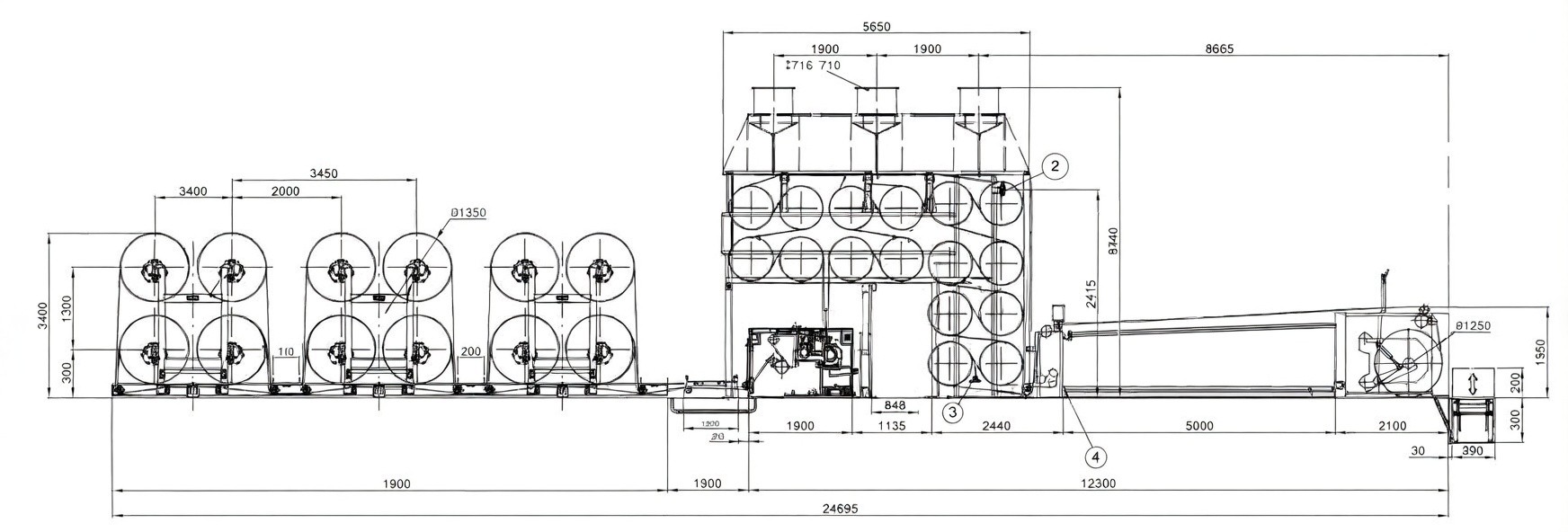
Why Is the Sizing Process Important?
Sizing prepares warp yarns for the intense stresses of weaving. Without proper sizing:
Abrasion at heddles and reeds increases
End-breaks rise
Loom stoppages multiply
Fabric quality drops
Production cost increases
Sizing creates a protective polymer film around yarns, improving:
Strength
Cohesion
Smoothness
Flexibility
In mills operating high-speed air-jet or rapier looms, stable and controlled sizing chemistry (like Alpenol’s low-add-on, high-adhesion systems) reduces variability and enhances weaving efficiency.
What Are the Checkpoints to Carry Out the Sizing Process Successfully?
Successful sizing is monitored across three stages:
1. Pre-Sizing Checkpoints
A. Yarn Quality Assessment
Count consistency
Twist level
Hairiness
Moisture content
Fiber composition
Spun yarns with high hairiness demand stronger, flexible films; Alpenol formulations help compensate for these variations.
B. Size Recipe Validation
Polymer selection (starch, PVA, acrylic blends)
Solids concentration
Additive compatibility
Expected viscosity curve
C. Size Bath Preparation
Proper dissolution
Homogeneous mixing
No lumps or gels
Temperature stabilization (85-90°C typical for starch-based systems)
2. In-Process Checkpoints
A. Viscosity Monitoring
Must remain within the standard window
Measured every 1-2 hours
Viscosity drift is a major cause of uneven pick-up
Alpenol’s stable rheological profile reduces drift and simplifies in-process control.
B. Size Pick-Up Control
Ensure uniformity across warp sheet width
Avoid over/under pick-up
Use immersion depth, tension, and roller pressure adjustments
C. Squeeze Roller Pressure
Uniform nip pressure
No misalignment
Roll hardness and wear checked regularly
D. Drying System
Cylinder temperatures balanced
Moisture content target (6-12% depending on yarn type)
Over-drying → brittle yarn
Under-drying → sticky yarn
3. Post-Sizing Checkpoints
A. Yarn Strength Testing
Tensile strength improvement (ideally 15-25% increase)
No brittle feel
B. Hairiness Reduction
Smooth surface
Reduced protruding fibers
Measured via hairiness testers
C. Adhesion & Film Uniformity
No flaking
No powdering
No sticking
Film should be flexible and intact
D. Beam Build Quality
Even tension
No slack ends
No overlapping or snarls
E. Loom Trial Performance
Fewer end-breaks
Stable warp sheet
No excessive dust
Alpenol’s film-forming chemistry is designed to remain flexible even at lower add-on, improving success rates on beam performance and loom trials.
How Do You Know the Sizing Process Was a Success?
A sizing process is considered successful when the following technical metrics are met:
1. Target Size Pick-Up Achieved
Pick-up must be within the specified range for the yarn type.
For cotton → typically 8-14%.
Lower pick-up is possible with high-performance agents like Alpenol.
2. Improved Tensile Strength
Warp yarn strength should improve by at least 15-25%.
Strength consistency across samples is equally important.
3. Reduced Hairiness
Significant drop in surface fuzz and protruding fibers.
4. Cohesive & Flexible Size Film
The film should not crack or powder.
Flexibility ensures smooth shedding and beating-up.
5. Uniform Moisture Content
Target regain levels ensure correct yarn bending stiffness.
6. Low End-Break Rate in Loom Trials
A clear success indicator:
Less warp shedding failure
Fewer stoppages
Better loom efficiency
Warp beams sized with Alpenol often show lower breakage and dust, particularly in spun yarn fabrics.
7. Smooth Warp Sheet Movement
No sticking, tangling, or roller deposits.
8. Clean Beam Build
No variation in tension across beam flanges.
What Are the Common Problems That Occur in Sizing?
Problem | Cause | Impact |
Uneven size pick-up | Viscosity drift, roller pressure variation | Barriness, inconsistent strength |
Flaking/powdering | Brittle film, over-drying | Dust, loom stoppage |
Sticking | Under-drying, excessive softeners | Reed marks, poor shedding |
High hairiness | Under-sizing, poor penetration | Yarn breakage |
Roller deposits | Lumps, gels, poor mixing | Streaky sizing |
Weak film adhesion | Incorrect solids or polymer | Poor weaving efficiency |
How Are Problems in Sizing Solved?
1. Fixing Uneven Pick-Up
Stabilize viscosity
Adjust squeeze pressure
Improve size circulation
Ensure roller alignment
2. Preventing Flaking and Brittleness
Increase moisture content slightly
Reduce solids or adjust polymer blend
Use flexible-film chemistries
3. Avoiding Sticky Yarn
Raise drying temperature slightly
Reduce plasticizer content
4. Improving Yarn Adhesion
Modify size recipe
Strengthen starch/PVA/acrylic balance
Use high-adhesion engineered size agents
5. Reducing Hairiness
Increase penetration
Raise pick-up slightly
Optimize pretension
Summary: What Proves Sizing Was Done Correctly?
A successful sizing process will show:
Uniform size pick-up
Higher strength
Reduced hairiness
Flexible film formation
Low end-breaks during weaving
Clean, smooth warp movement
Stable loom efficiency
Reduced dust, reduced deposition
Excellent beam build quality
Alpenol’s modern sizing systems help mills achieve these outcomes at lower chemical usage and with more predictable control-making sizing success more repeatable and less operator-dependent.
FAQ
1. How do you know if sizing is successful?
Check strength, pick-up, hairiness, film flexibility, moisture content, and loom performance.
2. What is the most important sizing parameter?
Uniform size pick-up-without it, film quality and strength become inconsistent.
3. How can I reduce sizing defects?
Stabilize viscosity, control temperature, calibrate rollers, and use reliable sizing formulations.
4. Why does sizing affect weaving?
It protects warp yarn from mechanical stress, reducing breakages and improving fabric quality.
5. Does the type of sizing agent matter?
Yes. Starch-only systems can be brittle; blended or engineered systems like Alpenol create stronger, more flexible films.
References
PMC: Cotton Warp Sizing Performance (Strength/Pick-Up Metrics),
https://pmc.ncbi.nlm.nih.gov/articles/PMC12845530/
PMC: Starch Sizing Film Evaluation (Hairiness/Moisture),
https://pmc.ncbi.nlm.nih.gov/articles/PMC6572457/
PMC: Warp Yarn Metrics (Adhesion/Flexibility),
https://pmc.ncbi.nlm.nih.gov/articles/PMC10820382/
Textile Learner: Sizing Defects & Success QC (Film Uniformity),
https://textilelearner.net/sizing-defects-causes-and-remedies/
Textile Trainer: Sizing Faults Remedies (Viscosity/Pick-Up),
https://textiletrainer.com/faults-of-sizing-with-effective-remedy/
Global Polyester: Sizing Problems Guide (Tension/Drying QC),
https://globalpolyester.com/common-problems-in-textile-sizing-a-simple-guide/
JEMIT PDF: Sizing Efficiency QC (Loom Trials),
https://jemit.aspur.rs/archive/v3/n1/3.pdf
Sage Journals: Warp Sizing Review (Success Parameters),
https://journals.sagepub.com/doi/abs/10.1177/00405175241235400
Textile Trainer: Sizing Ingredients QC (Recipe Stability),
https://textiletrainer.com/sizing-ingredients-with-their-function/
Textile Trainer: Drying Techniques (Moisture Control),
https://textiletrainer.com/techniques-of-drying-in-sizing-process/
Suntech Machine: Sizing Loom Beam Defects (Beam Build QC),
TextileListing: Sizing Principles (Process Checkpoints),
Anytester: Textile Sizing QC (Squeezing/Pick-Up),
https://www.anytester.com/textile-process-sizing-part-1.html
NPTEL Archive: Sizing Bath QC (Temperature/Viscosity),
https://archive.nptel.ac.in/content/storage2/courses/116102016/m-10/desizing.htm
Fibre2Fashion: Size Verification (Post-Sizing Tests),
https://www.fibre2fashion.com/industry-article/3703/identification-of-type-of-size-in-woven-fabrics
Textile School: Sizing Operation QC Points,
https://www.textileschool.com/1080/sizing-operation-for-textiles/
ACS ES&T: Sizing Film Success Metrics,
https://pubs.acs.org/doi/10.1021/es504988w
Sekisui SC: PVOH Sizing Performance (Strength Tests),
https://www.sekisui-sc.com/blog/7-reasons-to-use-polyvinyl-alcohol-for-textile-warp-sizing/
Siam Modified Starch: Warp Sizing QC Standards,
https://www.siammodifiedstarch.com/product/non-food/detail/Warp-Sizing
ZDHC Guidelines: Sizing Effluent Success (Low COD),
https://downloads.roadmaptozero.com/output/ZDHC-Wastewater-Guidelines
Liked it? Share it with your people.


Disclaimer
The information provided in this blog is intended solely for educational and informational purposes within the textile industry. While the content references technical concepts, sizing and desizing practices, and general chemical information, it does not constitute professional, commercial, or operational advice for any specific textile process or production environment.
Process conditions, chemical selections, and operational parameters may vary significantly across mills, machinery types, fabric constructions, and environmental constraints. Readers should always consult qualified technical professionals, internal laboratory data, and product-specific Technical Data Sheets before making any decisions related to textile processing.
Any references to Alpenol, Sizaltex, or other products are included only for contextual, educational, and illustrative purposes and should not be interpreted as endorsements, recommendations, or guarantees of performance. The authors assume no responsibility for decisions made based on the information contained herein.