
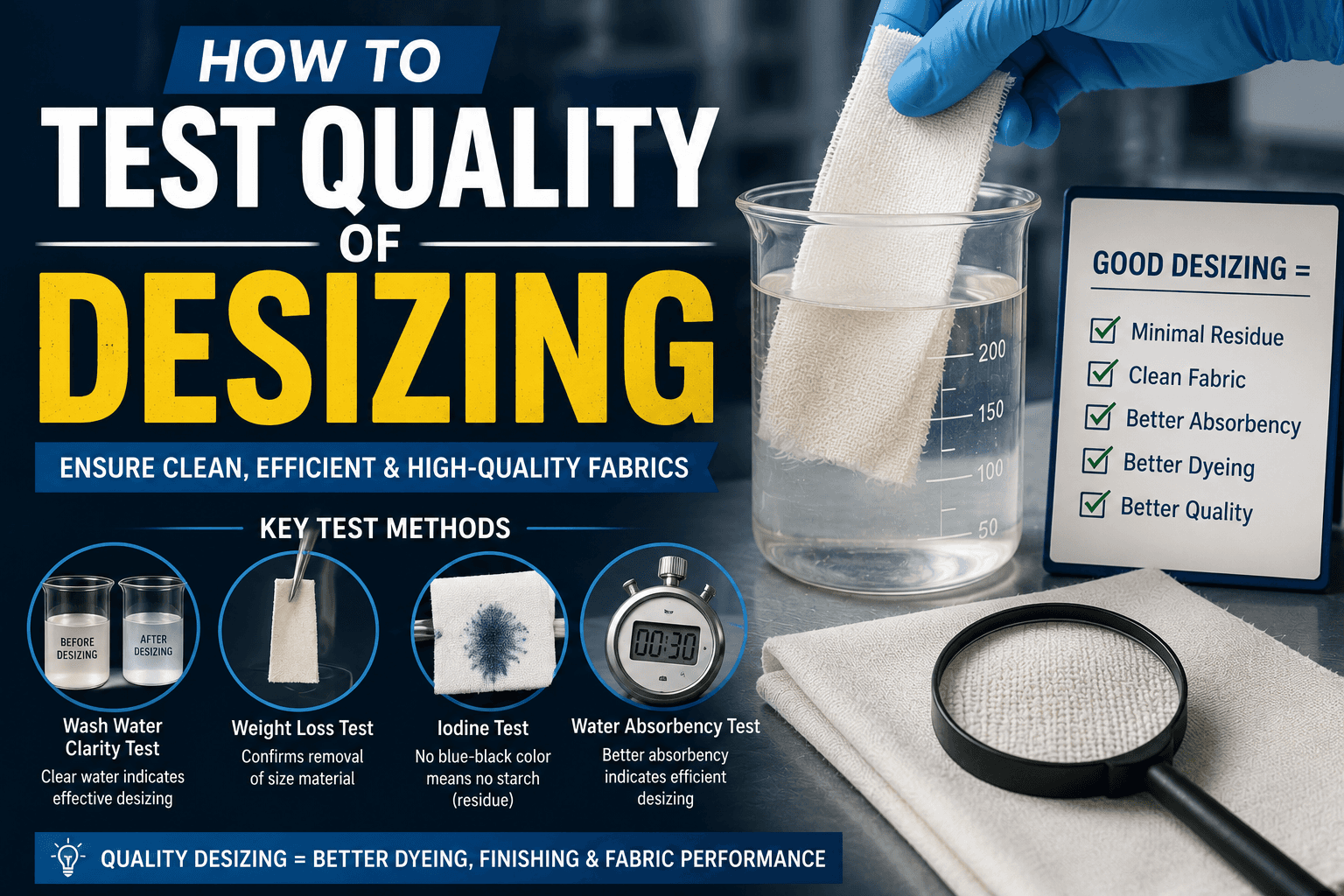
What Is Desizing and Why Is It Essential in Textile Processing?
Desizing is the removal of sizing agents applied to warp yarns during weaving.
If residual size remains on the fabric, it can severely impact downstream processes.
Importance of proper desizing:
Ensures uniform dye uptake
Prevents patchiness, streaks and barre
Improves absorbency and wettability
Reduces chemical demand in scouring and bleaching
Prevents white specks and uneven prints
Enhances fabric softness and handle
Alpenol’s one-shot, binder-free formulations desize more cleanly compared to PVA or acrylic-rich size recipes, reducing the risk of residual films.
What Are the Different Methods of Desizing Used in Industry?
1. Enzymatic Desizing
Uses amylase enzymes to hydrolyze starch-based sizes
Mild, eco-friendly, effective
2. Oxidative Desizing
Uses peroxide or potassium persulfate
Effective for starch + synthetic blends
Must be controlled to avoid fiber damage
3. Acid Desizing
Dilute acids break down starches
Less common due to risk of strength loss
4. Hot Washing / Surfactant Desizing
Removes hydrophobic or partially soluble sizes
Often used for synthetic blends
5. Solvent Desizing
Used for fully synthetic sizes (e.g., PVA)
Rare today due to environmental concerns
Note: Alpenol’s biodegradable polymers allow mills to use simple hot wash* or enzyme-assisted desizing rather than harsh oxidative methods.
To learn more about desizing, click here.
How Can I Assess the Effectiveness of Desizing on Cotton Fabric in a Laboratory?
Desizing quality is typically evaluated through:
Iodine-starch test
Enzymatic digest test
TOC (Total Organic Carbon) of wash liquors
FTIR analysis
Wettability and absorbency tests
Drop test or sink test
Residual size weight measurement
Each test measures whether starch, PVA, acrylic binders or film residues remain on the fabric surface.
What Are the Best Quick Tests to Check Whether Fabric Has Been Fully Desized?
1. Iodine Test (Spot Test) - Fastest
Apply iodine solution to fabric
Blue-black color = residual starch
No color = successful desizing
2. Water Drop Test
Place a droplet of water on fabric
Rapid absorption (< 3 seconds) indicates good desizing
3. pH & Conductivity of Wash Liquor
Helps assess removal of acidic or alkaline chemicals
4. Absorbency Test (Wetting Time)
A properly desized fabric wets quickly and evenly
Why Alpenol helps:
Because Alpenol avoids synthetic binders like PVA, desizing becomes easier and faster-meaning quick tests show cleaner, more reliable results.
Which Instruments Detect Residual Starch or Synthetic Sizes Most Accurately?
1. Iodine Test
Best for starch-only systems
Not useful for PVA or acrylic residue
2. Enzymatic Assay
Measures starch breakdown quantitatively
More precise than iodine spot tests
3. TOC (Total Organic Carbon)
Measures organic load of wash water
Indicates how much size has dissolved
4. FTIR Spectroscopy
Identifies functional groups of synthetic polymers
Useful for fabrics sized with PVA or acrylic binders
Iodine Test vs Enzymatic Assay vs FTIR: Pros and Cons
Method | Detects | Pros | Cons |
Iodine Test | Starch | Fast, cheap | Cannot detect PVA/acrylic |
Enzymatic Assay | Starch (quantitative) | Very accurate | Time-consuming |
TOC | All organic residues | Measures total size removal | Needs lab equipment |
FTIR | Synthetic polymers | Detects PVA/acrylic films | Requires specialized lab |
Burn Test (rare) | Organic residues | Quick visual cue | Crude, not reliable |
Practical lab rule:
Use iodine + absorbency as quick screen tests; use TOC/FTIR for detailed analysis.
How Does Incomplete Desizing Affect Dye Uptake and Printing Quality?
If desizing is incomplete:
Dyeing becomes uneven or blotchy
Printing shows poor penetration
Patches appear as lighter areas
Fabric retains stiffness
Residual films interfere with enzyme activity
Shade reproducibility becomes unpredictable
Alpenol’s clean-desizing behavior ensures minimal residues, leading to better dyestuff fixation, cleaner prints and fewer reprocesses.
How Sensitive Are Iodine Tests Compared to TOC or Enzymatic Assays?
Iodine test sensitivity:
Detects as little as 0.1-0.2% starch
Cannot detect PVA/acrylic
Enzymatic assay sensitivity:
Detects exact amounts of starch residue
Highly sensitive and quantitative
TOC sensitivity:
Measures all dissolved organic carbon
Excellent for assessing blend sizes
FTIR sensitivity:
Detects synthetic polymers at very low concentration
High specificity for molecular bonds
For mills moving away from PVA-based sizing-and adopting Alpenol binder-free sizes-the iodine and TOC methods become simpler, more consistent and highly reliable.
How Do I Interpret Desizing Test Results?
Iodine Test Interpretation
Blue/black: Poor desizing
Light brown: Partial desizing
No color: Good desizing
Absorbency (Drop Test)
< 3 seconds: Excellent
3-10 seconds: Acceptable
10 seconds: Poor
TOC Values
Higher TOC in wash liquor = effective removal
Low TOC may mean under-desizing
FTIR Results
Characteristic PVA peaks = incomplete desizing
Absence of synthetic signals = successful desizing
Why Do Fabrics Sized with Alpenol Desize Better?
Because Alpenol’s technology is:
Binder-free (no PVA or acrylics)
Eco-engineered starch-based
Easily dispersible in hot water
Designed for full removal during desizing
Compatible with enzymatic & oxidative desizing methods
Low residue = fewer laboratory failures
Mills using Alpenol consistently report:
Faster desizing
Lower chemical consumption
Cleaner absorbency profiles
Better dye levelness
Fewer quality rejections
FAQs
1. What is the easiest way to test desizing in a mill lab?
The iodine test combined with absorbency testing.
2. Can iodine detect synthetic sizes?
No-it only detects starch. Use FTIR or TOC for PVA or acrylics.
3. Why is desizing important?
Because residual size prevents proper dyeing, printing and finishing.
4. What is the best test for PVA residues?
FTIR or TOC analysis.
5. Do Alpenol-sized fabrics desize easily?
Yes, Alpenol is binder-free and fully biodegradable, making desizing quick and highly efficient.
Reference Links
Wikipedia: Iodine-Starch Test (Residual Starch Detection),
https://en.wikipedia.org/wiki/Iodine%E2%80%93starch_test
NPTEL Archive: Desizing Testing Methods (Iodine Spot Test),
https://archive.nptel.ac.in/content/storage2/courses/116102016/m-10/desizing.htm
Fibre2Fashion: Size Identification in Fabrics (Iodine for Starch/PVA),
https://www.fibre2fashion.com/industry-article/3703/identification-of-type-of-size-in-woven-fabrics
TextileTrainer: Oxidative Desizing Effect Testing (Iodine + PVA),
https://textiletrainer.com/oxidative-desizing-process-of-cotton/
TextileChemistry Blog: Desizing Material Test (Starch Iodine),
https://drmsparmar.blogspot.com/2014/12/how-to-test-desized-material-starch.html
PMC: Eco-Friendly Enzymatic Desizing (Drop Absorbency AATCC 79),
https://pmc.ncbi.nlm.nih.gov/articles/PMC10368615/
Symposium TF: Desizing Efficiency Testing (Absorption, Strength SRPS/ISO),
https://symposium.tf.ni.ac.rs/wp-content/uploads/zbornik-2025/R-7.pdf
RSC Publishing: Handheld FTIR vs TOC for Residue Detection,
https://pubs.rsc.org/en/content/articlelanding/2023/an/d3an00167a
EOPCW: Lab Tasks for Desizing (AATCC Absorbency Test 79),
http://eopcw.com/find/downloadLectureNote/1339
Slideshare: Desizing Methods & Testing (Enzymatic Assays),
https://www.slideshare.net/slideshow/desizing-34238292/34238292
ScienceDirect: FTIR for Enzyme Activity in Desizing,
https://www.sciencedirect.com/science/article/pii/S0003267099001920
TLR Journal: Sustainable Desizing Absorbency (AATCC 39),
https://www.tlr-journal.com/wp-content/uploads/2024/02/TLR_2024_007_PATIL.pdf
YouTube: Iodine Test for Starch Practical (Visual Demo),
https://www.youtube.com/watch?v=72zKnccyH-w
ACS Omega: Photocatalytic Desizing (TOC Measurement),
https://pubs.acs.org/doi/10.1021/acsomega.3c00713
ZDHC Wastewater Guidelines (Desizing Residue Effluent),
https://downloads.roadmaptozero.com/output/ZDHC-Wastewater-Guidelines
ZDHC Wastewater V1.1 (Organic Carbon Testing),
https://wastewater.sustainabilityconsortium.org/downloads/zdhc-wastewater-guidelines-verson-1-1/
GOTS Manual (Desizing Quality Standards),
https://global-standard.org/images/Implementation_Manual_7.0_Second_Revision_Draft.pdf
OEKO-TEX Standards (Fabric Cleanliness Testing),
https://www.oeko-tex.com/en/our-standards/
PMC: Starch Sizing Desizing Assays,
https://pmc.ncbi.nlm.nih.gov/articles/PMC6572457/
PMC: Quantitative Starch Removal,
https://pmc.ncbi.nlm.nih.gov/articles/PMC10820382/
ACS ES&T: Synthetic Residue Detection,
https://pubs.acs.org/doi/10.1021/es504988w
Persistence: Sizing Testing Market Insights,
https://www.persistencemarketresearch.com/market-research/textile-sizing-chemicals-market.asp
TextileSchool: Lab Desizing Tests,
https://www.textileschool.com/206/basic-weaving-operations/
AATCC Test Methods (Absorbency 79, Wettability),
https://www.aatcc.org/testing/laboratory-services/test-methods/
[AATCC site for standards]
Liked it? Share it with your people.


Disclaimer
The information provided in this blog is intended solely for educational and informational purposes within the textile industry. While the content references technical concepts, sizing and desizing practices, and general chemical information, it does not constitute professional, commercial, or operational advice for any specific textile process or production environment.
Process conditions, chemical selections, and operational parameters may vary significantly across mills, machinery types, fabric constructions, and environmental constraints. Readers should always consult qualified technical professionals, internal laboratory data, and product-specific Technical Data Sheets before making any decisions related to textile processing.
Any references to Alpenol, Sizaltex, or other products are included only for contextual, educational, and illustrative purposes and should not be interpreted as endorsements, recommendations, or guarantees of performance. The authors assume no responsibility for decisions made based on the information contained herein.