What Are Knitted Fabrics?
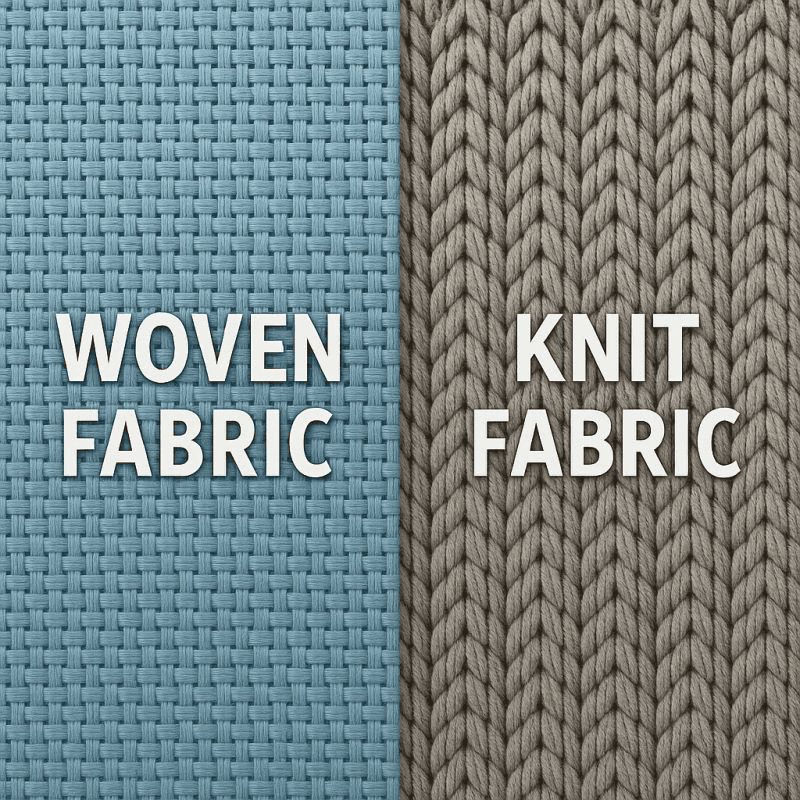
Knitted fabrics are constructed by interlooping a single yarn or multiple yarns to form a continuous series of interconnected loops. Because loops naturally expand and contract, these fabrics are known for:
High stretchability
Excellent comfort
Good breathability
Soft drape
Wrinkle resistance
How Knitted Fabrics Are Manufactured
Knitted fabrics are produced on:
Weft knitting machines (circular knitting, flatbed knitting)
Warp knitting machines (tricot, raschel)
Key Process Steps
Yarn feeding
Needle movement (latch, bearded, or compound needle)
Loop formation
Loop intermeshing
Fabric take-down
Because knitting does not require warp preparation or sizing, it is faster and more economical in certain product categories. However, knitted yarn quality still matters - yarns with lower hairiness (ring-spun or compact) produce cleaner, smoother knitted surfaces, improving both aesthetics and performance.
What Are Woven Fabrics?
Woven fabrics are constructed by interlacing two sets of yarns:
Warp yarns (longitudinal direction)
Weft yarns (crosswise direction)
This interlacing creates structures such as:
Plain weave
Twill weave
Satin weave
How Woven Fabrics Are Manufactured
Wovens require a more complex preparation phase, including:
Warp preparation
Sizing of warp yarns
Warping
Drawing-in and denting
Weaving on shuttle, air-jet, rapier or waterjet looms
Why Sizing Matters for Wovens
Warp yarns experience intense mechanical stresses during weaving. Applying a protective sizing film:
Increases tensile strength
Reduces hairiness
Minimizes abrasion
Enhances loom efficiency
What Is the Difference Between Knitted and Woven Fabrics?
Feature | Knitted Fabrics | Woven Fabrics |
Construction | Interlooping yarns | Interlacing warp & weft |
Stretch | Naturally high | Low unless elastane added |
Drape | Excellent | Moderate to stiff |
Durability | Moderate | Very high |
Air permeability | High | Medium |
Wrinkle resistance | High | Low to medium |
Fraying tendency | Low | High (needs edge finishing) |
Production speed | Fast | Medium to slow (due to sizing & preparation) |
Common use | T-shirts, sportswear, leggings | Shirts, trousers, denim, upholstery |
Sizing required? | No | Yes - Alpenol improves woven performance |
Knitted vs Woven Fabrics: Which Is Better for Everyday Clothing?
For everyday wear, knitted fabrics typically excel because:
They stretch with body movement
They offer superior comfort
They regulate air flow efficiently
This is why T-shirts, activewear, underwear and loungewear are almost always knitted.
Wovens, however, dominate structured garments like shirts, trousers and jackets. When woven fabric uses a high-quality sizing agent like Alpenol, it gains:
Better smoothness
Fewer weaving defects
Enhanced strength and longevity
This improves not only fabric performance but also consumer experience.
Compare Knit and Woven Textiles - Construction, Properties & Uses
Construction
Knits → loops
Wovens → interlaced yarns
Properties
Knits → elastic, breathable, comfortable
Wovens → strong, dimensionally stable, crisp
Uses
Knits → sportswear, T-shirts, hosiery
Wovens → suiting, shirting, denim, upholstery, industrial textiles
Wovens intended for demanding applications (e.g., upholstery) rely on precise warp sizing-an area where Alpenol’s consistent film formation contributes to long-term durability.
Knitted vs Woven Fabrics: How Do Stretch, Durability & Breathability Differ?
Stretch
Knits stretch inherently because loops open and recover.
Wovens stretch only with elastane or mechanical weave structures.
Durability
Wovens are more durable due to tightly packed yarns.
Warp sizing further enhances woven durability-especially in fabrics like denim or heavy upholstery.
Breathability
Knits have greater openness → higher breathability.
Wovens have tighter constructions → controlled airflow.
Knitted or Woven for Upholstery & Home Textiles - Which Is Better Long Term?
Woven fabrics win for upholstery due to:
High abrasion resistance
Dimensional stability
Long-term durability
Tight weaves that resist deformation
Well-sized warp yarns (using advanced systems like Alpenol) make woven upholstery fabrics:
More resistant to pilling
Less prone to yarn slippage
Better suited for heavy-duty applications
Knits are rarely used for upholstery due to excessive stretch and lower structural rigidity.
Why Do Knitted Fabrics Stretch More Than Woven Fabrics?
Stretch in knitted fabrics is mechanical, not chemical.
Loops expand and recover, allowing the fabric to elongate in multiple directions.
Wovens rely on the friction between warp and weft yarns, restricting movement. Unless elastane is added, woven fabrics have minimal stretch.
How Does Fabric Construction Affect Clothing Fit & Movement?
Knits follow the body’s contours → flexible, shape-accommodating fit
Wovens retain shape → structured silhouettes
Sizing improves woven yarn’s glide and reduces friction during weaving, which directly translates into smoother, more consistent fabric surfaces and better garment finish.
Advantages & Disadvantages of Knitted Fabrics
Advantages
Stretchy and comfortable
Wrinkle-resistant
Breathable
Soft drape
Disadvantages
Lower dimensional stability
Prone to snagging
Limited durability for heavy applications
Advantages & Disadvantages of Woven Fabrics
Advantages
Superior durability
Excellent tensile strength
Shape stability
Ideal for structured garments and upholstery
Disadvantages
Low stretch without elastane
Can wrinkle easily
Requires warp sizing for efficient weaving
Production takes longer
This is where Alpenol’s contribution is subtle but critical: by minimizing defects and enhancing warp strength, mills achieve higher weaving speeds and better-quality wovens without compromising cost efficiency.
FAQs on Knitted vs Woven Fabrics
1. What is the key difference between knitted and woven fabrics?
Knits are loop-based and stretchy; wovens are interlaced and strong.
2. Which fabric is better for everyday clothing?
Knits, due to superior comfort-though woven shirts and trousers remain wardrobe essentials.
3. Why do wovens require sizing?
To protect warp yarns from abrasion during weaving. Sizing systems like Alpenol support smoother, more efficient production.
4. Which fabric lasts longer?
Wovens generally outperform knits in durability and abrasion resistance.
5. Is knitted or woven fabric better for upholstery?
Wovens, because they resist deformation and wear.
References
The Textile Institute - Publications Catalogue
https://www.textileinstitute.org/publications/
Ajgaonkar, D.B. - Knitting Technology (Book details via publisher)
https://www.wiley.com/en-us/Knitting+Technology%3A+A+Comprehensive+Handbook-p-9788123911127
Lord & Mohamed - Weaving: Conversion of Yarn to Fabric (Taylor & Francis)
https://www.routledge.com/Weaving-Conversion-of-Yarn-to-Fabric/Lord-Mohamed/p/book/9781855733336
David Spencer - Knitting Technology (Woodhead Publishing)
https://www.elsevier.com/books/knitting-technology/spencer/978-1-84569-314-5
Sabit Adanur - Handbook of Weaving
https://www.taylorfrancis.com/books/mono/10.1201/9781420025100/handbook-weaving-sabit-adanur
Stitch Clinic - Differences Between Knit, Woven and Non-Woven Fabrics (Stretch Test), https://www.stitchclinic.com/difference-between-fabrics/
MMI Textiles - Knits vs Woven vs Non-Woven (Durability/Breathability), https://www.mmitextiles.com/jason-mills/blog/knits-vs-woven-vs-non-woven-fabrics-what-s-the-difference/
Yuta Textiles - Distinguish Woven Knitted Nonwoven (Construction), https://www.yutaitextiles.com/news/how-to-distinguish-woven-knitted-and-nonwove-85152770.html
Liked it? Share it with your people.


Disclaimer
The information provided in this blog is intended solely for educational and informational purposes within the textile industry. While the content references technical concepts, sizing and desizing practices, and general chemical information, it does not constitute professional, commercial, or operational advice for any specific textile process or production environment.
Process conditions, chemical selections, and operational parameters may vary significantly across mills, machinery types, fabric constructions, and environmental constraints. Readers should always consult qualified technical professionals, internal laboratory data, and product-specific Technical Data Sheets before making any decisions related to textile processing.
Any references to Alpenol, Sizaltex, or other products are included only for contextual, educational, and illustrative purposes and should not be interpreted as endorsements, recommendations, or guarantees of performance. The authors assume no responsibility for decisions made based on the information contained herein.