
What Are Sizing Defects in Textile Manufacturing?
Sizing defects are irregularities in the application or performance of the size film applied to warp yarn prior to weaving.
These irregularities affect:
Yarn strength
Abrasion resistance
Hairiness control
End-break rate
Overall weaving efficiency
Why sizing matters:
Warp yarn undergoes intense friction through healds, reeds, back-rests, and temple motion. If the size film is uneven, brittle, or poorly adhered, the yarn fails under tension. Alpenol’s technology aims to strengthen this critical interface by delivering a stable, consistent film that performs uniformly across different yarn types.
What Are the Different Types of Sizing Defects?
1. Uneven Size Pickup
Occurs when some sections of the warp sheet absorb more size than others.
Visible symptoms: barriness, alternating thick-thin patches, uneven strength.
Technical cause: variable viscosity, poor tension control, damaged squeeze rollers.
Why it matters: A fabric woven from unevenly sized yarn develops irregular dye uptake and unstable weaving performance.
2. Over-Sizing (Excess Add-On)
Happens when yarn absorbs too much size, making it stiff and brittle.
Impact:
Cracking during bending
Stickiness
Higher end-break rates at the lease rods
Modern low-add-on technologies (like Alpenol offers) help reduce such risks while maintaining required adhesion for high-speed weaving.
3. Under-Sizing
Insufficient size film results in poor abrasion resistance.
Symptoms:
High hairiness
Frequent warp breakages
Dusting in the loom shed
Under-sizing is especially problematic for yarns like OE (open-end) and viscose, which inherently require higher surface reinforcement.
4. Poor Penetration of Size
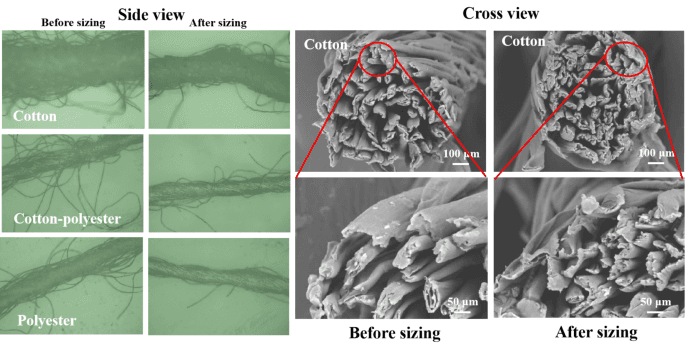
When size coats the yarn surface but does not penetrate the fiber bundle.
Causes:
Incorrect viscosity
Inadequate temperature
Improper wetting of hydrophobic fibers (e.g., polyester)
A well engineered size must balance film formation with penetration-something achieved by the controlled molecular design often used in Alpenol’s formulations.
5. Size Flaking or Powdering
Brittleness in the size film causes it to crack and convert into fine powder.
Triggers:
Excessive drying
Too high solids concentration
Low flexibility of the film
This creates heavy dusting in the loom shed and contaminates machinery.
6. Size Sticking or Tacky Yarn
Over-plasticized or under-dried size can cause ends to stick together.
Consequences:
Reed marks
Cluster breaks
Poor opening during shedding
Sticking is often linked with poor bath temperature control or incorrect balance of softeners.
What Causes Sizing Defects in Textile Manufacturing?
1. Improper Size Viscosity
If viscosity rises or falls during the run, the amount of size absorbed varies accordingly.
High viscosity → over-sizing
Low viscosity → under-sizing
Stable formulations reduce the risk of viscosity fluctuation and enable uniform film build-up.
2. Machine-Related Faults
Sizing defects often result from:
Damaged squeeze rollers
Uneven nip pressure
Air bubbles in the size box
Improper yarn sheet alignment
These faults directly produce uneven pick-up across warp width.
3. Yarn Structural Variations
Different yarn types behave differently during sizing:
Yarn Type | Sizing Risk | Notes |
Ring | Low | Smooth, uniform structure |
OE | High | Hairy, bulky, needs stronger films |
Vortex | Medium | Very low hairiness but requires wetting efficiency |
Viscose | High | High absorbency → risk of over-penetration |
PC Blends | Medium | Hydrophobic polyester needs improved wetting |
Modern sizing agents designed for multi-fiber compatibility (like those used in Alpenol solutions) help reduce these structural risks.
4. Inadequate Mixing or Cooking
Incorrect gelatinization, insufficient stirring, or rapid cooling leads to:
Lumps
Gels
Inconsistent solution quality
These inevitably create pickup-related defects.
5. Faulty Drying Process
If drying cylinders are too hot or too cold:
Over-drying → brittle films
Under-drying → sticky yarn
A stable size film should tolerate slight drying fluctuations without losing adhesion or flexibility - one of the advantages of advanced starch-derivative systems used in modern sizing.
Why Does Uneven Sizing Occur During Finishing?
Uneven sizing detected during finishing (after desizing, bleaching, or dyeing) typically originates from:
Width-wise uneven pickup during sizing
Moisture variation between beams
Non-uniform yarn tension distribution
Variability in fiber absorbency
Alpenol’s single-shot formulation strategy aims to reduce human dependency at the mixing stage, minimizing upstream errors that surface later in finishing.
Yarn Sizing Defects: Pickup
What Is Size Pickup?
Size pickup = (Weight of sized yarn - weight of unsized yarn) / unsized yarn weight × 100
Too high: brittleness
Too low: abrasion breaks
A correctly engineered sizing agent achieves optimal adhesion at minimal add-on %, a key consideration in mills weaving high-density fabrics.
How to Identify and Troubleshoot Sizing Issues
1. Visual Indicators
Glossy yarn → over-sizing
Dull powdery yarn → flaking
Hairy yarn → under-sizing
Streaks → uneven pickup
2. Physical Checks
Consistency tests
Tensile strength sampling
Add-on measurement
Loom performance logs
3. Troubleshooting Actions
Adjust viscosity with controlled dilution
Regulate temperature to 85-90°C
Ensure even roller pressure
Replace worn-out elements in the size box
The right chemistry stabilizes many of these parameters naturally, which is why modern mills prefer predictable formulations like those manufactured by Alpenol.
How Do Sizing Defects Affect Weaving?
Sizing defects directly reduce weaving efficiency by increasing:
Warp breaks
Dusting in loom shed
Reed marks
Bar lines
Fabric unevenness
Every extra loom stoppage increases cost per meter.
A uniform, flexible size film reduces frictional stress on the yarn, enabling mills to run high-speed air-jet or rapier looms with higher efficiency precisely the performance domain Alpenol designs its formulations for.
Conclusion
Sizing defects undermine weaving performance, fabric quality, and mill productivity. However, with controlled viscosity, correct tension management, optimized pick-up, proper drying, and advanced sizing formulations, most defects can be eliminated. Modern chemical engineering - such as the starch-derivative systems used by Alpenol - allows mills to maintain consistent, high-quality sizing at high loom speeds with minimal human error.
FAQs
1. What is the most common sizing defect in modern mills?
Uneven size pickup, typically caused by viscosity instability. Alpenol formulations reduce this by offering naturally stable solutions.
2. Do blended yarns develop more sizing defects?
Yes. PC and PV yarns show variable absorption. Alpenol TTL and Alpenol ALTRA are designed for blended yarn stability.
3. How does size add-on impact weaving performance?
Higher add-on increases stiffness and lowers flexibility. Alpenol DHC variants allow minimal add-on without compromising adhesion.
4. Why is hydroxylated starch important?
This modified starch-central to Alpenol KV DEN, FNR, JV-creates improved molecular bonding, ensuring strong yet flexible films.
5. Can better sizing chemistry completely remove dusting issues?
Not completely, but Alpenol significantly minimizes dust by forming stable, flexible, non-flaking films suitable for high-speed loom loads.
References
Ajgaonkar, D. B. Sizing: Materials, Methods, and Machines. Textile Trade Press.
Lord, P. R., & Mohamed, M. H. Textile Sizing. The Textile Institute.
Journal of Textile Engineering & Fashion Technology (JTEFT) - Various papers on sizing behavior and defects.
Textile Learner - “Sizing in Weaving: Process, Materials and Faults.” https://textilelearner.net
ScienceDirect - Warp sizing research papers on viscosity, penetration, and film mechanics. https://www.sciencedirect.com
Textile School - “Yarn Sizing: Functions, Requirements and Defects.” https://textileschool.com
NCBI - Cellulosic fiber adhesion and starch chemistry studies. https://www.ncbi.nlm.nih.gov
India Textile Journal - Articles on slasher and multibox sizing performance. https://indiantextilejournal.com
Fibre2Fashion Knowledge Center - Technical bulletins on warp sizing defects and troubleshooting. https://www.fibre2fashion.com
Textile Learner - Sizing Defects Causes and Remedies (Pickup/Flaking/Sticking),
https://textilelearner.net/sizing-defects-causes-and-remedies/
Textile Trainer - 10 Faults of Sizing & Effective Remedy (Viscosity/Roller),
https://textiletrainer.com/faults-of-sizing-with-effective-remedy/
Global Polyester - Common Problems in Textile Sizing Guide (Tension/Penetration),
Liked it? Share it with your people.


Disclaimer
The information provided in this blog is intended solely for educational and informational purposes within the textile industry. While the content references technical concepts, sizing and desizing practices, and general chemical information, it does not constitute professional, commercial, or operational advice for any specific textile process or production environment.
Process conditions, chemical selections, and operational parameters may vary significantly across mills, machinery types, fabric constructions, and environmental constraints. Readers should always consult qualified technical professionals, internal laboratory data, and product-specific Technical Data Sheets before making any decisions related to textile processing.
Any references to Alpenol, Sizaltex, or other products are included only for contextual, educational, and illustrative purposes and should not be interpreted as endorsements, recommendations, or guarantees of performance. The authors assume no responsibility for decisions made based on the information contained herein.