What Are Spun Yarns?
Spun yarns are made by aligning, drafting and twisting short fibers (staples) into a cohesive strand. These fibers may be natural (cotton, wool), regenerated (viscose), or synthetic cut into staple lengths (polyester staple, acrylic staple).
Why spun yarn behaves the way it does:
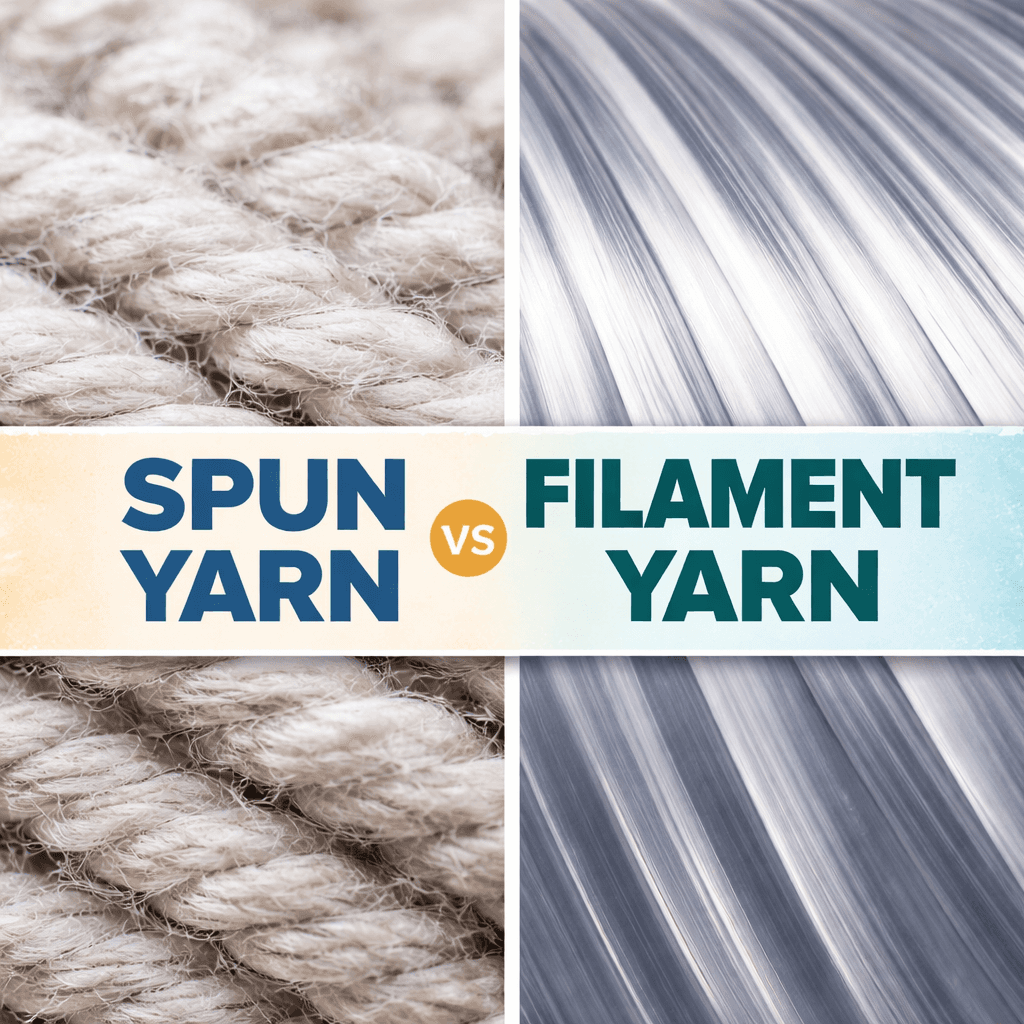
Short fibers protrude → giving a soft, warm, matte appearance
Higher twist required → to bind fibers together
More friction during handling → requires protection (sizing) in weaving
Variable hairiness → affects pilling, dye uptake, fabric hand
Spun yarn’s inherent loft and thermal resistance make it the preferred choice for knits, flannels, sweaters, and high-comfort wear.
What Are Filament Yarns?
Filament yarns consist of continuous fibers, either monofilament or multifilament bundles. Common examples:
Polyester filament
Nylon filament
Silk
Viscose filament
Polypropylene filament
Characteristics of filament yarns:
Smooth surface
High uniformity
Excellent tensile strength
Lustrous appearance
Minimal hairiness
Lower twist needed
Filament yarns are ideal for applications requiring strength, sheen, and abrasion resistance - such as lingerie, performance wear, linings, upholstery, and technical textiles.
Manufacturing Process for Spun Yarns
1. Fiber Opening and Cleaning
Raw fibers are opened, cleaned, and blended for uniformity.
2. Carding
Fibers are individualized and made parallel into a sliver.
3. Drawing
Multiple slivers are blended and drafted to improve uniformity.
4. Roving / Speed Frame
Twist is inserted lightly to form a roving strand.
5. Ring, Compact, Rotor, or Vortex Spinning
The final twist is inserted, producing the yarn with the desired count, strength, and hairiness.
Key Point
The short-fiber structure makes spun yarn more prone to abrasion.
This is why spun warp yarns require sizing before weaving, where Alpenol’s film-forming chemistry plays a vital role in improving performance at high loom speeds.
Manufacturing Process for Filament Yarns
1. Polymer Preparation
Raw materials are melted or dissolved.
2. Extrusion Through Spinneret
Liquid polymer is forced through microscopic holes.
3. Filament Solidification
Air-cooled (melt spinning) or solvent-evaporated (dry spinning) or coagulated (wet spinning).
4. Drawing (Orientation)
Filaments are stretched to increase strength and reduce diameter.
5. Texturizing (optional)
Crimping or bulking improves elasticity and hand feel.
Key Difference
Filament yarns are born continuous and smooth; as a result, they generally need little or no sizing during weaving - except for fine deniers or high-speed technical applications.
What Is the Difference Between Spun and Filament Yarns?
Property | Spun Yarn | Filament Yarn |
Structure | Short fibers twisted | Continuous fibers |
Surface | Hairy, fuzzy | Smooth, lustrous |
Strength | Moderate | High |
Stretch | Twist-dependent | Structure-dependent |
Warmth | High | Low |
Drapability | Soft | Fluid or crisp |
Abrasion Resistance | Lower | Higher |
Sizing Need for Weaving | Essential | Minimal |
Dyeing Behavior | Deeper, softer shades | More uniform but may require carriers (polyester) |
How Is the Weaving of Spun Yarn Different from Filament Yarn?
Spun Yarns in Weaving:
Spun yarns tend to:
Shed fibers
Produce hairiness
Suffer abrasion at healds and reeds
Break more often under tension
Why sizing is critical:
Warp yarns made from spun fibers must be coated with a protective film.
Quality size - such as Alpenol’s formulations - reduces:
Hairiness
Abrasion breakages
Dusting
End breaks
Loom stoppages
This difference explains why spun yarn weaving is more preparation-intensive but yields warmer, comfortable fabrics.
Filament Yarns in Weaving:
Filaments glide smoothly through the loom due to:
No protruding fibers
High tensile strength
Low friction
Many polyester and nylon filaments are woven without sizing, though high-speed air-jet looms or fine deniers may still benefit from a light size application.
Spun Yarn vs Filament Yarn: Pros and Cons for Apparel
Spun Yarn Pros
Soft and comfortable
Warm
Natural feel
Good moisture absorption (cotton, viscose)
Spun Yarn Cons
Lower strength
More pilling
Requires sizing for weaving
Less abrasion-resistant
Filament Yarn Pros
High strength
Smooth, lustrous appearance
Excellent for fluid drape
High abrasion resistance
Filament Yarn Cons
Can feel synthetic
Lower warmth
Poor moisture absorption (polyester, nylon)
What Fibers Are Used for Spun and Filament Yarns?
Spun Fiber Sources
Cotton
Wool
Flax
Viscose staple
Polyester staple
Acrylic
Modal & Tencel (staple form)
Filament Fiber Sources
Silk
Polyester filament
Nylon filament
Polypropylene
Rayon viscose filament
High-performance fibers (Kevlar, carbon, glass)
Which Is Better for Knitwear vs Woven Fabric?
For Knitwear → Spun Yarn Wins
Because:
Spun yarns have bulk and softness
Better elasticity
Warmth and comfort
For Wovens → Filament or Spun Depending on Purpose
Shirting & suiting → fine spun cotton or blends
Linings & drapey dresses → polyester filaments
High-speed weaving → requires strong warp sizing for spun yarns (Alpenol plays a role here)
How Do Yarn Count, Twist & Fiber Length Change Yarn Properties?
1. Yarn Count
Fine counts → smoother, stronger, higher-quality yarn
Coarse counts → bulkier, rougher, cheaper
2. Twist
Higher twist → strength ↑, softness ↓
Lower twist → softness ↑, strength ↓
3. Staple Length (for spun)
Longer fibers → better strength, fewer neps, less hairiness
Shorter fibers → more defects, higher twist required
Filaments
Depend more on:
Denier
Filament count (monofilament vs multifilament)
Texturizing method
How Can I Tell if a Yarn or Fabric Contains Spun or Filament Yarns?
Visual Test
Spun → fuzzy, matte
Filament → shiny, smooth
Hand Test
Spun → warm, soft, slightly rough
Filament → cool, silky, smooth
Magnification
Spun → visible tiny fiber ends
Filament → continuous strands without breaks
Which Yarn Takes Dye More Evenly - Spun Cotton or Filament Polyester?
Spun Cotton
Hydrophilic
Absorbs dyes readily
Excellent shade depth
High color warmth
Filament Polyester
Hydrophobic
Requires disperse dyes
More uniform, flatter shades
High lightfastness but less depth
This difference makes spun cotton preferred for vibrant, natural-looking colors, while polyester excels in color uniformity and durability.
Durability and Strength Comparison: Spun vs Filament Yarn
Spun Yarn
Moderate tensile strength
Strength decreases with higher hairiness
Dependent on fiber length & twist
Filament Yarn
Very high tensile strength
Excellent abrasion resistance
Stable under high-speed weaving
Filament yarns are the backbone of technical textiles, while spun yarns dominate comfort-oriented apparel.
Why Choose Spun Yarn for Comfort and Warmth?
Spun yarn traps air between fibers due to its fuzzy structure.
This:
Improves insulation
Enhances softness
Increases moisture absorption
This explains why T-shirts, sweaters, thermal wear, and towels rely heavily on spun structures.
FAQs
1. What is the main difference between spun and filament yarns?
Spun yarns are made from short staple fibers, while filament yarns are continuous strands.
2. Which yarn is better for weaving?
Filaments weave more easily, but spun yarns create more comfortable fabrics. Spun warps generally require sizing-where Alpenol supports high efficiency.
3. Why do spun yarns need sizing?
Short fibers protrude and create abrasion. Sizing protects spun warps during weaving.
4. Which yarn type is stronger?
Filament yarns are significantly stronger than spun yarns.
5. What yarn type is best for knitwear?
Spun yarns due to softness, warmth, and elasticity.
References
Wikipedia – Yarn (Spun and Filament Yarn Definitions, Structure, Properties), https://en.wikipedia.org/wiki/Yarn
Wikipedia – Spinning (Textiles): Fiber-to-Yarn Conversion (Staple Fiber Spinning), https://en.wikipedia.org/wiki/Spinning_(textiles)
Wikipedia – Spinning (Polymers): Melt/Wet/Dry Spinning for Filament Production, https://en.wikipedia.org/wiki/Spinning_(polymers)
Wikipedia – Ring Spinning (Spun Yarn Manufacturing), https://en.wikipedia.org/wiki/Ring_spinning
Wikipedia – Rotor Spinning (Open-End Spun Yarn System), https://en.wikipedia.org/wiki/Rotor_spinning
Wikipedia – Synthetic Fiber (Filament Extrusion via Spinneret), https://en.wikipedia.org/wiki/Synthetic_fiber
Damodar Menon – Difference Between Spun and Filament Yarn (Properties, Applications, Manufacturing), https://damodarmenon.com/difference-between-spun-and-filament-yarn/
ICE Yarns – Spun vs Filament Yarns (Surface, Strength, Luster, End Uses), https://www.iceyarns.com/blogs/news/spun-vs-filament-yarns
Sage Zander – Ultimate Guide: Monofilament, Multifilament and Spun Yarns (Hairiness, Tensile Strength, Luster), https://sagezander.com/monofilament-multifilament-spun-yarns/
KNIT Magazine (Maruyasu) – The Story of Spun Yarn and Filament Yarn (Fiber Length, Gloss, Strength), https://www.maruyasu-fil.com/knit-magazine/2120
Yarns and Fibers – What Is Melt Spinning? (Filament Extrusion: Polyester, Nylon, Polypropylene), https://www.yarnsandfibers.com/textile-resources/textiles/fundamental-processes-in-textile-manufacturing/spinning/what-is-melt-spinning/
PMC – Melt-Spun Fibers for Textile Applications (Spinneret, Extrusion, Filament Formation), https://pmc.ncbi.nlm.nih.gov/articles/PMC7579636/
CottonWorks – Yarn Spinning: Ring, Rotor and Air-Jet Systems (Spun Yarn Manufacturing), https://cottonworks.com/learning-hub/yarn-manufacturing/yarn-spinning/
Cotton.org – Size Lubrication Methods for Air-Jet-Spun and Ring-Spun Warp Yarns (Spun Yarn Sizing Comparison), https://www.cotton.org/journal/2000-04/2/upload/jcs04-112.pdf
Coek.info – Yarn Preparation for Weaving: Sizing (Sizing Spun Cotton vs Filament, Hairiness and Warp Breakage), https://c.coek.info/pdf-yarn-preparation-for-weaving-sizing-.html
Textile Learner – Yarn Sizing: Important Warp Preparatory Process (Why Spun Warps Need Sizing), https://textilelearner.net/yarn-sizing-important-warp-preparatory-process/
Textile Learner – Cotton Yarn Spinning Process Step by Step (Blowroom to Ring Frame), https://textilelearner.net/cotton-yarn-spinning-process/
Textile Learner – Compact Spinning System (Reduced Hairiness, Improved Strength for Spun Yarns), https://textilelearner.net/compact-spinning-system/
Textile Learner – Sizing Defects Causes and Remedies (Why Spun Warps Break Without Proper Sizing), https://textilelearner.net/sizing-defects-causes-and-remedies/
Textile Trainer – Sizing in Weaving: Objectives (Film Formation on Spun vs Filament), https://textiletrainer.com/sizing-in-weaving-easy-objectives-of-sizing/
TextileListing – Sizing Operation in Textiles: Principles, Processes and Industrial Practice, https://textilelisting.com/sizing-operation-in-textiles-principles-processes-materials-and-industrial-practice/
JEMIT PDF – Sizing Efficiency and Cost Reduction Strategies (Spun Yarn Sizing Performance), https://jemit.aspur.rs/archive/v3/n1/3.pdf
PMC – Performance Evaluation of Cotton Warp Sizing (Spun Yarn Strength/Abrasion Metrics), https://pmc.ncbi.nlm.nih.gov/articles/PMC12845530/
Sewport – Cotton Fabric Guide (Spun Fiber Comfort and Breathability), https://sewport.com/fabrics-directory/cotton-fabric
Sewport – Polyester Fabric Guide (Filament Yarn Properties and Manufacturing), https://sewport.com/fabrics-directory/polyester-fabric
Sewport – Silk Fabric Guide (Natural Continuous Filament Fiber), https://sewport.com/fabrics-directory/silk-fabric
Sewport – Nylon Fabric Guide (Synthetic Filament Yarn Properties and Applications), https://sewport.com/fabrics-directory/nylon-fabric
Good On You – Material Guide: Tencel and Modal (Spun Staple Regenerated Fibers), https://goodonyou.eco/material-guide-tencel/
Liked it? Share it with your people.


Disclaimer
The information provided in this blog is intended solely for educational and informational purposes within the textile industry. While the content references technical concepts, sizing and desizing practices, and general chemical information, it does not constitute professional, commercial, or operational advice for any specific textile process or production environment.
Process conditions, chemical selections, and operational parameters may vary significantly across mills, machinery types, fabric constructions, and environmental constraints. Readers should always consult qualified technical professionals, internal laboratory data, and product-specific Technical Data Sheets before making any decisions related to textile processing.
Any references to Alpenol, Sizaltex, or other products are included only for contextual, educational, and illustrative purposes and should not be interpreted as endorsements, recommendations, or guarantees of performance. The authors assume no responsibility for decisions made based on the information contained herein.