Which Countries Have the Largest Textile Markets in the World by Market Value?
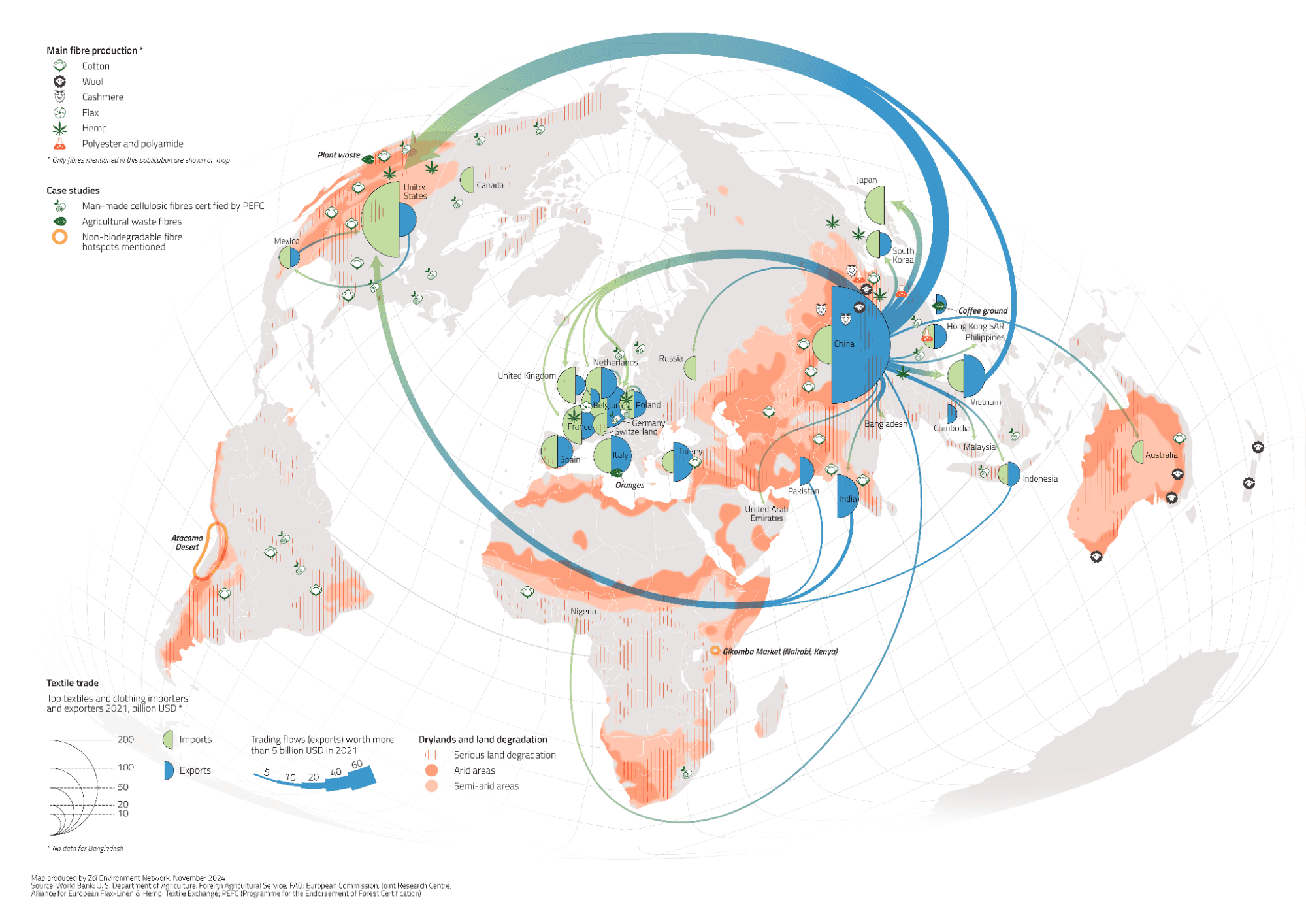
The largest textile markets blend domestic consumption, manufacturing capacity, and export strength:
Rank* | Country* | Key Strength* | Export Value (Est. 2023/24)* |
1 | China | Complete supply chain, automation, scale | $303 Billion |
2 | Bangladesh | Low-cost apparel (RMG), export-focused | $57.7 Billion |
3 | Vietnam | Free trade agreements, high-tech finishing | $48.8 Billion |
4 | India | Raw material abundance (Cotton/Silk), domestic market | $41.4 Billion |
5 | Turkey | Fast fashion proximity to EU, high quality | $35.7 Billion |
6 | Italy | Luxury textiles, design leadership | $35.4 Billion |
Large textile markets for woven fabrics benefit heavily from efficient sizing and weaving performance, where solutions like Alpenol’s single-shot and compound sizing materials support high-speed loom production, an essential requirement in these markets.
*We have gotten this data from sites like royaleuropetextile and tradeimex
Which Cities & Regions Serve as the World's Major Textile Hubs?
The textile ecosystem is shaped by regional clusters that specialize in speed, scale, or niche products:
Dhaka, Bangladesh: Global center for apparel sourcing, knitwear, and mass-scale garment stitching.
Guangzhou & Zhejiang, China: Wholesale marketplaces, synthetic fabrics, apparel trims, high-volume manufacturing.
Istanbul, Bursa & Denizli, Turkey: Fast-fashion supply for Europe, premium knits, towels, technical textiles.
Prato, Italy: Luxury wool & circular textile economy.
Tiruppur & Surat, India: Knitwear (Tiruppur), synthetic fabrics (Surat).
Ho Chi Minh City & Hanoi, Vietnam: FDI-driven apparel manufacturing clusters.
What Factors Make a Country a Leading Textile Market?
A textile market becomes globally competitive when it excels in four foundational pillars:
1. Raw Material Advantage
Cotton (India, USA, Turkey), synthetics (China), and regenerated fibres (Indonesia, China) drive integrated supply chains.
2. Labor Competitiveness & Skill
Bangladesh, Vietnam, India, and Pakistan remain strong due to cost and scale.
Technical segments (EU, Japan, South Korea) benefit from a skilled workforce.
3. Infrastructure & Technology
A country's textile strength increasingly depends on the quality, scale and modernization of its infrastructure and technology. These factors determine production speed, consistency, sustainability, and cost efficiency across the entire value chain.
Key Components of World-Class Textile Infrastructure
Integrated Manufacturing Clusters
Regions with spinning, weaving, processing and garmenting facilities in close proximity reduce transport time and logistics cost.Efficient Power & Utilities
Access to stable electricity, steam, compressed air and water treatment systems significantly impacts loom uptime and process consistency.Modern Logistics & Connectivity
Efficient ports, road networks and export zones accelerate shipment cycles-critical for fast fashion and just-in-time supply chains.Specialized Industrial Parks
Textile parks equipped with effluent treatment plants (ETPs), warehousing and common processing facilities support sustainability and cost control.
4. Trade Agreements & Policy
Bangladesh’s duty-free access to the EU
Vietnam’s FTAs with Europe
Mexico’s proximity to the U.S. under USMCA
Government incentives determine investment attractiveness.
How Do China, India & Bangladesh Compare in Production, Exports & Domestic Consumption?
China
Production: #1 globally-cotton, polyester, synthetics, technical textiles
Exports: Over 30% of global textile/apparel exports
Domestic Market: Largest on earth, fueled by e-commerce
India
Production: Huge cotton & home textile capacity
Exports: Strong in yarn, cotton fabrics, home textiles
Domestic Market: Rapidly growing middle class
Bangladesh
Production: Largest garment-making hub for brands
Exports: 80% of its industry revenue
Domestic Market: Smaller, but rising
Which Segments Are the Largest Within the Global Textile Market?
Application Segment | Global Market Share | Growth Rate (CAGR 2025-2030) |
Fashion & Apparel | 55-58% | 4.2-4.8% |
Home & Furnishing Textiles | 11-13% | 5.6-6.8% |
Industrial & Technical Textiles | 11-13% | 5.8-6.5% |
Medical & Healthcare Textiles | 2.5-3% | 6.8-7.5% |
Other Segments | 2-3% | 3.5-4.5% |
Which Textile Markets Will Grow Fastest in the Next 5-10 Years?
The highest forecasted growth rates include:
Vietnam: Strong FDI, modern factories, and FTAs.
Bangladesh: Continued dominance in apparel.
Indonesia: Rising viscose export base.
Ethiopia & East Africa: Long-term low-cost potential.
Technical Textiles Worldwide: CAGR 5-7%, influenced by automotive, medical and protective sectors.
What Are the Top 20 Textile Markets in the World Today?
China
India
Bangladesh
Vietnam
Turkey
Indonesia
Egypt
European Union
United States
Pakistan
Mexico
Japan
South Korea
Brazil
Thailand
Taiwan
Malaysia
Ethiopia
Cambodia
Sri Lanka
Each of these regions supports different textile value chains-from low-cost spinning to high-performance weaving-areas where efficient warp sizing remains essential.
Which Global Wholesale Marketplaces & Trade Fairs Are Most Important?
Major Wholesale Textile Markets
Guangzhou Fabric Market (China)
Shaoxing Keqiao Market (China)
Istanbul Merter & Laleli Markets (Turkey)
Surat Ring Road Market (India)
Leading Textile Trade Fairs
Heimtextil (Germany) - Home textiles & sustainability
ITMA (Global) - Largest textile machinery & innovation show
Intertextile Shanghai Apparel Fabrics - Global sourcing center
Techtextil (Germany) - Technical textiles & nonwovens
IndiaTex / Bharat Tex (India) - Manufacturing & export platform
Which Markets Are Most Attractive to Foreign Investors?
Vietnam: Stable FTAs, ease of doing business
Bangladesh: Scale & cost advantage
Turkey: Near-shoring demand from EU
India: Massive domestic market + export incentives
Ethiopia: Long-term frontier market potential
Foreign investors prioritize:
Vertical integration
High-speed weaving infrastructure
Certified sustainable chemistry (ZDHC, GOTS, Eco Passport)
FAQ Section
1. What is the largest textile market in the world today?
China remains the world’s largest textile market by both production and consumption.
2. Which region is the fastest-growing textile manufacturing hub?
Vietnam and Bangladesh are expanding fastest due to foreign investment and trade-friendly policies.
3. Why do weaving markets care about advanced sizing materials?
High-speed looms demand strong adhesion, low hairiness, and flexible films-qualities provided by modern single-shot sizing materials like Alpenol’s.
4. Which textile segment is growing quickest?
Technical textiles, driven by medical, automotive, defense and filtration applications.
5. What makes a country competitive in global textiles?
Raw materials, skilled labor, modern machinery, sustainable practices and cost-efficient weaving operations.
References
RoyaleuropeTextile: Top 10 Textile Countries FY2024 (China $265B, Bangladesh),
WorldPopulationReview: Textile Exports by Country 2026 (China $303B, Vietnam $48.8B),
https://worldpopulationreview.com/country-rankings/textile-exports-by-country
Fibre2Fashion: Top 10 Textile Exporters (Italy, Germany, Turkey),
DevelopmentAid: Top 5 Textile Exporters (Asia-Pacific Dominance),
IndianExpress: Top 10 Exporters (India, China, Bangladesh Competition),
...
UKBanglaSourcing: Top 10 2025 (China $303B, Bangladesh RMG),
https://ukbanglasourcing.com/top-10-textile-and-apparel-exporting-countries-in-2025/
NiveshMitra UP: Global Textile Trade Exports (China 39% Share),
https://niveshmitra.up.nic.in/Textiles.aspx
Wikipedia: Countries by Textile Exports (Rankings Data),
https://en.wikipedia.org/wiki/List_of_countries_by_textile_exports
Fadfay: China Textile Hubs (Guangzhou, Shaoxing),
MetroPlastic: World's Textile Capitals (Guangzhou, Tiruppur, Dhaka),
https://metroplastic.in/world-s-textile-capital-the-city-driving-global-fabric-production
SourcifyChina: China Textile Lanes (Shaoxing Keqiao Largest),
https://www.sourcifychina.com/textile-lanes-guide-in-depth/
CapitalWorldGroup: Top Clothing Manufacturers 2025 (Vietnam FDI),
https://capitalworldgroup.com/clothing-manufacturing-countries/
EcoZymat: China's Top 6 Textile Cities (Nantong Home Textiles),
Yahoo Finance: 15 Largest Exporters (Pakistan, Mexico),
https://finance.yahoo.com/news/15-largest-textile-exporting-countries-123225641.html
LinkedIn Shokhrukh: Uzbekistan/China/India/Bangladesh Comparison,
TradeImex: Biggest Exporters (India $41.4B),
Liked it? Share it with your people.


Disclaimer
The information provided in this blog is intended solely for educational and informational purposes within the textile industry. While the content references technical concepts, sizing and desizing practices, and general chemical information, it does not constitute professional, commercial, or operational advice for any specific textile process or production environment.
Process conditions, chemical selections, and operational parameters may vary significantly across mills, machinery types, fabric constructions, and environmental constraints. Readers should always consult qualified technical professionals, internal laboratory data, and product-specific Technical Data Sheets before making any decisions related to textile processing.
Any references to Alpenol, Sizaltex, or other products are included only for contextual, educational, and illustrative purposes and should not be interpreted as endorsements, recommendations, or guarantees of performance. The authors assume no responsibility for decisions made based on the information contained herein.