What Is a Binder in Textile Sizing?
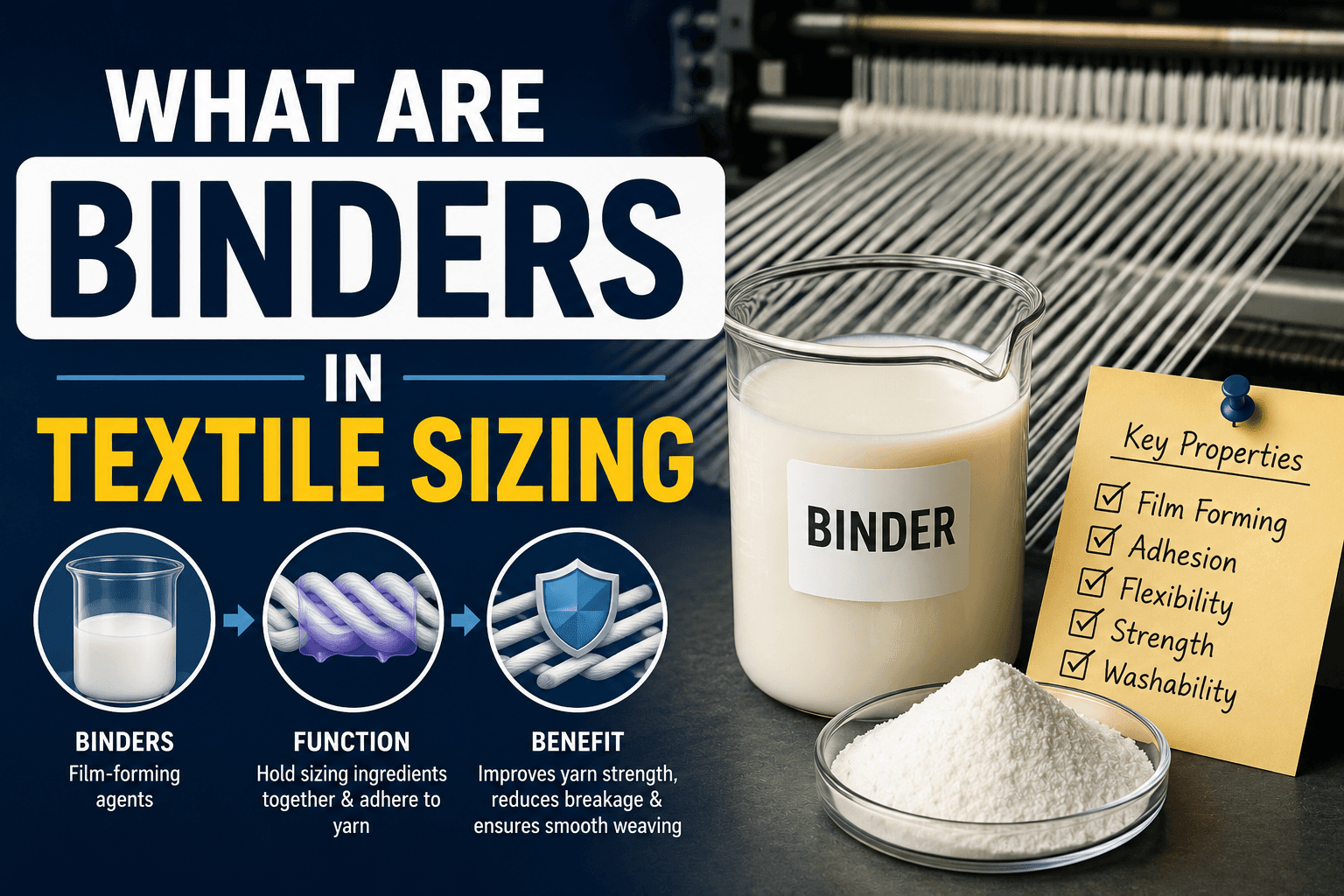
A binder is a chemical component in a size formulation that helps create a strong, continuous film over warp yarns during weaving preparation.
It functions like a “glue”-ensuring the size sticks to the yarn surface and holds the fibers together under tension.
How binders work:
Form a film around warp yarns
Improve adhesion between fibers
Increase abrasion resistance during weaving
Reduce hairiness and friction
Support higher loom speeds
However, these benefits come with chemical, economic, and environmental trade-offs-which is why the industry increasingly seeks binder-free solutions.
Why Are Binders Used in Warp Sizing Formulations?
Binders are used to compensate for limitations in basic starch-based sizing systems.
Key functions of binders:
Strengthen size films that would otherwise crack or flake
Improve cohesion of short or weak fibers
Enhance wetting and penetration into yarn bundles
Reduce warp breakage on high-speed airjet and rapier looms
Improve loom shed efficiency and reduce downtime
Where binders matter most:
Fine-count yarns
High-density weave structures
Modern high-speed looms
Low-strength, regenerated fibers like viscose
Mixed fiber blends requiring strong adhesion
Yet advances like Alpenol’s hydroxylated starch chemistry achieve these effects without adding binders-simplifying processes and reducing costs.
What Are the Common Types of Binders Used in Yarn Sizing?
1. PVA (Polyvinyl Alcohol)
Most widely used synthetic binder
Excellent adhesion and film strength
Very difficult to biodegrade
Expensive and increases effluent load
2. Acrylic Binders
Provide high flexibility
Good cohesion on polyester & blends
Higher cost and petrochemical origin
3. Modified Starch Binders
Partially biodegradable
Lower adhesion than PVA
Often used in combination with synthetics
4. Natural Binders (Limited Use)
Gum arabic, plant gums
Too weak for modern weaving needs
All of these binders must be blended with the main sizing agent, increasing formulation complexity, cost, storage needs, and error risk.
Synthetic vs. Natural Binders: How Do They Compare?
Property | Synthetic Binders (PVA/Acrylic) | Natural/Starch Binders | Alpenol (Binder-Free) |
Adhesion | High | Moderate | High |
Biodegradability | Poor | Excellent | Excellent |
Cost | High | Low | Moderate |
Effluent Impact | High | Low | Low |
Loom Speed Support | Excellent | Moderate | Excellent |
Ease of Desizing | Difficult | Easy | Very easy |
Formulation Complexity | High | Medium | One-shot, no binder required |
This table clearly shows how Alpenol eliminates multiple limitations through integrated film-forming chemistry.
What Are the Environmental Impacts of Binders in Sizing?
Binders-especially PVA and acrylics-are major contributors to pollution in textile wet processing.
Environmental disadvantages of traditional binders:
Poor biodegradability (especially PVA)
Higher Chemical Oxygen Demand (COD) in effluent
More complex and costly wastewater treatment
Petroleum-derived raw materials
Harmful sludge generation
How Alpenol Solves This
Alpenol’s 100% binder-free formulations eliminate these issues by using eco-engineered hydroxylated starch molecules that naturally adhere to fibers without secondary adhesive agents.
Can the Use of a Binder Be Eliminated Entirely?
Yes-if the sizing agent itself contains built-in adhesion chemistry.
Traditional recipes add binders because their base size lacks sufficient:
Film strength
Flexibility
Adhesion
Cohesion under tension
Alpenol removes the need for binders because:
Its hydroxylated starch molecules contain extra OH groups that increase bonding with fibers
It forms a flexible, uniform film without cracking
It has high wet pick-up and penetration
It provides both adhesion AND lubrication
It eliminates the risk of over-sizing caused by binder overload
This is why mills using Alpenol achieve:
Lower size pick-up
Lower inventory cost
Easier desizing
Lower dead-loss
High loom efficiency
How Do Binders Improve Yarn Strength in Sizing?
Binders increase yarn strength by:
Penetrating fiber bundles and reducing slippage
Forming a continuous film that holds protruding fibers
Increasing abrasion resistance
Reducing hairiness
Helping yarn withstand loom friction at high RPM
But the issue:
Excess binder can make yarns:
Too stiff
Hard to bend
Prone to cracking
Difficult to desize
Susceptible to color patchiness in processing
How Alpenol avoids this problem:
Alpenol creates flexible adhesion, not rigid adhesion-giving:
Strength without stiffness
Protection without brittleness
High-speed weaving performance without overloading yarn diameter
Are There Biodegradable or Bio-Based Binder Alternatives?
Yes-bio-based binders such as modified starches, plant polymers, and biopolymers exist.
However, compared to synthetic binders they often suffer from:
Lower strength
Lower flexibility
Limited suitability for high-speed looms
Alpenol’s approach:
Instead of adding a binder, Alpenol reinvents the sizing agent itself using bio-modified starch technology that is:
Fully biodegradable
High in adhesion strength
Exceptional in weaving performance
Ideal for both natural and synthetic yarns
Future-proof for ZDHC, GOTS, and OEKO-TEX compliance
Why Alpenol Is the Future of Binder-Free Textile Sizing
Alpenol’s technology replaces the traditional two-chemical approach (size + binder) with one single-shot product that:
Strengthens warp yarns
Acts as its own binder
Reduces chemical inventory
Eliminates PVA and acrylic pollution
Improves loom efficiency
Reduces environmental load
Simplifies process control
Cuts overall cost
Supports high-speed weaving of fine, dense fabrics
For mills seeking sustainability + performance, Alpenol is the most advanced binder-free solution in the textile sizing landscape.
FAQs
1. What is a binder in textile sizing?
A binder is an adhesive additive used to strengthen the size film on warp yarns and improve adhesion during weaving.
2. Why do mills use binders?
To increase film strength, adhesion, flexibility, and abrasion resistance-especially for high-speed looms or weak fibers.
3. Can binder use be eliminated?
Yes. Alpenol’s single-shot sizing technology integrates adhesion directly into the size, removing the need for any binder.
4. Are traditional binders bad for the environment?
Synthetic binders like PVA are poorly biodegradable and increase effluent load and wastewater treatment costs.
5. What is the best binder-free sizing solution today?
Alpenol, due to its eco-friendly, high-adhesion, high-performance technology that replaces binders entirely.
Reference and Backlinks
ZDHC Wastewater Guidelines (Binder Effluent COD/BOD),
https://downloads.roadmaptozero.com/output/ZDHC-Wastewater-Guidelines
ZDHC Wastewater V1.1 (PVA/Acrylic Treatment),
https://wastewater.sustainabilityconsortium.org/downloads/zdhc-wastewater-guidelines-verson-1-1/
Textile Wastewater Standards (Sizing Binder Load),
GOTS Implementation Manual (Binder-Free Sizing),
https://global-standard.org/images/Implementation_Manual_7.0_Second_Revision_Draft.pdf
GOTS Official Site (Sustainable Adhesives),
OEKO-TEX Standards (Sizing Chemical Compliance),
https://www.oeko-tex.com/en/our-standards/
OEKO-TEX STeP (Process Adhesion),
https://www.oeko-tex.com/en/our-standards/oeko-tex-step/
PMC: Modified Starch as Binder Alternative,
https://pmc.ncbi.nlm.nih.gov/articles/PMC6572457/
PMC: Starch Compounds (No External Binders),
https://pmc.ncbi.nlm.nih.gov/articles/PMC10820382/
PMC: Corn Starch Adhesion Properties,
https://pmc.ncbi.nlm.nih.gov/articles/PMC7361798/
ACS ES&T: PVA Binder Biodegradation Issues,
https://pubs.acs.org/doi/10.1021/es504988w
PubMed: Biodegradable Sizing Films (Binder Role),
https://pubmed.ncbi.nlm.nih.gov/25687520/
ScienceDirect: Pollution from Sizing Binders,
https://www.sciencedirect.com/science/article/abs/pii/S0959652613006598
Persistence: Sizing Chemicals Market (Binder Trends),
https://www.persistencemarketresearch.com/market-research/textile-sizing-chemicals-market.asp
MarketsandMarkets: Binders & Adhesives in Textiles,
https://www.marketsandmarkets.com/Market-Reports/textile-chemical-market-12380328.html
Mordor Intelligence: Eco-Binders Analysis,
https://www.mordorintelligence.com/industry-reports/textile-chemicals-market
Fibre2Fashion: Size Identification (PVA/Starch Binders),
https://www.fibre2fashion.com/industry-article/3703/identification-of-type-of-size-in-woven-fabrics
NPTEL Archive: Sizing Formulation (Binders Explained),
https://archive.nptel.ac.in/content/storage2/courses/116102016/m-10/desizing.htm
TextileSchool: Warp Sizing Binders (Types/Functions),
https://www.textileschool.com/206/basic-weaving-operations/
TextileLearner: Binder Role in Adhesion,
https://textilelearner.net/different-parts-of-loom-and-their-functions/
TextileChemistry Blog: Binder Testing in Size Mix,
https://drmsparmar.blogspot.com/2014/12/how-to-test-desized-material-starch.html
Slideshare: Sizing Chemistry Presentations (PVA vs Starch),
https://www.slideshare.net/slideshow/desizing-34238292/34238292
PMC: Eco-Enzymatic Desizing (Binder Residues),
https://pmc.ncbi.nlm.nih.gov/articles/PMC10368615/
Heuritech: 2026 Binder Innovations,
https://heuritech.com/articles/fashion-fabric-innovations/
Textile Excellence: Compound Sizing (Binder Reduction),
Liked it? Share it with your people.


Disclaimer
The information provided in this blog is intended solely for educational and informational purposes within the textile industry. While the content references technical concepts, sizing and desizing practices, and general chemical information, it does not constitute professional, commercial, or operational advice for any specific textile process or production environment.
Process conditions, chemical selections, and operational parameters may vary significantly across mills, machinery types, fabric constructions, and environmental constraints. Readers should always consult qualified technical professionals, internal laboratory data, and product-specific Technical Data Sheets before making any decisions related to textile processing.
Any references to Alpenol, Sizaltex, or other products are included only for contextual, educational, and illustrative purposes and should not be interpreted as endorsements, recommendations, or guarantees of performance. The authors assume no responsibility for decisions made based on the information contained herein.