
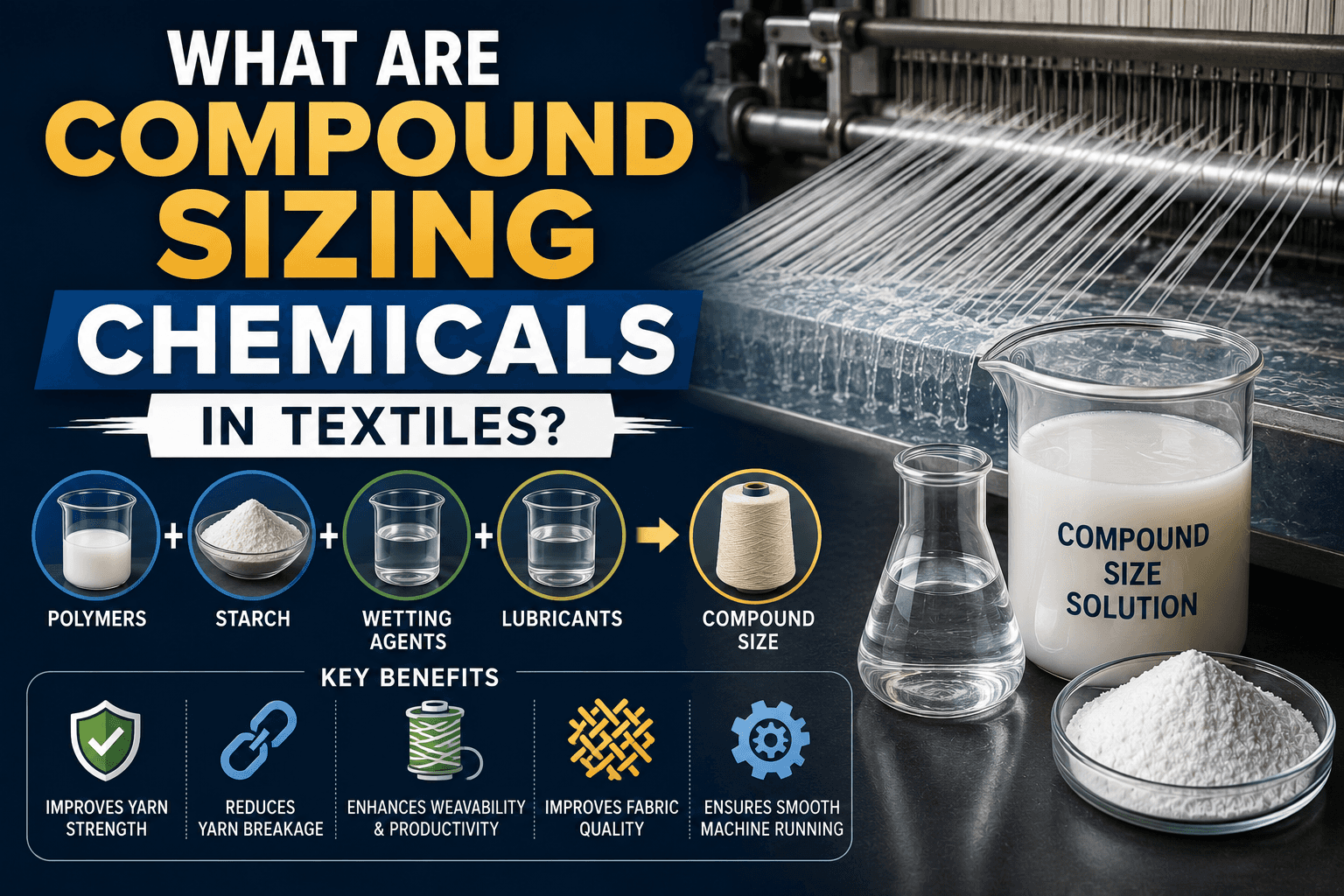
What Are Sizing Chemicals in Textiles?
Sizing chemicals strengthen warp yarns before weaving by forming a protective film to withstand:
High warp tension
Abrasion from heddles and reeds
Friction at high-speed looms
Fiber-to-fiber movement
Traditional size mixes include starch, binders, lubricants, waxes, antistatic agents and softeners-often requiring multiple ingredients, accurate dosing and long cooking cycles.
Compound sizing eliminates this complexity entirely.
To learn more about sizing chemicals, click here.
What Are Compound Sizing Chemicals and How Do They Work?
Compound sizing chemicals are ready-to-use, single-component sizing agents engineered to perform all critical sizing functions without additional additives.
How they work:
Form strong, flexible films on warp yarns
Provide adhesion, cohesion and lubrication simultaneously
Penetrate fibers to reduce hairiness
Enable high-speed weaving with reduced size add-on
Offer controlled viscosity and pick-up with minimal variation
Simplify the cooking process-only one component to handle
What makes Alpenol unique?
Alpenol’s Compound Sizing formulations integrate binder function directly into the size, thanks to modified starch chemistry. This means:
No PVA
No acrylics
No secondary binders
No waxes or softeners required
Lower dead-loss and cleaner effluent
This is the modern definition of warp efficiency.
Why Choose Compound Sizing Instead of Traditional Multi-Step Sizing?
Traditional sizing challenges:
Requires multiple raw materials
High inventory cost
More human error in formulation
Complicated cooking parameters
Higher effluent pollution due to synthetic binders
Inconsistent adhesion across fiber blends
Longer prep time
Advantages of Compound sizing:
Single product, zero mixing complexity
Better reproducibility from batch to batch
Lower size pick-up on yarns
Improved loom efficiency and fewer warp breaks
Reduced wastewater load
Faster setup and shorter cooking cycles
Alpenol’s Compound Sizing products further add value by providing high-speed loom compatibility and uniform film strength even for critical fabrics like fine cottons, PC blends and viscose.
Compound Sizing vs. : How Do They Differ?Conventional Sizing
Feature | Conventional Sizing | Compound Sizing |
Ingredients | Starch + binder + softener + wax + emulsifier | One single all-in-one product |
Process complexity | High | Low |
Cost | Higher due to multiple chemicals | Lower total cost |
Environmental impact | High (especially with PVA) | Very low |
Desizing | Difficult for synthetics | Easy |
Film strength | Depends on binder quality | Integrated strong film |
Loom performance | Moderate | Excellent at high speeds |
Compound solutions are engineered for today’s weaving: fast, clean, consistent, sustainable.
What Are the Environmental, Health & Safety Concerns with Compound Sizing?
Older Compound Sizing formulas (especially petrochemical-based) sometimes contained:
High VOC content
Non-biodegradable polymers
Harmful wetting agents
Toxic preservatives
The modern alternative: Alpenol
Alpenol’s Compound Sizing products use bio-based, biodegradable, ZDHC-aligned chemistry with:
No PVA
No acrylic binders
No restricted chemicals
Low cooking temperatures
Lower effluent load
This makes Alpenol one of the cleanest sizing systems for mills pursuing GOTS, OEKO-TEX or ZDHC certification.
How Do Compound Sizing Chemicals Affect Finishing?
A good Compound sizing must desize quickly and completely, leaving no residue.
Positive downstream effects:
Cleaner desizing
Lower chemical consumption in pretreatment
Alpenol’s film dissolves easily during desizing, ensuring fewer defects and higher first-quality output.
Synthetic Polymer-Based vs. Starch/Natural-Based Compound Sizing Solutions
Synthetic polymer-based Compound Sizing (older generations):
Excellent adhesion
Poor biodegradability
Expensive
Hard to desize
Starch or natural-based Compound Sizing (modern systems):
Biodegradable
Lower cost
Softer hand and flexible film
Easy desizing
Alpenol’s technology stands out because:
It uses modified starch with built-in binder properties-offering performance of synthetics without environmental drawbacks.
What Are the Benefits and Advantages of Using Compound Sizing Agents?
Reduced chemical inventory
Faster production cycles
Consistent viscosity and performance
Less human error
Lower cost of preparation
Higher weaving efficiency
Cleaner effluent and easy desizing
Improved warp strength and cohesion
Better abrasion resistance
Suitable for high-speed air-jet and rapier looms
Alpenol users often report:
Higher loom efficiency
Lower warp breaks
Lower size pick-up
Reduced humidity needs
Improved packing and processing performance
Which Textile Fibers and Fabrics Are Suitable for Compound Sizing?
Compound sizing works well for all types of spun yarn.
Alpsnol’s single-shot and compound sizing products are widely used for shirting, home textiles, greige fabrics, terry towels and complex dobby fabrics.
What Challenges Do Mills Face When Switching to Compound Sizing?
Typical challenges:
Retraining operators
Adjusting viscosity and pick-up settings
Fear of performance loss (rare with modern products)
Old assumptions about the need for PVA binders
Equipment calibration
How Alpenol helps mills transition smoothly:
On-site technical support
Clear, simple preparation procedures
Low-skill requirement for mixing
Stable viscosity reduces adjustment frequency
Proven results across hundreds of mills
Why Alpenol Represents the Future of Compound Sizing
Alpenol offers a true Compound sizing solution that:
Acts as sizing agent + binder + lubricant
Eliminates need for PVA, acrylics, waxes or softeners
Delivers high weaving efficiency
Provides eco-friendly, ZDHC-ready chemistry
Supports cotton, viscose, PC, PV and blended yarns
Reduces cost, complexity and environmental impact
It is one of the few sizing systems engineered entirely around modern weaving, high speed, sustainability and simplicity.
FAQs
1. What is Compound sizing in textiles?
A single-component sizing agent that performs all functions-adhesion, lubrication, film formation-without additional chemicals.
2. How does Compound sizing differ from traditional sizing?
Traditional sizing uses multiple chemicals; Compound sizing uses one, reducing complexity and cost.
3. Can Compound sizing replace PVA or binders?
Yes. Alpenol’s technology fully replaces PVA, acrylic binders and additives.
4. Is Compound sizing environmentally safe?
Modern bio-based systems like Alpenol are biodegradable and compliant with global standards.
5. Does Compound sizing work for blended yarns?
Yes-especially PC and PV blends, which benefit from Alpenol’s high-adhesion film.
Reference and Backlinks
ZDHC Wastewater Guidelines (Sizing Effluent from Compounds),
https://downloads.roadmaptozero.com/output/ZDHC-Wastewater-Guidelines
ZDHC Wastewater V1.1 (Synthetic Binder Reduction),
https://wastewater.sustainabilityconsortium.org/downloads/zdhc-wastewater-guidelines-verson-1-1/
Textile Wastewater Standards (Compound Size Load),
GOTS Implementation Manual (Sustainable Sizing Compounds),
https://global-standard.org/images/Implementation_Manual_7.0_Second_Revision_Draft.pdf
GOTS Official Site (Chemical Inputs for Sizing),
OEKO-TEX Standards (Compound Sizing Compliance),
https://www.oeko-tex.com/en/our-standards/
OEKO-TEX STeP (Process Efficiency),
https://www.oeko-tex.com/en/our-standards/oeko-tex-step/
PMC: Modified Starch Compounds (Adhesion/Film),
https://pmc.ncbi.nlm.nih.gov/articles/PMC6572457/
PMC: Starch-Based Warp Sizing (No Binder PVA),
https://pmc.ncbi.nlm.nih.gov/articles/PMC10820382/
PMC: Corn Starch Derivatives (Compound Systems),
https://pmc.ncbi.nlm.nih.gov/articles/PMC7361798/
ACS ES&T: PVA-Free Compound Alternatives,
https://pubs.acs.org/doi/10.1021/es504988w
PubMed: Biodegradable Compound Sizes,
https://pubmed.ncbi.nlm.nih.gov/25687520/
Persistence Market Research: Textile Sizing Chemicals (Compound Growth),
https://www.persistencemarketresearch.com/market-research/textile-sizing-chemicals-market.asp
MarketsandMarkets: Sizing Agents Market (Single-Shot),
https://www.marketsandmarkets.com/Market-Reports/textile-chemical-market-12380328.html
Mordor Intelligence: Compound Sizing Trends,
https://www.mordorintelligence.com/industry-reports/textile-chemicals-market
Textile Excellence: Sizing to $33.1B (Eco-Compounds),
Fibre2Fashion: Compound Sizing for Blends (Practical Guide),
https://www.fibre2fashion.com/industry-article/3703/identification-of-type-of-size-in-woven-fabrics
TextileSchool: Sizing Formulations (Multi vs Compound),
https://www.textileschool.com/206/basic-weaving-operations/
TextileLearner: Warp Sizing Agents (Starch Compounds),
https://textilelearner.net/different-parts-of-loom-and-their-functions/
NPTEL Archive: Sizing Chemistry (Viscosity/Pick-up),
https://archive.nptel.ac.in/content/storage2/courses/116102016/m-10/desizing.htm
Slideshare: Compound Sizing Presentations (Benefits),
https://www.slideshare.net/slideshow/desizing-34238292/34238292
PMC: Eco-Desizing Starch Compounds,
https://pmc.ncbi.nlm.nih.gov/articles/PMC10368615/
Heuritech: 2026 Sizing Innovations,
Liked it? Share it with your people.


Disclaimer
The information provided in this blog is intended solely for educational and informational purposes within the textile industry. While the content references technical concepts, sizing and desizing practices, and general chemical information, it does not constitute professional, commercial, or operational advice for any specific textile process or production environment.
Process conditions, chemical selections, and operational parameters may vary significantly across mills, machinery types, fabric constructions, and environmental constraints. Readers should always consult qualified technical professionals, internal laboratory data, and product-specific Technical Data Sheets before making any decisions related to textile processing.
Any references to Alpenol, Sizaltex, or other products are included only for contextual, educational, and illustrative purposes and should not be interpreted as endorsements, recommendations, or guarantees of performance. The authors assume no responsibility for decisions made based on the information contained herein.