
What Are Sizing Defects?
Sizing defects are irregularities that occur during the application of size to warp yarns, resulting in:
Uneven adhesion
Poor penetration
Flaking or powdering
Sticky yarn
Film brittleness
Excessive or insufficient pick-up
Uniformity issues across warp width
Because sized yarn carries the responsibility of protecting warp threads through shedding, denting, and beating-up, even minor sizing defects can escalate into major weaving problems.
What Are the Different Kinds of Sizing Defects?
Below is a complete classification used in mills and QC labs:
1. Uneven Size Pick-Up
Caused by viscosity fluctuation, faulty squeeze pressure, tension variation
Leads to barriness and inconsistent warp strength
2. Over-Sizing (Excess Add-On)
Too much size → brittle yarn, stiffness, poor drape
3. Under-Sizing
Too little size → fuzziness, abrasion breaks, dusting in loom shed
4. Flaking / Powdering
Brittle size film cracks under bending
Caused by high solids, over-drying, or weak binders
5. Sticky Yarn
Under-drying or over-plasticization
Results in reed marks, end sticking, poor shedding
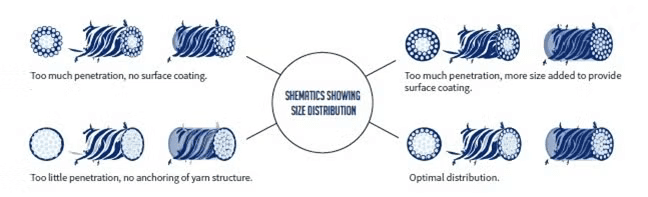
6. Poor Penetration
Size sits on surface; does not enter yarn interstices
Common with blends or hydrophobic fibers
7. Lumps / Gels in Size Bath
Incomplete cooking, poor mixing, contamination
8. Roller Deposition
Accumulated gels or degraded size material transfer to rollers
9. Uneven Drying or Moisture Variation
Causes inconsistencies in film strength
10. High Hairiness After Sizing
Under-sizing, low penetration, incorrect tension
Alpenol, with its controlled viscosity and flexible film formation, helps prevent many of these defects by reducing variability in film performance.
How to Mitigate Sizing Defects
Effective mitigation begins with process stability, recipe control, and real-time monitoring.
1. Stabilize Viscosity & Size Bath Quality
Measure viscosity every 1–2 hours
Maintain temperature at recommended levels
Ensure proper dispersion and dissolution of starch, PVA, or acrylic agents
Alpenol advantage: Low viscosity drift across long runs reduces uneven pick-up.
2. Maintain Correct Squeeze Roller Pressure
Balance pressure left–right
Inspect roller hardness
Clean roller surfaces regularly
Uneven pressure leads directly to streaky pick-up across the warp beam.
3. Control Warp Tension
Ensure parallel sheet movement
Adjust creel tension to avoid loose/over-tight ends
Incorrect tension = uneven penetration + variable drying.
4. Ensure Proper Drying
Avoid over-drying → brittle films
Avoid under-drying → sticky yarn
Maintain uniform temperature distribution across cylinders
Flexible film-forming agents like Alpenol reduce brittleness and powdering even when moisture variations occur.
5. Maintain Clean Equipment
Remove roller build-up
Check size box for gels or char
Inspect immersion rollers and guides
Contamination → defective film formation.
6. Use Stable, High-Performance Sizing Agents
Choosing a robust sizing system is central to mitigation.
Modern systems (like Alpenol) ensure:
Low add-on but high adhesion
Controlled penetration
Minimal dusting
Smooth desizing
Superior film strength
How to Fix a Sizing Defect
When defects appear, mills follow this systematic troubleshooting procedure:
Step 1: Identify the Defect (Visual + Instrumental)
Use hairiness testers, pick-up scales, and visual checks
Identify whether the issue is pick-up, penetration, adhesion, drying, or film brittleness
Step 2: Map the Defect Across Warp Width
Check if the issue is:
Edge-only
Center-only
Intermittent
Full-width
This helps pinpoint whether it is mechanical, chemical, or operator-related.
Step 3: Check Critical Process Parameters
Verify:
Viscosity levels
Temperature of size bath
Roller pressure uniformity
Warp sheet tension
Drying cylinder settings
Moisture content after drying
Step 4: Correct Based on Defect Type
If the Defect is Uneven Pick-Up:
Normalize viscosity
Realign roller pressure
Ensure steady warp tension
Improve circulation of size bath
If the Defect is Flaking / Powdering:
Lower drying temperature
Reduce solids percentage
Use a more flexible polymer system
Increase moisture at the take-up beam
(Alpenol’s flexible film chemistry reduces brittleness here.)
If the Defect is Sticky Yarn:
Increase drying temperature
Reduce excess softener
Increase time on drying cylinders
If the Defect is Poor Penetration:
Reduce viscosity
Lower tension for better immersion
Ensure better wetting
Adjust recipe for hydrophobic fibers
If the Defect is High Hairiness After Sizing:
Increase pick-up slightly
Improve starch/PVA blend
Check for roller wear
Reduce warp tension
Step 5: Produce a Trial Beam
Run a short trial on the loom:
Check end-break rate
Observe dusting
Evaluate warp sheet stability
Inspect fabric surface
Step 6: Document Root Cause and Standardize Improved Parameters
Quality documentation ensures repeatability and prevents future errors.
Once the issue is fixed:
Update SOPs
Train operators
Lock viscosity/temperature/pressure settings
This ensures continuous, consistent sizing quality.
Summary: A Successful Sizing Correction Approach Includes:
Accurate defect identification
Root-cause mapping
Immediate parameter correction
Trial verification
Documentation & SOP revision
High-stability sizing chemistry (Alpenol) to minimize future defects
FAQs
1. What are sizing defects?
Issues such as uneven pick-up, flaking, powdering, sticking, poor penetration, and film brittleness.
2. What causes most sizing problems?
Viscosity drift, roller misalignment, poor drying, and yarn tension variations.
3. How do you fix sizing defects?
Identify defect → analyze root cause → adjust viscosity, pressure, tension, or drying → verify via loom trial.
4. Why is sizing important?
It strengthens warp yarns, reduces hairiness, and improves weaving efficiency.
5. How does sizing chemistry affect defects?
Stable, flexible-film systems like Alpenol reduce brittleness, improve adhesion, and ensure consistent pick-up.
References
Textile Learner – Sizing Defects, Causes and Remedies,
https://textilelearner.net/sizing-defects-causes-and-remedies/
Textile Trainer – Faults of Sizing & Effective Remedies,
https://textiletrainer.com/faults-of-sizing-with-effective-remedy/
Global Polyester – Common Problems in Textile Sizing: A Simple Guide,
https://globalpolyester.com/common-problems-in-textile-sizing-a-simple-guide/
TexNote – Sizing Faults: Causes of Faults of Sizing,
https://texnoteblog.wordpress.com/2013/09/02/sizing-faults-causes-of-faults-of-sizing/
LinkedIn – Textile De-sizing: Troubles and Remedies,
https://www.linkedin.com/pulse/textile-de-sizing-troubles-remedies-dr-anubhav-gupta
Anytester – Textile Process: Sizing (Control of Pick-Up via Squeezing),
https://www.anytester.com/textile-process-sizing-part-1.html
Textile Trainer – Techniques of Drying in Sizing Process,
https://textiletrainer.com/techniques-of-drying-in-sizing-process/
Suntech Machine – Prevention and Treatment Method on Common Defect of Sizing Loom Beam,
TextileListing – Sizing Process in Textile Manufacturing (Principles & Practice),
PMC – Performance Evaluation of the Sizing of Cotton Warp Yarns,
https://pmc.ncbi.nlm.nih.gov/articles/PMC12845530/
PMC – Sustainable Starch-Based Sizing and Desizing (Film Behavior),
https://pmc.ncbi.nlm.nih.gov/articles/PMC6572457/
PMC – Starch Graft Copolymers in Warp Sizing (Strength & Flexibility),
https://pmc.ncbi.nlm.nih.gov/articles/PMC10820382/
ACS ES&T – PVA-Based Sizing and Effluent Load,
https://pubs.acs.org/doi/10.1021/es504988w
Sekisui SC – Polyvinyl Alcohol vs Starch as Warp Sizing Chemical,
https://www.sekisui-sc.com/blog/polyvinyl-alcohol-vs-starch-as-warp-sizing-chemical-in-textiles/
Textile Trainer – Sizing Ingredients with Their Function,
https://textiletrainer.com/sizing-ingredients-with-their-function/
Textile Learner – Warping Defects (Linked Issues with Sizing),
https://textilelearner.net/warping-defects-in-textiles-common-causes-and-remedies/
Textile Learner – Sizing Defects Causes and Remedies (Beam Ridges, Sticky Ends),
https://textilelearner.net/sizing-defects-causes-and-remedies/
NPTEL – Desizing & Sizing Control Notes (Viscosity, Temperature),
https://archive.nptel.ac.in/content/storage2/courses/116102016/m-10/desizing.htm
Fibre2Fashion – Identification of Type of Size in Woven Fabrics (QC Testing),
https://www.fibre2fashion.com/industry-article/3703/identification-of-type-of-size-in-woven-fabrics
Textile School – Sizing Operation for Textiles (Machine & QC Points),
https://www.textileschool.com/1080/sizing-operation-for-textiles/
Liked it? Share it with your people.


Disclaimer
The information provided in this blog is intended solely for educational and informational purposes within the textile industry. While the content references technical concepts, sizing and desizing practices, and general chemical information, it does not constitute professional, commercial, or operational advice for any specific textile process or production environment.
Process conditions, chemical selections, and operational parameters may vary significantly across mills, machinery types, fabric constructions, and environmental constraints. Readers should always consult qualified technical professionals, internal laboratory data, and product-specific Technical Data Sheets before making any decisions related to textile processing.
Any references to Alpenol, Sizaltex, or other products are included only for contextual, educational, and illustrative purposes and should not be interpreted as endorsements, recommendations, or guarantees of performance. The authors assume no responsibility for decisions made based on the information contained herein.