
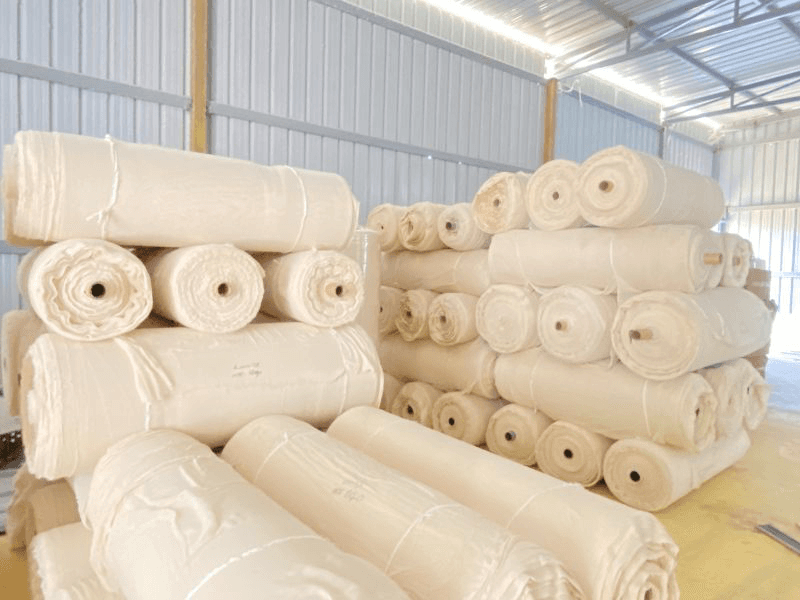
What Is Greige Fabric?
Greige fabric refers to a woven or knitted fabric exactly as it comes off the loom or knitting machine. It retains:
Natural fiber color (off-white, cream, greyish)
Warp sizing materials
Cotton waxes, pectins, oils, and dirt
No chemical finishing or coloration
From a manufacturing perspective, greige fabric is potential, not a final product. Its quality determines how successfully it can be dyed, printed, or finished later.
For weavers, producing stable, uniform greige fabric is essential-and this is where warp preparation and sizing chemistry become critical. Advanced sizing systems like Alpenol’s starch-based sizing solutions are specifically designed to deliver cleaner, more uniform greige fabric with easier downstream processing.
How Is Greige Fabric Made?
Greige fabric is produced through a structured textile manufacturing process before finishing:
Key Manufacturing Steps
Spinning – Fibers (cotton, viscose, polyester, blends) are converted into yarn.
Warp Sizing – Warp yarns are coated with a sizing solution to improve strength and abrasion resistance.
Weaving / Knitting – Warp and weft yarns are interlaced to form fabric.
Fabric Inspection & Rolling – Fabric is inspected but not chemically treated.
At this stage, the fabric is officially called greige.
Industry insight:
Uniform sizing and controlled add-on levels-such as those achieved with single-shot sizing agents from Alpenol-directly impact greige fabric strength, hairiness, and dye uptake consistency.
Is Greige Fabric the Same as Raw Fabric?
Not exactly.
Term | Meaning |
Raw fabric | Broad term; may include loosely processed material |
Greige fabric | Specifically woven/knitted fabric before finishing |
Finished fabric | Dyed, bleached, printed, softened, or treated |
Greige fabric is technically raw, but raw fabric is not always greige. In mills, greige has a precise operational meaning tied to finishing readiness.
How Can You Identify Greige Fabric?
You can identify greige fabric using the following characteristics:
No uniform color (natural off-white/grey)
No softness or drape enhancement
Presence of sizing stiffness
Slight odor from natural waxes or size
Higher tensile strength than finished fabric
Experienced inspectors can also detect greige fabric by touch and sound, as sized warp yarns create a crisper fabric handle.
Why Is Greige Fabric Left Undyed?
Greige fabric is intentionally left undyed to provide maximum flexibility to manufacturers.
Advantages
One greige lot → multiple colorways
Lower inventory risk
Reduced upfront chemical cost
Better color matching accuracy
Enables demand-driven finishing
From a sustainability lens, postponing dyeing reduces overproduction and chemical waste, aligning with ZDHC and OEKO-TEX compliant manufacturing practices-a philosophy strongly reflected in Alpenol’s sizing chemistry approach.
What Is the Most Important Process in Greige Fabric Manufacturing?
Warp Sizing
Warp sizing is the single most critical step affecting greige fabric quality.
Why?
Determines warp strength during weaving
Controls hairiness and loom efficiency
Impacts desizing, dye penetration, and effluent load
Influences final fabric appearance
Modern mills are shifting away from heavy PVA-based sizing toward starch-based, easily removable systems-where Alpenol has specialized for decades.
How Does Greige Fabric Behave During Dyeing and Finishing?
Before dyeing, greige fabric must undergo pre-treatment:
Pre-Treatment Steps
Desizing – Removal of warp size
Scouring – Elimination of waxes and oils
Bleaching – Achieving uniform whiteness (optional)
Common Challenges
Incomplete desizing → patchy dyeing
Excess synthetic size → high COD/BOD in effluent
Uneven size add-on → shade variation
Greige fabrics sized with clean-removal starch systems show:
Faster desizing
Lower water and chemical consumption
Better shade consistency
Greige Fabric vs Finished Fabric: Key Differences
Parameter | Greige Fabric | Finished Fabric |
Color | Natural / uneven | Uniform |
Strength | Higher | Slightly reduced |
Cost | Lower | Higher |
Handle | Stiff | Soft |
Chemical load | Minimal | High |
Customization | Maximum | Fixed |
Why Is Greige Fabric Important in Textile Production?
Greige fabric acts as the foundation of the entire textile value chain:
Dyeing success depends on greige quality
Finishing costs depend on sizing chemistry
Sustainability metrics begin at greige stage
Fabric rejection rates trace back to greige defects
A well-engineered greige fabric reduces reprocessing, re-dyeing, and effluent treatment costs-making upstream decisions (like sizing chemistry) commercially decisive.
Environmental and Chemical Impacts of Greige Fabric Manufacturing
Greige production itself is low-impact, but sizing choices matter:
Environmental Factors
Synthetic sizes → high effluent load
Difficult desizing → more water & energy
Poor size removal → chemical overdosing in finishing
Sustainable Direction
Starch-based sizing
PVA replacement
Lower add-on percentages
Easier biodegradation
Alpenol’s formulations align with GOTS, OEKO-TEX Eco Passport, and ZDHC Level 3 principles, enabling cleaner greige fabrics and simpler finishing chemistry.
Frequently Asked Questions
Is greige fabric washable?
Yes, but only after desizing and scouring. Direct washing may cause uneven shrinkage or stains.
Does greige fabric shrink more than finished fabric?
Yes. Shrinkage is controlled during finishing processes.
Can greige fabric be sold directly?
Typically no, except for industrial or testing purposes.
Is greige fabric stronger than dyed fabric?
Yes, due to sizing and lack of chemical degradation.
Why do dye houses prefer uniform greige fabric?
Because uniform greige fabric ensures even dye uptake, lower rework, and consistent shades.
Reference and Backlinks
GarmentsMerchandising: Greige Fabric Guide (Properties & Production),
https://garmentsmerchandising.com/difference-between-greige-fabric-and-rfd-fabric/
TextileIndustry.net: Greige Fabric Characteristics (Post-Weaving),
https://www.textileindustry.net/difference-between-greige-fabric-and-rfd-fabric/
OnlineClothingStudy: Greige vs Finished (Sizing Impact),
https://www.onlineclothingstudy.com/2013/07/difference-between-rfd-and-greige-fabric.html
Green-Tailor: Greige to Dyeing Prep (Impurities/Waxes),
https://green-tailor.com/rfd-fabrics-understanding-what-it-means/
GarmentExportHouse: Greige Fabric Rolling/Inspection,
https://www.garmentexporthouse.com/2021/10/ready-for-dyeing-rfd-fabric.html
Google Patents: Greige Processing (Desizing Pre-Treatment),
https://patents.google.com/patent/US3619111A/en
Inflibnet: Grey Cloth Manufacturing (Singeing to Greige PDF),
_ ...
ICIRESM: Greige Wet Processing Impacts,
...
Wiley: Textile Manufacturing Review (Greige Quality),
https://onlinelibrary.wiley.com/doi/abs/10.1002/tqem.21538
ScienceDirect: Greige Wet Processing Assessment,
https://www.sciencedirect.com/science/article/abs/pii/S0048969722065949
ZDHC Wastewater Guidelines (Greige Sizing Effluent),
https://downloads.roadmaptozero.com/output/ZDHC-Wastewater-Guidelines
ZDHC Wastewater V1.1 (Pre-Treatment Load),
https://wastewater.sustainabilityconsortium.org/downloads/zdhc-wastewater-guidelines-verson-1-1/
Textile Wastewater Standards (Sizing in Greige),
GOTS Implementation Manual (Organic Greige Processing),
https://global-standard.org/images/Implementation_Manual_7.0_Second_Revision_Draft.pdf
OEKO-TEX Standards (Greige Compliance),
https://www.oeko-tex.com/en/our-standards/
PMC: Starch Sizing for Greige Uniformity,
https://pmc.ncbi.nlm.nih.gov/articles/PMC6572457/
PMC: Warp Preparation for Dye Uptake,
https://pmc.ncbi.nlm.nih.gov/articles/PMC10820382/
PMC: Corn Starch in Greige Fabrics,
https://pmc.ncbi.nlm.nih.gov/articles/PMC7361798/
ACS ES&T: Synthetic Sizes in Greige Effluent,
https://pubs.acs.org/doi/10.1021/es504988w
Persistence: Sizing Market (Greige Quality Impact),
https://www.persistencemarketresearch.com/market-research/textile-sizing-chemicals-market.asp
MarketsandMarkets: Textile Chemicals for Greige,
https://www.marketsandmarkets.com/Market-Reports/textile-chemical-market-12380328.html
Mordor Intelligence: Greige Production Analysis,
https://www.mordorintelligence.com/industry-reports/textile-chemicals-market
TextileSchool: Greige Weaving Operations,
https://www.textileschool.com/206/basic-weaving-operations/
TextileLearner: Greige Loom Processes,
https://textilelearner.net/different-parts-of-loom-and-their-functions/
CottonWorks: Greige Basics (Warp/Weft),
https://cottonworks.com/learning-hub/weaving/weaving-basics/
Heuritech: Greige Trends 2026,
https://heuritech.com/articles/fashion-fabric-innovations/
Tessuti: Fabric Forecast (Greige Sustainability),
Liked it? Share it with your people.


Disclaimer
The information provided in this blog is intended solely for educational and informational purposes within the textile industry. While the content references technical concepts, sizing and desizing practices, and general chemical information, it does not constitute professional, commercial, or operational advice for any specific textile process or production environment.
Process conditions, chemical selections, and operational parameters may vary significantly across mills, machinery types, fabric constructions, and environmental constraints. Readers should always consult qualified technical professionals, internal laboratory data, and product-specific Technical Data Sheets before making any decisions related to textile processing.
Any references to Alpenol, Sizaltex, or other products are included only for contextual, educational, and illustrative purposes and should not be interpreted as endorsements, recommendations, or guarantees of performance. The authors assume no responsibility for decisions made based on the information contained herein.