What Is Lyocell Fabric?
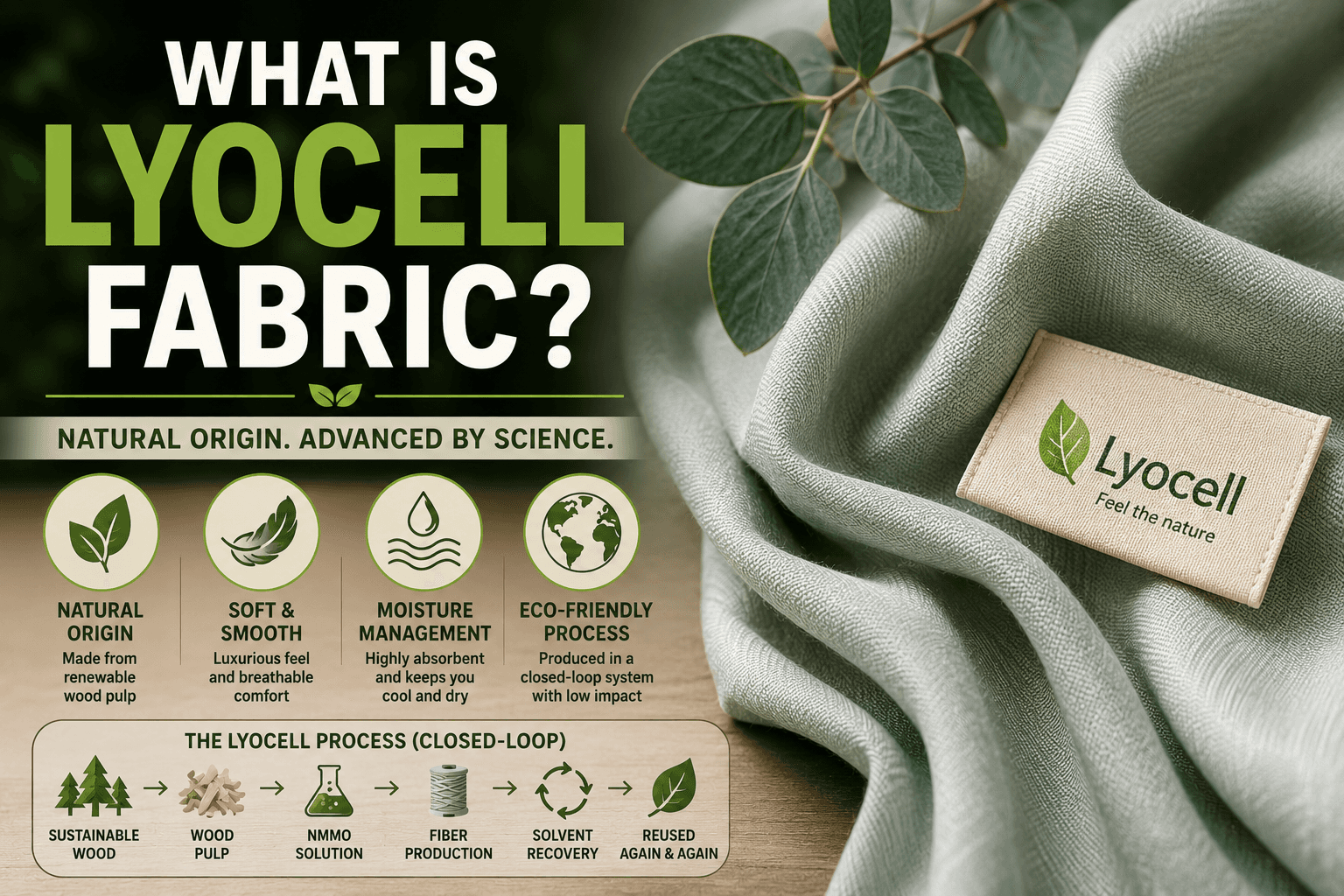
Lyocell is a regenerated cellulose fiber made from sustainably sourced wood-typically eucalyptus, beech, or spruce. Unlike traditional viscose, which uses carbon disulfide, lyocell uses N-methylmorpholine-N-oxide (NMMO) as a non-toxic solvent.
Key characteristics of lyocell:
100% cellulose
High absorbency and moisture-wicking
Smooth, silky hand feel
High dry and wet strength
Naturally breathable
Biodegradable and compostable
Lyocell is often marketed under brand names like TENCEL™.
How Is Lyocell Manufactured? (Closed-Loop Process Explained)
Lyocell production involves a highly controlled, sustainable sequence:
Wood harvesting from FSC-certified forests
Pulp production from cellulose-rich wood
Dissolution of pulp in NMMO solvent
Spinning the solution through spinnerets to form continuous filaments
Washing & drying the regenerated fibers
Cutting into staple fiber or using as filament yarn
Why the closed-loop system matters:
99% of solvent is recovered & reused
Low emissions
Low energy & water consumption
Minimal chemical discharge
This is why lyocell repeatedly ranks as one of the world’s most sustainable fibers.
What Are the Properties, Advantages & Disadvantages of Lyocell Fabric?
Advantages
Superb softness (smooth fiber surface)
Excellent breathability
High moisture absorption & thermoregulation
Strong when wet or dry
Reduced bacterial growth due to moisture wicking
Minimal pilling compared to viscose
Biodegradable & compostable
Suitable for sensitive skin
Disadvantages
Prone to shrinkage without proper finishing
Can wrinkle more easily than polyester
Slightly higher cost than cotton or viscose
Requires controlled warp sizing to prevent fibrillation and abrasion during weaving
Alpenol’s gentle, binder-free sizing helps maintain lyocell yarn integrity by reducing hairiness and minimizing fibril breakouts on high-speed looms.
Why Is Lyocell Considered More Sustainable Than Viscose or Rayon?
Feature | Lyocell | Rayon/Viscose |
Solvent | NMMO (recovered 99%) | Carbon disulfide (toxic) |
Water use | Low | High |
Emissions | Very low | High VOCs |
Wastewater | Minimal | Significant |
Fiber yield | High | Medium |
Biodegradability | Excellent | Good |
Key sustainability reasons:
Closed-loop chemical recovery
No toxic solvents
Fast-growing, renewable wood sources
Lower energy and water consumption
Certified eco-friendly production routes (e.g., Lenzing’s TENCEL™)
Lyocell vs Modal vs Rayon: How Do They Compare?
Property | Lyocell | Modal | Rayon |
Softness | Very soft | Very soft | Soft |
Strength (wet) | High | Good | Low |
Sustainability | Excellent | Good | Moderate/Poor |
Moisture absorption | High | Moderate | High |
Feel | Smooth & cool | Silky | Slightly crisp or silky |
Durability | High | Medium | Low |
Best uses | Apparel, bedding, activewear | Underwear, loungewear | Dresses, linings |
Lyocell delivers the best balance of strength + sustainability + comfort.
What Are the Best Uses of Lyocell Fabric Across Categories?
1. Apparel
Dresses
Shirts
Blouses
Denim (lyocell blends)
Underwear
Athleisure
2. Bedding & Home Textiles
Bedsheets
Pillowcases
Duvet covers
Mattress toppers
3. Towels
High-absorbency, quick-drying bath linens
4. Technical & Industrial Applications
Automotive interiors
Wipes and nonwovens
Medical textiles
Lyocell blends beautifully with cotton, polyester and wool-though blends often require precise warp preparation, where Alpenol sizing ensures consistent adhesion and smoother weaving behavior.
Lyocell for Bedding: What Are the Benefits?
Ultra-soft and silky
Highly breathable
Excellent moisture management (ideal for hot sleepers)
Hypoallergenic
Naturally temperature regulating
Smooth drape and flow
Lyocell for Activewear: How Does It Perform?
Lyocell is an excellent activewear fiber due to:
Moisture-wicking ability
Fast drying time
Breathability
Anti-bacterial characteristics
Smooth feel during movement
Best blends for activewear:
Lyocell + Spandex (stretch)
Lyocell + Polyester (shape retention)
Lyocell + Nylon (durability)
How Long Do Lyocell Garments Last Compared to Cotton or Polyester?
Lyocell:
Stronger than cotton
Stronger than viscose
Maintains strength even when wet
Resistant to long-term fiber fatigue
Cotton:
Very durable, but prone to breakage under moisture stress
Polyester:
Longest-lasting but lowest sustainability
Lyocell offers an excellent middle ground: high performance + eco-friendliness.
What Is the Sustainability Profile of Lyocell Production?
Lyocell is recognized by sustainability organizations for:
FSC-certified wood sourcing
Closed-loop solvent recycling
Low carbon footprint
Low water use
Full biodegradability
Reduced chemical toxicity
Alpenol’s eco-friendly size complements lyocell’s sustainability by avoiding synthetic binders, reducing wastewater load and supporting mills' ZDHC and GOTS compliance.
FAQs
1. What is lyocell fabric made from?
Lyocell is made from wood pulp dissolved in a closed-loop NMMO solvent system.
2. Why is lyocell considered eco-friendly?
Because 99% of its solvent is recovered, it uses sustainable wood and produces very low emissions.
3. Is lyocell better than cotton?
It is softer, more breathable and more moisture-wicking, though cotton may outperform it in long-term abrasion resistance.
4. Does lyocell shrink?
It can shrink if exposed to high heat; cold washing and low drying are recommended.
5. Can lyocell be woven or blended easily?
Yes, but it requires controlled sizing for best results - Alpenol sizing helps support lyocell’s sensitivity to abrasion and fibrillation.
Reference and Backlinks
TENCEL Official: Lyocell Sustainability (Closed-Loop, Low Emissions),
https://www.tencel.com/fibers/benefits/sustainability
Sewport: Lyocell Fabric Properties & Manufacturing (Organic Certification),
https://sewport.com/fabrics-directory/lyocell-fabric
Sealy India: TENCEL vs Modal/Viscose (Eco-Production),
https://sealy.in/blogs/sleep-hub/what-is-tencel
Ecolife: Lyocell Overview & Sustainability (Wood Pulp Process),
https://www.ecolife.com/learn/what-is-lyocell-fabric
Wilda Eco: TENCEL Lyocell Low Impact (Renewable Sources),
https://wilda.eco/tencel-lyocell/
TextilesBar: Viscose/Modal/Lyocell Differences (Strength, Absorption),
https://textilesbar.com/difference-in-viscose-modal-and-lyocell-fiber/
Fibre2Fashion PDF: Spin to Weave Lyocell (Sizing Recommendations),
https://static.fibre2fashion.com/articleresources/PdfFiles/56/5504.pdf
Lenzing Pro: TENCEL Certificates (OEKO-TEX, Biodegradable, USDA),
https://lenzingpro.com/en/portal/certificates/
GoodOnYou: TENCEL Ethical Guide (NMMO Closed-Loop),
https://goodonyou.eco/how-ethical-is-tencel/
Scribd: Viscose/Modal/Lyocell Comparison (Properties Table),
https://www.scribd.com/document/837396624/Comparison-of-Viscose-Modal-and-Lyocell-Fibers
Google Patents: Lyocell Knitted-Like Fabric (Sizing Process),
https://patents.google.com/patent/CN105442149A/en
Lenzing: TENCEL Lyocell Natural Comfort (Certifications),
https://www.lenzing.com/products/textile-fibers/tenceltm-lyocell/
NaturalBorn: TENCEL Eco-Friendly (Energy/Water Savings),
VNPolyFiber: Viscose/Rayon/Modal/Lyocell/Tencel,
https://vnpolyfiber.com/viscose-rayon-modal-lyocell-tencel/
ScienceDirect: Anti-Fibrillation Lyocell Finishing (Weaving Challenges),
https://www.sciencedirect.com/science/article/abs/pii/S0926669024003832
ZDHC Guidelines (Lyocell Wet Processing Compliance),
https://downloads.roadmaptozero.com/output/ZDHC-Wastewater-Guidelines
GOTS Manual (Cellulosic Fiber Finishing),
https://global-standard.org/images/Implementation_Manual_7.0_Second_Revision_Draft.pdf
OEKO-TEX Standards (Lyocell Certification),
https://www.oeko-tex.com/en/our-standards/
PMC: Cellulose Fibers Properties (Lyocell Strength),
https://pmc.ncbi.nlm.nih.gov/articles/PMC6572457/
Lenzing Modal/Lyocell Sustainability (EU Ecolabel),
Liked it? Share it with your people.


Disclaimer
The information provided in this blog is intended solely for educational and informational purposes within the textile industry. While the content references technical concepts, sizing and desizing practices, and general chemical information, it does not constitute professional, commercial, or operational advice for any specific textile process or production environment.
Process conditions, chemical selections, and operational parameters may vary significantly across mills, machinery types, fabric constructions, and environmental constraints. Readers should always consult qualified technical professionals, internal laboratory data, and product-specific Technical Data Sheets before making any decisions related to textile processing.
Any references to Alpenol, Sizaltex, or other products are included only for contextual, educational, and illustrative purposes and should not be interpreted as endorsements, recommendations, or guarantees of performance. The authors assume no responsibility for decisions made based on the information contained herein.