
What Is the Purpose of Sizing in Textile Manufacturing?
Textile sizing exists for one reason: to help warp yarn survive the stress of weaving.
A warp yarn is subjected to:
High tension
Abrasion with healds and reeds
Repeated bending and friction
High-speed weft insertion
Without sizing, yarns break frequently, causing loom stoppages, low efficiency, and higher fabric defects.
Well-sized yarns especially those using hydroxylated starch technologies like Alpenol are designed to offer:
Higher breaking strength
Lower hairiness
Better cohesion between fibers
Uniform stretch under tension
Reduced shedding and dust
These benefits directly translate into higher loom efficiency and lower weaving costs, which is why sizing is critical for every woven fabric manufacturer.
What Is the Warp Sizing Process in Textiles?
The warp sizing process has two dimensions:
1. The Mechanical Sizing Process (Machine-Side)
This process takes place on a sizing machine—typically a slasher or sectional sizing range.
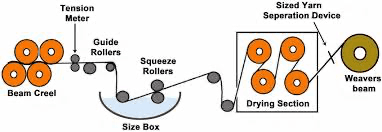
Steps in Mechanical Sizing
Warp beam feeding – Multiple warp beams from warping enter the size bath.
Size application (size box) – Yarns pass through a hot slurry where adhesive forms a thin, uniform coating.
Squeezing – Squeeze rollers remove excess size and control add-on %.
Drying – Yarn passes over drying cylinders at controlled temperature/humidity.
Stretching – Controlled stretch gives uniform tension before winding.
Re-beaming – All sized threads are wound into a final weaving beam.
Why Alpenol products perform better here
Alpenol’s single-shot and compound agents deliver:
Higher adhesive power with lower pick-up %
Uniform film formation
Better moisture management
Reduced shedding
Fewer end breaks at high-speed looms
These are repeatedly validated in customer mill trials across cotton, viscose, (Polyester-Cotton) PC, (Polyester-Viscose) PV, and specialty high-density programs.
2. The Chemical Sizing Process (Chemical-Side)
The size bath composition determines how the yarn behaves on the loom.
Typical components of a traditional recipe
Starch / modified starch
PVA (polyvinyl alcohol)
CMC (carboxy methyl cellulose)
Binders & softeners
Waxes & lubricants
Preservatives
What modern formulations look like
Alpenol’s chemical technology replaces multi-chemical recipes with:
Hydroxylated starch-based single-shot products
No PCP, no restricted substances
GOTS-approved for organic cotton
ZDHC Level 3 compliant ingredients
This drastically reduces:
Complexity
Environmental load
Inventory
Human error
Effluent COD/BOD during desizing
How Does Sizing Improve Yarn Strength and Weaveability?
Sized yarns show measurable improvements:
Property | Before Sizing | After Sizing | Impact in Weaving |
Strength | Low | Higher | Fewer end breaks |
Hairiness | High | Reduced | Less abrasion, cleaner shed |
Cohesion | Poor | Improved | Higher efficiency |
Abrasion resistance | Low | High | Better performance at high speeds |
Moisture uniformity | Inconsistent | Stable | Less tension variation |
Alpenol’s hydroxylated starch molecules penetrate yarn cores more effectively, producing flexible yet strong films ideal for modern looms.
What Types of Sizing Agents Are Used in the Textile Industry?
Traditional Sizing Agents
Starches (maize, tapioca, potato)
PVA
CMC
Acrylic binders
Softening oils and waxes
To learn more about the different sizing agents used, click here.
Modern/Advanced Agents (Alpenol examples)
Alpenol is Single-shot products requiring no extra binders, lubricants or additives
These modern agents offer performance + sustainability without complexity.
What Is the Desizing Process in Textile Manufacturing? (Brief)
Desizing removes the size film from woven fabric before dyeing and finishing.
Common Desizing Methods
Enzymatic desizing (amylase)
Oxidative desizing
Hot wash desizing
To learn more about the desizing process, click here.
Modern sustainable sizes such as those from Alpenol require:
Lower chemical dosage
Faster washing-off
Lower effluent load
Better whiteness in bleaching
This is repeatedly validated in mill reports where desizing chemical cost reduces significantly.
How Does Sizing Differ for Cotton vs. Synthetic Yarns?
Fiber | Properties | Sizing Requirement |
Cotton | Absorbent, hairy, flexible | Modified starch + lubrication; high adhesion |
Viscose | High absorbency, poor wet strength | Flexible film-forming agents like Alpenol DHC & FNR |
Polyester | Hydrophobic, smooth | Requires wetting agents, modified starch + binders (e.g., Alpenol TTL) |
PC/PV blends | Mixed behavior | Balanced film with controlled pick-up; single-shot blends |
Alpenol’s product range covers all compositions with specialized versions for open-end, ring, vortex, fine counts, coarse counts, and dyed yarn requirements.
What Are the Challenges and Common Problems in Textile Sizing?
Excess size pick-up
Inconsistent viscosity
Improper penetration
Yarn sticking
Beam softening/drying out
High hairiness post drying
Excessive dust & fly
High end breaks on loom
Desizing difficulty
High BOD/COD effluent load
Modern single-shot products (Alpenol) minimize these issues due to consistent chemistry and optimized cooking behavior.
What Is the Environmental Impact of Sizing Chemicals?
Traditional sizing using PVA, synthetic binders, and waxes leads to:
High BOD/COD in wastewater
Microplastic-like residues
Large water consumption
High energy drying load
How Alpenol reduces environmental impact
ZDHC Level 3 compliant
GOTS approved for organic cotton
OEKO-TEX Eco Passport certified
Starch-based chemistry (biodegradable)
Reduced pick-up → reduced drying energy
Easy desizing → lower chemical use
No PCP or other restricted substances
What Are the Benefits of Modern Sizing Technologies in Weaving?
Key Benefits
Higher loom efficiency (5–10% improvement commonly reported)
Lower warp breaks even at low humidity
Higher production at high insertion speeds (up to 1200 picks/min)
Improved fabric appearance
Lower dead-loss (down to 15–20%)
Lower energy cost (up to 20% reduction)
Better export-grade packing due to reduced defects
Modern sizing is not just a chemical—it’s a cost-saving and quality-improving strategy.
What Are the Quality Control Parameters in Sizing?
QC Parameters to Check
Size viscosity
pH
Temperature in size box
Pick-up %
Moisture of sized yarn
Stretch %
Film strength & flexibility
Beam density & uniformity
End breakage rate
Size penetration depth
Alpenol’s cooking instructions provided in product TDS and the technical service provided ensures consistent slurry quality and reproducible performance.
What Are the Alternatives to Traditional Textile Sizing?
Foam sizing
Solvent or low-liquor sizing
Synthetic binder-free formulations (Alpenol, siZaltex LVn)
Biodegradable size systems (Alpenol, siZaltex LVn)
Single-shot sizing compounds
Slurry-less cold-soluble preparations
These alternatives reduce water, steam, and chemical load significantly.
Frequently Asked Questions (FAQs)
1. What exactly does sizing do to yarn?
Sizing forms a thin, protective film over warp yarns to enhance strength, cohesion and abrasion resistance, ensuring smoother and faster weaving.
2. Is sizing necessary for all woven fabrics?
Yes. Almost every woven fabric requires sizing except very coarse or specially engineered yarns. Fine, dyed, viscose, PC and high-density fabrics benefit the most.
3. Does sizing impact dyeing quality?
Yes. Proper sizing and easy desizing (as seen in Alpenol products) improves fabric whiteness, dye uniformity, and reduces processing chemicals.
4. How much size add-on is ideal?
Typically 5–12% depending on yarn count and fiber. Modern single-shot agents require lower add-on for higher performance.
5. Which sizing agent is best for PC or PV blends?
Compounds like Alpenol ALTRA, TTL, KV and EXC-2 are engineered specifically for PC/PV blends and high-density dobby fabrics.
Reference Links
Liked it? Share it with your people.


Disclaimer
The information provided in this blog is intended solely for educational and informational purposes within the textile industry. While the content references technical concepts, sizing and desizing practices, and general chemical information, it does not constitute professional, commercial, or operational advice for any specific textile process or production environment.
Process conditions, chemical selections, and operational parameters may vary significantly across mills, machinery types, fabric constructions, and environmental constraints. Readers should always consult qualified technical professionals, internal laboratory data, and product-specific Technical Data Sheets before making any decisions related to textile processing.
Any references to Alpenol, Sizaltex, or other products are included only for contextual, educational, and illustrative purposes and should not be interpreted as endorsements, recommendations, or guarantees of performance. The authors assume no responsibility for decisions made based on the information contained herein.