What This Guide Covers
This pillar guide explains:
Basic weaving concepts and terminology
Fundamental weave structures (plain, twill, satin)
Loom setup and warp calculation
Handloom vs power loom
Jacquard and dobby weaving systems
Yarn properties affecting fabric behavior
Troubleshooting weaving problems
Sustainability in weaving
Loom types and their impact on production
Woven vs knitted fabrics
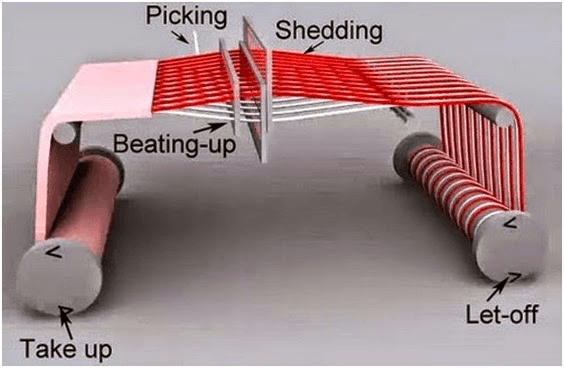
What Is Weaving? Basic Definition and Key Terms
Weaving involves two primary yarn systems:
Warp yarns → run lengthwise and are held under tension
Weft yarns → inserted across warp yarns
Key Weaving Terms
Warp beam → holds warp yarns
Heddles → control yarn movement
Reed → beats weft into place
Selvedge → fabric edge
Pick → one insertion of weft yarn
Weaving matters because it produces fabrics with:
High strength
Dimensional stability
Structured appearance
Proper warp preparation and sizing (where Alpenol plays a critical role) ensures smooth weaving and minimal yarn breakage.
Fundamental Weave Structures: Plain, Twill, Satin
Plain Weave
Simplest structure (over-under pattern)
High durability
Balanced fabric
Applications
Shirts
Bedsheets
Twill Weave
Diagonal pattern
Better drape
Higher flexibility
Applications
Denim
Workwear
Satin Weave
Smooth surface
High luster
Lower abrasion resistance
Applications
Luxury fabrics
Evening wear
Comparison of Weave Structures
Property | Plain | Twill | Satin |
Durability | High | Medium | Low |
Appearance | Simple | Textured | Smooth |
Production ease | Easy | Moderate | Complex |
How to Set Up a Warp on a Loom
Warp preparation is critical before weaving begins.
Steps in Warp Setup
Yarn selection
Warping (arranging yarns)
Sizing (critical step)
Drawing-in (gaiting)
Beam mounting
Warp Length Calculation
Warp length depends on:
Fabric length
Loom waste
Shrinkage allowance
Take-up percentage
Yarn Requirement Formula
Total yarn = (warp ends × warp length)
Proper sizing-especially using consistent formulations like Alpenol’s compound sizing systems-ensures uniform warp tension and smooth weaving performance.
Handloom vs Power Loom
Handloom
Advantages
Low energy usage
Flexible designs
Artisan production
Limitations
Low speed
Labor-intensive
Power Loom
Advantages
High production speed
Consistent quality
Scalable manufacturing
Limitations
Higher energy consumption
Modern weaving relies on power looms, where efficient warp protection using advanced sizing systems like Alpenol’s becomes essential.
Jacquard vs Dobby Weaving Systems
Dobby System
Controls small patterns
Limited harness control
Jacquard System
Individual yarn control
Complex patterns
When to Use Each
System | Use Case |
Dobby | Simple geometric patterns |
Jacquard | Complex designs |
Both systems require highly stable warp yarns, making sizing quality critical.
Yarn Properties and Their Impact on Fabric
Yarn Twist
Higher twist → stronger yarn
Lower twist → softer fabric
Yarn Count
Fine yarn → lightweight fabric
Coarse yarn → heavier fabric
Fiber Type
Cotton → breathable
Polyester → durable
Viscose → smooth
Sizing chemistry (such as Alpenol’s formulations) enhances these properties by improving yarn cohesion and reducing hairiness.
Troubleshooting Common Weaving Problems
Uneven Tension
Causes:
Poor warping
Inconsistent sizing
Solution:
Ensure uniform sizing pickup (Alpenol helps maintain consistency)
Poor Selvedges
Causes:
Incorrect tension
Improper weft insertion
Warp Breaks
Causes:
Weak yarn
Poor sizing
Solution:
Use high-performance sizing systems like Alpenol
Weaving vs Knitting
Feature | Weaving | Knitting |
Structure | Interlaced yarns | Looped yarns |
Strength | High | Moderate |
Stretch | Low | High |
Applications | Wovens, denim | T-shirts, sportswear |
Weaving requires stronger warp yarns-making sizing a critical step.
Loom Types and Their Impact on Production
CAM Loom
Simple designs
Cost-effective
Crank Loom
Mechanical motion control
Moderate speed
ESOP (Electronic Shedding)
Advanced automation
Higher precision
Jacquard Loom
Complex pattern capability
Higher-speed looms require:
Better yarn quality
Superior sizing performance
This is where Alpenol’s advanced sizing systems ensure warp stability and high-speed compatibility.
Characteristics of Woven Fabrics
Woven fabrics are known for:
High strength
Dimensional stability
Low stretch
Structured appearance
These properties depend heavily on:
Yarn quality
Weave structure
Sizing efficiency
Sustainable Weaving Practices
Sustainability in weaving focuses on:
Fiber Selection
Organic cotton
Tencel
Recycled fibers
Energy Efficiency
Modern looms
Reduced energy consumption
Chemical Optimization
Reduced synthetic chemicals
Lower effluent load
Sizing plays a major role here. Traditional systems increase environmental impact, while Alpenol’s advanced compound sizing technologies help reduce chemical load and improve sustainability.
Environmental Impact of Textile Weaving
Weaving itself is energy-intensive, but the biggest environmental impact comes from:
Yarn preparation
Sizing
Wet processing
Reducing chemical usage in sizing-through innovations like Alpenol’s PVA-free systems-helps significantly lower environmental impact.
Why Sizing Is Critical in Weaving
Sizing directly impacts:
Warp strength
Loom efficiency
Fabric quality
Production cost
Poor sizing leads to:
Warp breaks
Fabric defects
Reduced efficiency
Advanced sizing technologies such as those developed by Alpenol ensure consistent performance, reduced downtime, and improved fabric quality.
Final Insight: Weaving Performance Begins Before the Loom
Weaving is not just about interlacing yarns-it is about preparing yarns to perform under extreme conditions.
The most critical factor behind successful weaving is:
Consistent, high-performance sizing
By adopting advanced technologies such as Alpenol’s compound sizing systems, textile mills can achieve:
Higher loom efficiency
Better fabric quality
Reduced environmental impact
FAQ’s
What is weaving in simple terms?
Weaving is the interlacing of warp and weft yarns to create fabric.
What are the three basic weave types?
Plain, twill, and satin weaves.
Why is sizing important in weaving?
Sizing strengthens warp yarns and prevents breakage during weaving.
What is the difference between dobby and jacquard weaving?
Dobby controls small patterns, while jacquard enables complex designs.
How does Alpenol contribute to weaving performance?
Alpenol provides advanced sizing solutions that improve warp protection, reduce yarn breaks, and enhance loom efficiency.
References
Wikipedia – Weaving (History, Warp/Weft, Loom Types, Weave Structures),
https://en.wikipedia.org/wiki/Weaving
Wikipedia – Loom (Handloom to Power Loom, CAM/Dobby/Jacquard Systems),
https://en.wikipedia.org/wiki/Loom
Wikipedia – Plain Weave (Structure, Properties, Applications),
https://en.wikipedia.org/wiki/Plain_weave
Wikipedia – Twill Weave (Diagonal Structure, Denim, Workwear),
https://en.wikipedia.org/wiki/Twill
Wikipedia – Satin Weave (Smooth Surface, Luster, Luxury Fabrics),
https://en.wikipedia.org/wiki/Satin_weave
Wikipedia – Jacquard Loom (Individual Warp Control, Complex Patterns),
https://en.wikipedia.org/wiki/Jacquard_machine
Wikipedia – Dobby Loom (Small Geometric Patterns, Harness Control),
https://en.wikipedia.org/wiki/Dobby_loom
Wikipedia – Warping (Warp Beam Preparation for Weaving),
https://en.wikipedia.org/wiki/Warping_(weaving)
Textile School – Basic Weaving Operations (Loom Components, Shedding, Beating),
https://www.textileschool.com/206/basic-weaving-operations/
Textile Learner – Parts of a Loom and Their Function (Reed/Heddles/Temple/Take-Up),
https://textilelearner.net/parts-of-a-loom-and-their-function/
Textile Learner – Yarn Sizing: Important Warp Preparatory Process (Sizing Before Weaving),
https://textilelearner.net/yarn-sizing-important-warp-preparatory-process/
Textile Learner – Process Control in Sizing of Warp Yarn (Viscosity/Temperature/Pickup),
https://textilelearner.net/process-control-in-sizing-of-warp-yarn/
Textile Learner – Sizing Defects Causes and Remedies (Warp Break, Poor Selvedge),
https://textilelearner.net/sizing-defects-causes-and-remedies/
Textile Trainer – Sizing in Weaving: Objectives (Film Formation, Abrasion Resistance),
https://textiletrainer.com/sizing-in-weaving-easy-objectives-of-sizing/
TextileListing – Sizing Operation in Textiles: Principles, Processes and Industrial Practice,
Textile Learner – Fabric Manufacturing Process: Woven, Knit and Nonwoven (Construction Comparison),
https://textilelearner.net/fabric-manufacturing-process-woven-nonwoven-and-knit/
Toyota Industries – Textile Machinery: Air-Jet Looms (High-Speed Weaving),
https://www.toyota-industries.com/products/textile_machinery/
Picanol – Weaving Machines: Rapier and Air-Jet Systems (Loom Technology),
Itema – Weaving Solutions: Rapier Looms (Apparel Fabrics),
Dornier – Weaving Machines: Technical Textiles (High-Precision Weaving),
https://www.lindauerdornier.com
Karl Mayer – Warp Preparation Technology (Sizing and Warping Systems),
PMC – Performance Evaluation of Cotton Warp Sizing (Loom Efficiency Metrics),
https://pmc.ncbi.nlm.nih.gov/articles/PMC12845530/
PMC – Novel Energy-Saving Starch for Warp Sizing (PVA-Free, High Adhesion),
https://pmc.ncbi.nlm.nih.gov/articles/PMC10820382/
JEMIT PDF – Sizing Efficiency and Cost Reduction Strategies (Weaving Performance),
https://jemit.aspur.rs/archive/v3/n1/3.pdf
Sekisui SC – Polyvinyl Alcohol vs Starch as Warp Sizing Chemical (Sizing Comparison),
https://www.sekisui-sc.com/blog/polyvinyl-alcohol-vs-starch-as-warp-sizing-chemical-in-textiles/
ATIRA – Single Shot Sizing Analysis & Application Data (Case Study),
https://atira.in/single-shot-sizing-analysis-application-data-case-study/
Sewport – Cotton Fabric Guide (Plain/Twill Woven Cotton Properties),
https://sewport.com/fabrics-directory/cotton-fabric
Sewport – Denim Fabric Guide (Twill Weave, Indigo Yarn, Warp Sizing Needs),
https://sewport.com/fabrics-directory/denim-fabric
Fibre2Fashion – Weaving Technology and Fabric Construction (Industry Overview),
GOTS – All Processing Stages (GOTS Coverage of Weaving & Wet Processing),
https://global-standard.org/the-standard/gots-key-features/all-processing-stages
ZDHC – Wastewater Guidelines (Sizing Effluent COD/BOD Benchmarks),
https://downloads.roadmaptozero.com/output/ZDHC-Wastewater-Guidelines
Liked it? Share it with your people.


Disclaimer
The information provided in this blog is intended solely for educational and informational purposes within the textile industry. While the content references technical concepts, sizing and desizing practices, and general chemical information, it does not constitute professional, commercial, or operational advice for any specific textile process or production environment.
Process conditions, chemical selections, and operational parameters may vary significantly across mills, machinery types, fabric constructions, and environmental constraints. Readers should always consult qualified technical professionals, internal laboratory data, and product-specific Technical Data Sheets before making any decisions related to textile processing.
Any references to Alpenol, Sizaltex, or other products are included only for contextual, educational, and illustrative purposes and should not be interpreted as endorsements, recommendations, or guarantees of performance. The authors assume no responsibility for decisions made based on the information contained herein.