

 Summarize this Article with AI
Key Highlights
- Traditional desizing cannot always be avoided in textiles, but it can be simplified, minimized, or completely eliminated when modern water-soluble sizing technologies are used.
- Desizing is the first wet-processing step in textile finishing where warp sizing agents applied during weaving are removed from the fabric.
- Desizing is necessary because most conventional sizing agents are not naturally water-soluble once dried on yarn.
- Incorrect or incomplete desizing leads to downstream quality failures:
- Desizing difficulty is directly proportional to sizing agent complexity.
Quick Navigation
- What Is Desizing in Textiles?
- Why Is Desizing Necessary?
- What Happens If Desizing Is Not Done Correctly?
- Are Enzymes Needed in Desizing? Can We Reduce or Stop Using Them?
- What Is the Role of Sizing Agents in Desizing?
- What Effluents Are Released During Desizing and How Do They Harm the Environment?
- How Can Desizing Effluents Be Reduced?
- How Can Desizing Be Avoided in Textiles?
- How Sizaltex Changes the Desizing Equation (Process Perspective)
- How to Reduce Overall Desizing Costs
- What Are Sustainable Practices in Desizing?
- Key Insight: Desizing Is a Symptom, Not a Requirement
- Frequently Asked Questions
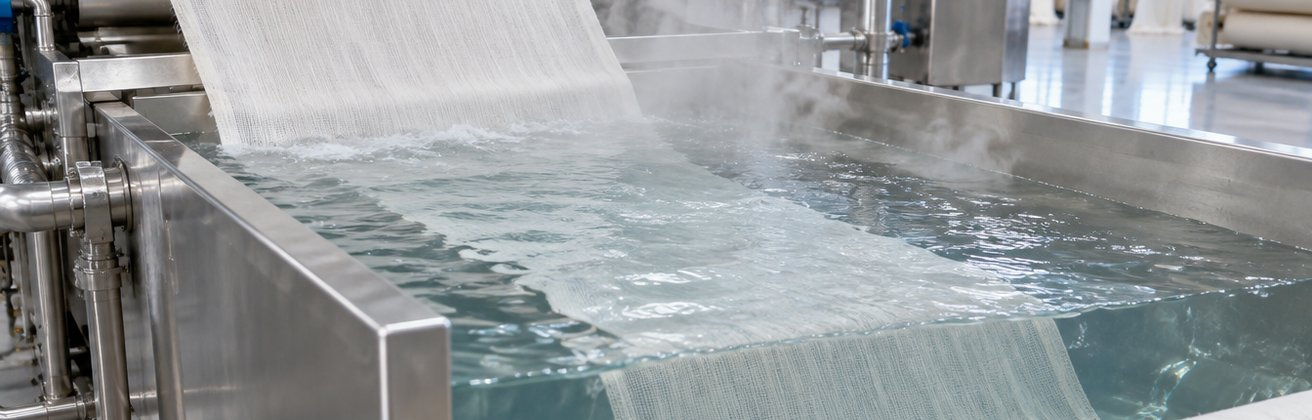
Traditional desizing cannot always be avoided in textiles, but it can be simplified, minimized, or completely eliminated when modern water-soluble sizing technologies are used. Conventional enzyme-based desizing exists mainly to remove insoluble starch and synthetic polymers. New-generation sizing systems-such as water-soluble polysaccharide-based sizing (e.g., Sizaltex)-allow fabrics to be desized using only hot water at 80-90 °C, without enzymes, acids, or harsh chemicals.
What Is Desizing in Textiles?
Desizing is the first wet-processing step in textile finishing where warp sizing agents applied during weaving are removed from the fabric.
Sizing is essential for weaving strength, but must be removed before dyeing, printing, or finishing because residual size:
- Blocks dye penetration
- Causes uneven shades
- Increases chemical consumption
Traditionally, desizing relies on enzymes (amylase) or oxidative/acid treatments to break down starch-based or synthetic sizing films.
To learn more about Desizing Process.
Why Is Desizing Necessary?
Desizing is necessary because most conventional sizing agents are not naturally water-soluble once dried on yarn.
Without desizing:
- Dyes cannot access fiber surfaces
- Printing paste penetration is restricted
- Finishing chemicals perform inconsistently
- Fabric defects like patchiness and streaks appear
In short, desizing exists to correct the chemical complexity introduced during sizing.
What Happens If Desizing Is Not Done Correctly?
Incorrect or incomplete desizing leads to downstream quality failures:
- Patchy or uneven dyeing
- Poor colorfastness
- Increased reprocessing
- Higher effluent load
- Reduced finishing efficiency
Ironically, many finishing problems originate not in finishing-but in the sizing chemistry used at the loom stage.
Are Enzymes Needed in Desizing? Can We Reduce or Stop Using Them?
Short answer: Enzymes are only needed because of traditional sizing chemistry.
Why enzymes are used:
- To hydrolyze insoluble starch films
- To break down complex polymeric sizing layers
- To reduce fabric damage compared to acids
However, enzymes:
- Add cost
- Increase process time
- Generate COD/BOD in effluent
- Are sensitive to pH and temperature control
How enzyme use can be reduced or eliminated
By switching to water-soluble sizing agents that:
- Dissolve directly in hot water
- Do not require molecular breakdown
- Leave no resistant film on fibers
This is where Sizaltex-type sizing technology becomes relevant-not as a product pitch, but as a process redesign.
What Is the Role of Sizing Agents in Desizing?
Desizing difficulty is directly proportional to sizing agent complexity.
| Type of sizing agent | Desizing requirement |
|---|---|
| Conventional starch | Enzymatic |
| PVA / synthetics | Hot alkali + surfactants |
| Modified starch blends | Enzyme + wash |
| Water-soluble polysaccharides (Sizaltex type) | Hot water only |
In other words: Desizing problems are created during sizing, not finishing.
What Effluents Are Released During Desizing and How Do They Harm the Environment?
Traditional desizing releases:
- Hydrolyzed starch fragments
- Synthetic polymers (PVA residues)
- Enzyme degradation by-products
- Surfactants and wetting agents
Environmental impact
- High COD & BOD
- Increased load on ETPs
- Sludge generation
- Poor biodegradability (especially PVA)
This makes desizing one of the most environmentally expensive “invisible” processes in wet processing.
How Can Desizing Effluents Be Reduced?
Desizing effluent reduction can be achieved by:
- Lower size add-on
- Better size uniformity
- Eliminating synthetic polymers
- Reducing enzymatic hydrolysis
But the largest reduction comes from eliminating the desizing chemistry itself.
How Can Desizing Be Avoided in Textiles?
Desizing can be functionally avoided by changing sizing philosophy
Instead of asking “How do we remove size?”, progressive mills ask: “Why are we applying something that needs removal at all?”
Water-Soluble Sizing Approach
Modern water-soluble sizing systems (such as Sizaltex):
- Form a strong yet fully water-dispersible film
- Maintain weaving efficiency
- Do not crosslink irreversibly on yarn
- Dissolve completely in hot water
Practical Outcome
- Fabric desizing = simple hot wash
- No enzymes
- No acids
- No alkali
- No desizing auxiliaries
At a process level, this collapses desizing into a basic washing step.
How Sizaltex Changes the Desizing Equation (Process Perspective)
Characteristics of Sizaltex:
- Polysaccharide-based
- Fully water-soluble
- Stable sizing film during weaving
- Completely desizes via hot water
From a mill operations standpoint, this means:
- Desizing step becomes optional
- Enzyme procurement eliminated
- Shorter wet-processing cycles
- Lower effluent treatment cost
- Better dye reproducibility
This aligns sizing, desizing, and sustainability into one continuous system, instead of three disconnected problems.
How to Reduce Overall Desizing Costs
Cost reduction does not come from cheaper enzymes, it comes from not needing them.
Key cost-reduction levers
- Eliminate enzyme usage
- Reduce water consumption
- Cut heating cycles
- Lower ETP load
- Reduce reprocessing and shade corrections
Water-soluble sizing like Sizaltex directly impacts all five levers simultaneously.
What Are Sustainable Practices in Desizing?
True sustainability in desizing means designing it out of the process.
Sustainable desizing principles
- Use biodegradable sizing agents
- Avoid synthetic polymers
- Prefer thermal solubility over chemical breakdown
- Minimize auxiliary chemicals
- Reduce effluent complexity
Water-soluble sizing technologies are increasingly aligned with:
- ZDHC goals
- GOTS processing requirements
- Low-impact wet processing
- Cleaner production benchmarks
Key Insight: Desizing Is a Symptom, Not a Requirement
Desizing exists because traditional sizing chemistry creates insoluble residues.
When sizing chemistry evolves:
- Desizing simplifies
- Enzymes become redundant
- Effluent load collapses
- Sustainability improves organically
This is not a finishing innovation-it is a weaving-stage decision with finishing-stage consequences.
Frequently Asked Questions
Can desizing be completely eliminated?
Functionally yes, when water-soluble sizing systems like Sizaltex are used.
Is enzyme desizing mandatory for cotton fabrics?
Only if conventional Starch or PVA sizing is used.
What temperature is required to remove water-soluble sizing?
This depends from chemical to chemical. Sizaltex typically desizes with 80-90 °C hot water.
Does enzyme-free desizing affect dye quality?
No, shade consistency often improves due to uniform size removal.
Is this approach suitable for high-speed looms?
Yes, provided the sizing film has adequate abrasion resistance during weaving. Companies like Arvind, PeeVee and Baldev LLP are regular purchasers of Sizaltex.


