

 Summarize this Article with AI
Key Highlights
- The textile sizing process is a critical preparatory step in the weaving process where warp yarns are coated with a protective sizing solution to improve strength, reduce hairiness.
- Before understanding the machines, it’s important to understand why sizing is required.
- The creel holds multiple warp yarn packages (cones or beams) in parallel arrangement.
- The premixer blends water and sizing ingredients to form a homogeneous slurry.
- The cooker gelatinizes starch at high temperature and pressure.
Quick Navigation
- What Happens in the Textile Sizing Process?
- Why Is the Textile Sizing Process Important in Weaving?
- Machine-by-Machine Breakdown of the Mechanical Sizing Process
- 1. What Is a Creel and Why Is It the Starting Point?
- 2. What Is the Premixer in Textile Sizing?
- 3. What Is the Cooker and Why Is Controlled Cooking Essential?
- 4. What Is the Storage Tank Used For?
- 5. What Happens Inside the Sizebox?
- 6. Why Are Squeeze Rolls Critical in Sizing?
- 7. How Do Drying Cylinders Improve Warp Strength?
- 8. What Is PLEVA (Moisture Control System)?
- 9. What Are Lease Rods Used For?
- 10. What Is the Head Stock in Sizing?
- Complete Sizing Flow Summary
- Sustainability and Modern Sizing
- FAQs
What Happens in the Textile Sizing Process?
The textile sizing process is a critical preparatory step in the weaving process where warp yarns are coated with a protective sizing solution to improve strength, reduce hairiness, and increase abrasion resistance. From the creel to the head stock, each machine in the sizing department plays a precise mechanical and chemical role in preparing warp yarns for high-speed weaving machines like air-jet and rapier looms.
Without proper sizing:
- Warp thread breakage increases
- Weaving efficiency drops
- Fabric quality suffers
- Production cost rises
Modern compound sizing agents such as Alpenol are engineered to provide optimal adhesion with minimum size add-on, supporting high-density woven fabric production .
Why Is the Textile Sizing Process Important in Weaving?
Before understanding the machines, it’s important to understand why sizing is required.
Warp yarns undergo:
- Constant tension
- Friction from heald wires and reed
- High-speed weft insertion (1200+ picks/min)
- Abrasion during shedding
According to industrial documentation from sizing and weaving operations, warp preparation directly impacts loom efficiency and breakage rate.
Sizing:
- Increases tensile strength
- Reduces hairiness
- Improves smoothness
- Enhances weaving efficiency
Alpenol’s hydroxylated starch-based compound sizing agents are designed to reduce dependency on polyvinyl alcohol (PVA) and synthetic binders while maintaining adhesion and flexibility .
Machine-by-Machine Breakdown of the Mechanical Sizing Process
1. What Is a Creel and Why Is It the Starting Point?
Function:
The creel holds multiple warp yarn packages (cones or beams) in parallel arrangement.
Mechanical Role:
- Ensures uniform unwinding tension
- Aligns sets of yarns into a warp sheet
- Prevents snarling and crossovers
Importance:
Uniform tension at the creel prevents uneven size penetration later in the sizebox. If tension varies here, weaving defects such as uneven warp and weft density occur.
In high-performance sizing systems using Alpenol compound sizing agents, controlled tension helps maintain optimal size add-on percentage .
2. What Is the Premixer in Textile Sizing?
Function:
The premixer blends water and sizing ingredients to form a homogeneous slurry.
Key Role:
- Dissolves starch derivatives
- Prevents lump formation
- Ensures chemical uniformity
Modern starch-based sizing agents such as Alpenol’s Compound systems reduce the need for complex multi-ingredient blending .
3. What Is the Cooker and Why Is Controlled Cooking Essential?
Function:
The cooker gelatinizes starch at high temperature and pressure.
Technical Importance:
- Activates adhesive properties
- Controls viscosity
- Enhances film formation
Alpenol documentation specifies high-pressure autoclave cooking for optimal performance .
Improper cooking leads to:
| Issue | Result |
|---|---|
| Under-cooking | Weak adhesion |
| Over-cooking | Brittleness |
| Poor viscosity control | Uneven pick-up |
4. What Is the Storage Tank Used For?
Function:
Stores cooked sizing solution before application.
Importance:
- Maintains constant temperature
- Prevents retrogradation
- Ensures continuous supply
Stable starch systems such as Alpenol are engineered to remain stable without frequent viscosity fluctuations .
5. What Happens Inside the Sizebox?
Function:
The warp sheet passes through the heated sizing solution.
Process:
- Yarn immersion
- Adhesion of sizing film
- Controlled penetration
Temperature typically maintained around 85-90°C as recommended for compound sizing agents .
Proper sizebox control ensures:
- Uniform coating
- Controlled add-on
- Better abrasion resistance
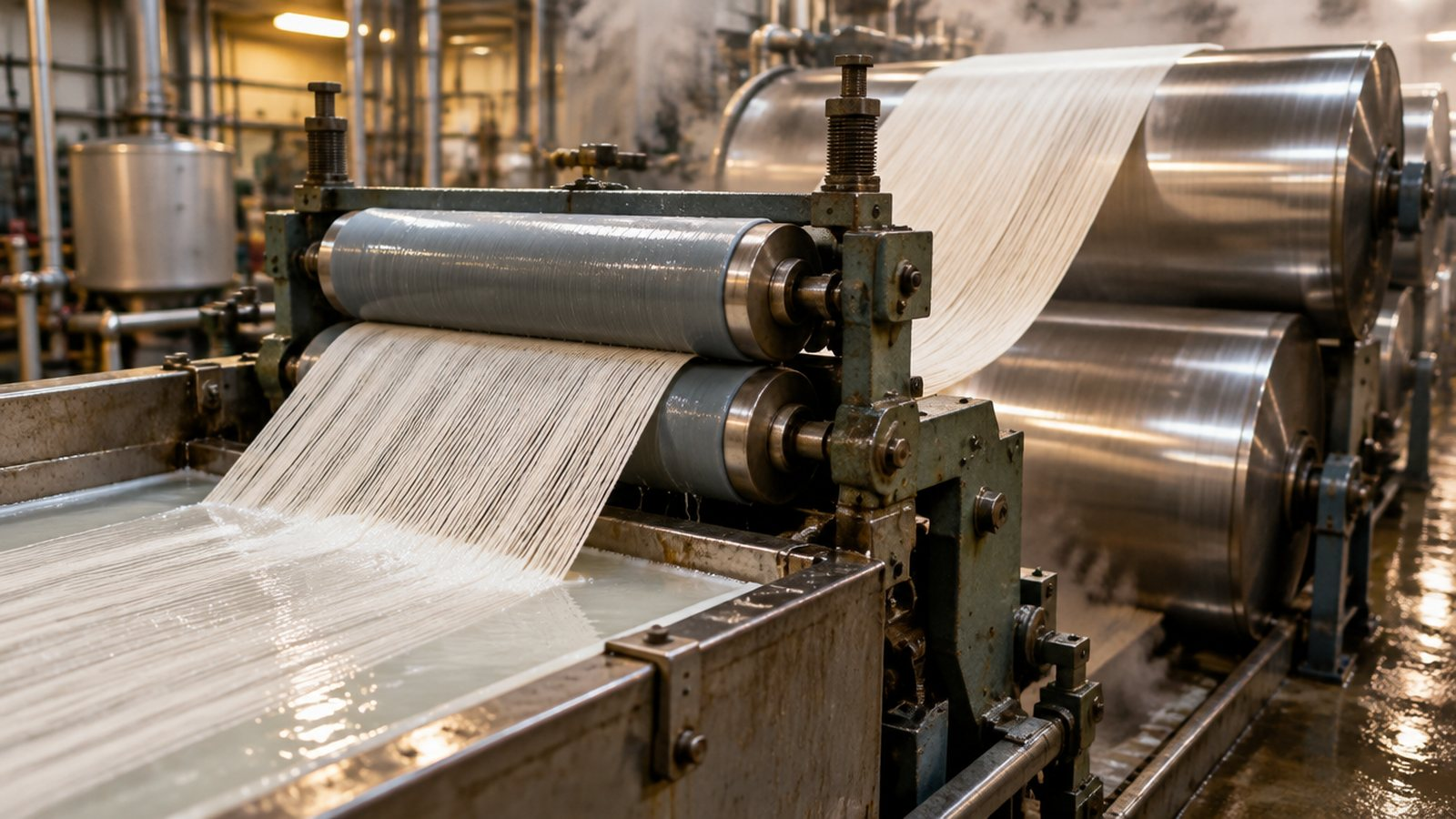
6. Why Are Squeeze Rolls Critical in Sizing?
Function:
Remove excess sizing solution.
Importance:
- Controls pick-up percentage
- Maintains consistent warp diameter
- Prevents sticky yarns
For high-density fabrics, minimum size add-on is crucial, especially for fine cotton and viscose yarns .
7. How Do Drying Cylinders Improve Warp Strength?
Function:
Evaporate moisture from sized warp yarns.
Mechanical Role:
- Film formation
- Moisture stabilization
- Strength development
Improper drying can cause:
- Brittleness (over-dry)
- Poor film strength (under-dry)
Balanced drying supports weaving efficiency and smooth shed formation.
8. What Is PLEVA (Moisture Control System)?
Function:
Online moisture monitoring system.
Importance:
- Ensures consistent residual moisture
- Prevents over-drying
- Reduces loom breakage
Moisture control is essential for sustainable sizing operations aligned with green chemistry principles .
9. What Are Lease Rods Used For?
Function:
Maintain warp yarn separation.
Importance:
- Prevents yarn entanglement
- Maintains order of warp threads
- Facilitates easier drawing-in
10. What Is the Head Stock in Sizing?
Function:
Winds the sized warp sheet onto the warp beam.
Importance:
- Uniform winding tension
- Correct beam density
- Smooth unwinding in weaving machine
Proper beam formation ensures trouble-free operation during weaving process.
Complete Sizing Flow Summary
| Stage | Machine | Purpose |
|---|---|---|
| 1 | Creel | Yarn alignment & tension control |
| 2 | Premixer | Size slurry preparation |
| 3 | Cooker | Gelatinization & viscosity control |
| 4 | Storage | Temperature stability |
| 5 | Sizebox | Coating application |
| 6 | Squeeze Rolls | Pick-up control |
| 7 | Drying Cylinders | Film formation |
| 8 | Pleva | Moisture control |
| 9 | Lease Rods | Yarn separation |
| 10 | Head Stock | Warp beam formation |
Sustainability and Modern Sizing
Traditional sizing often relied heavily on polyvinyl alcohol. Modern starch-based systems aim to reduce PVA and synthetic dependency while complying with sustainability standards such as ZDHC and OEKO-TEX .
Alpenol’s starch-based compound sizing systems are engineered to:
- Reduce synthetic polymers
- Lower effluent load
- Maintain high weaving efficiency
- Support environmentally responsible manufacturing
FAQs
What is the main purpose of warp sizing?
Warp sizing increases yarn strength, reduces hairiness, and improves abrasion resistance during the weaving process.
What temperature is maintained in the sizebox?
Typically 85-90°C depending on the sizing solution used .
Why are squeeze rolls important?
They control size pick-up percentage and ensure uniform coating thickness.
What happens if warp yarn is over-dried?
It becomes brittle, increasing warp thread breakage during weaving.
How does moisture control improve weaving efficiency?
Online moisture systems like Pleva ensure optimal residual moisture, preventing brittleness and loom stoppages.


