 Summarize this Article with AI
- Quality control (QC) in sizing keeps warp yarns strong, smooth, flexible and uniformly coated for high-speed weaving.
- Optimal sizing is measurable: size add-on, moisture content, tensile strength, elongation, hairiness and adhesion can all be checked.
- The most common defects are over-sizing, under-sizing, uneven size pick-up and brittleness from over-drying.
- Inconsistencies come from mechanical, chemical and operational causes, and each can be controlled with routine QC.
- Without QC, loom stoppages increase, fabric defects rise and production efficiency drops.
- 1. Why Quality Control in Sizing Matters
- 2. What Is Sizing in Textile Manufacturing?
- 3. How Do You Know Sizing Is Done Optimally?
- 4. Characteristics of an Optimally Sized Yarn
- 5. Common Sizing Defects and How to Detect Them
- 6. Why Do Sizing Inconsistencies Happen?
- 7. How Can Quality Control Prevent Sizing Defects?
- 8. How Sizing Chemicals Maintain Quality
- 9. Quality Control Checklist for Textile Sizing
- 10. How QC in Sizing Impacts Weaving Performance
- 11. FAQs
1. Why Quality Control in Sizing Matters
The textile sizing process is not just about coating warp yarns with a sizing solution. It is about precision engineering. Quality control (QC) in sizing ensures that warp yarns are:
- Strong enough to withstand shedding and reed beating
- Smooth enough to reduce hairiness
- Flexible enough to avoid brittleness
- Uniformly coated for high-speed weaving
Without proper QC, loom stoppages increase, fabric defects rise, and production efficiency drops.
Modern starch-based compound sizing systems, such as Alpenol‘s starch formulations, are engineered to deliver consistent adhesion and minimum size add-on.
2. What Is Sizing in Textile Manufacturing?
Definition
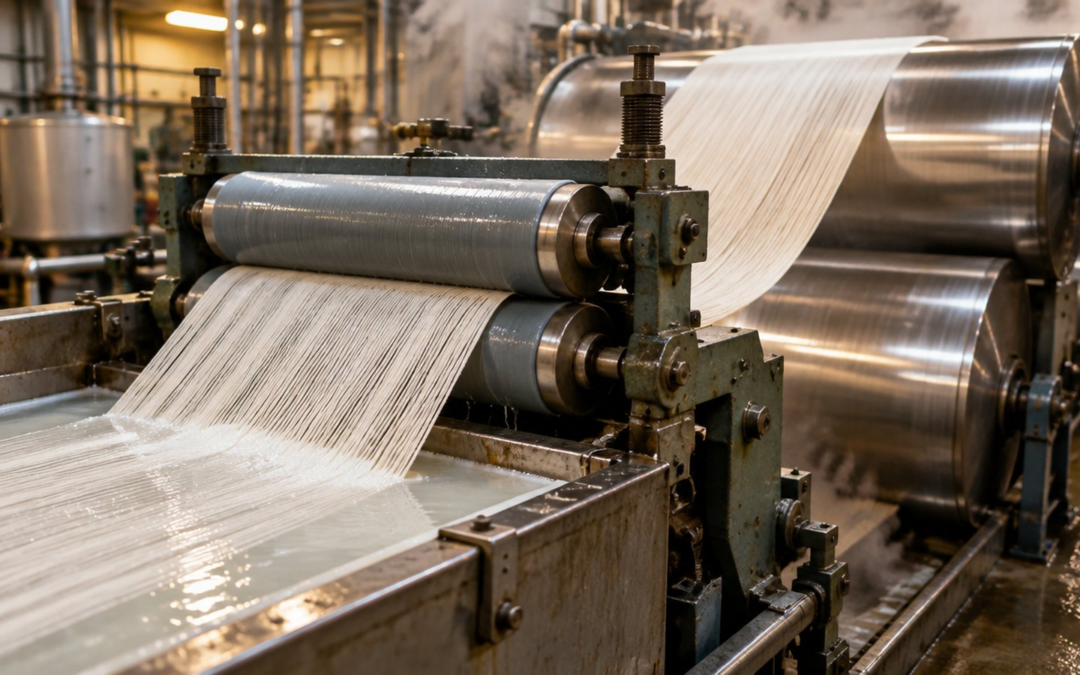
Sizing is the process of applying a protective film (called the sizing solution) to warp yarns before weaving.
Purpose of Sizing
- Increase tensile strength
- Reduce hairiness
- Improve abrasion resistance
- Control yarn friction
- Enhance weaving efficiency
During the weaving process, warp yarns face constant friction from:
- Heald wires
- Reed dents
- Drop pins
- High-speed air-jet insertion
Sizing strengthens the warp thread so it can survive these mechanical stresses.
3. How Do You Know Sizing Is Done Optimally?
Optimal sizing is measurable. It is not guesswork.
Key Quality Control Parameters
| Parameter | Target Control |
|---|---|
| Size Add-On % | Controlled within ±0.5% |
| Moisture Content | 6-8% (depending on fiber) |
| Tensile Strength | Improved vs grey yarn |
| Elongation | Slightly reduced but not brittle |
| Hairiness Index | Reduced |
| Adhesion | Uniform film formation |
Practical QC Tests
1. Size Add-On Test
Measures weight difference before and after sizing.
2. Moisture Test (Pleva System)
Online moisture monitoring ensures yarn is not over-dried.
3. Strength Testing
Single-end tensile testing confirms strength gain.
4. Visual Film Inspection
Checks for uniform coating and absence of patches.
Stable compound sizing systems help maintain consistent pick-up and adhesion.
4. What Are the Characteristics of an Optimally Sized Yarn?
An optimally sized warp yarn should have:
1. Uniform Film Formation
Even coating across the entire yarn length.
2. Reduced Hairiness
Fibers are bonded to the yarn body.
3. Improved Abrasion Resistance
Minimal fluff formation during rubbing.
4. Balanced Flexibility
Not too stiff (brittle), not too soft (sticky).
5. Controlled Diameter
Excessive add-on increases yarn thickness and affects fabric cover factor.
Hydroxylated starch-based compounds enhance bonding through additional hydroxyl functionality, improving film adhesion without excessive thickness.
5. Common Sizing Defects and How to Detect Them
1. Over-Sizing
Symptoms
- Sticky yarn
- High loom friction
- Increased warp breaks
Detection
- Excess size add-on %
- High fabric stiffness
2. Under-Sizing
Symptoms
- High hairiness
- Frequent warp breakage
- Poor abrasion resistance
Detection
- Low tensile strength gain
- Visible fiber protrusion
3. Uneven Size Pick-Up
Symptoms
- Shade variation in dyed fabric
- Uneven weaving performance
Detection
- Variable weight across warp sheet
- Moisture inconsistency
4. Brittleness (Over-Drying)
Symptoms
- Warp snapping
- Reduced elongation
Detection
- Low residual moisture
- High stiffness
6. Why Do Sizing Inconsistencies Happen?
Sizing inconsistencies arise from mechanical, chemical, or operational variations.
Mechanical Causes
- Uneven squeeze roll pressure
- Improper warp tension
- Temperature fluctuations in drying cylinders
Chemical Causes
- Incorrect cooking procedure
- Poor viscosity control
- Improper formulation balance
Advanced cooking systems using high-pressure autoclave techniques improve starch activation and stability.
Operational Causes
- Inadequate operator training
- Poor monitoring
- Irregular maintenance
Seeing inconsistent size pick-up or frequent warp breaks?
Tell us the count, the fibre and the loom you run. Our technical team will send the matching data sheet and a recommended starting recipe.
7. How Can Quality Control Prevent Sizing Defects?
Preventive QC Measures
1. Viscosity Monitoring
Maintains proper flow and penetration.
2. Temperature Control
Stable cooking and sizebox temperature.
3. Moisture Regulation
Prevents brittleness or softness.
4. Pick-Up Calibration
Squeeze roll pressure calibration ensures uniform add-on.
5. Routine Yarn Testing
Regular tensile and abrasion testing.
8. How Sizing Chemicals Play a Role in Maintaining Quality
The formulation of sizing chemicals directly influences quality control stability.
Key Chemical Attributes for QC Stability
| Chemical Feature | QC Benefit |
|---|---|
| Controlled Gelatinization | Consistent viscosity |
| Hydroxyl Functionality | Improved adhesion |
| Flexible Film Formation | Reduced brittleness |
| Stable pH | Uniform performance |
Modern compound sizing agents are engineered to:
- Reduce synthetic dependency
- Maintain film flexibility
- Support high-speed weaving
Sustainability-focused systems eliminate unnecessary synthetic binders while maintaining performance.
9. Quality Control Checklist for Textile Sizing
- Check viscosity every batch
- Monitor size add-on percentage
- Maintain sizebox temperature
- Measure residual moisture
- Test yarn tensile strength
- Inspect film uniformity
- Track loom efficiency
10. How Quality Control in Sizing Impacts Weaving Performance
Proper QC results in:
- Lower warp breakage rate
- Higher loom efficiency
- Consistent woven fabric density
- Improved fabric quality
Sizing directly impacts:
- Shedding smoothness
- Reed beating stability
- Weft insertion reliability
Without QC, even high-quality yarn cannot perform efficiently in weaving.
11. FAQs
What is sizing in textiles?
Sizing is the application of a protective coating on warp yarns to improve weaving performance.
How do you measure size add-on?
By calculating the weight difference before and after sizing.
What causes warp yarn brittleness?
Over-drying or excessive starch concentration.
How can uneven sizing be detected?
Through tensile testing, visual inspection, and add-on measurement.
Why is viscosity important in sizing?
It controls penetration, adhesion, and film formation.